

UK ends Gaza surveillance flights after 2-year mission to locate hostages held by Hamas

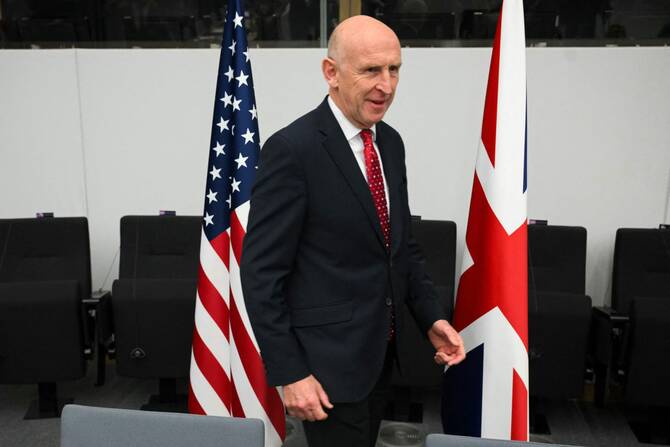
Britain's Defence Secretary John Healey arrives to attend the meeting of the Ukraine Defence Contact Group, part of the meeting of NATO Ministers of Defence Summit at the NATO headquarters in Brussels on October 15, 2025. (AFP)
Short Url
Updated 16 October 2025
Follow

UK ends Gaza surveillance flights after 2-year mission to locate hostages held by Hamas

  • ‘Professionalism’ of British personnel praised 

LONDON: The UK has ended its surveillance flights over Gaza after nearly two years, following the release of hostages held by Hamas as part of the recent ceasefire deal, Defense Secretary John Healey had confirmed.

Healey praised the “professionalism” of British personnel who had conducted the unarmed missions, which began in December 2023 with the stated goal of helping locate hostages taken during the Oct. 7 attacks of that year.

The final flight took place last week, shortly before the ceasefire came into effect, The Times newspaper reported.

“This ceasefire is a moment of profound relief, for the civilian population of Gaza, and for the Israeli hostages and their families, who have all endured unimaginable suffering,” Healey said.

“I am proud of the UK’s efforts to support the safe return of the hostages, and the professionalism of our service personnel involved.”

The UK’s Ministry of Defense said the aircraft were “always unarmed, did not have a combat role, and were tasked solely to locate hostages.”

Intelligence passed to Israel, officials said, was strictly limited to hostage rescue operations.

However, the program proved controversial throughout its duration.

The UK government confirmed earlier this year that operations were carried out either by the Royal Air Force or by US contractors it hired, a revelation that raised concerns within the MoD itself.

A technical error last July exposed one such US aircraft, registered in Nevada, flying above Khan Younis.

The program drew criticism from rights groups and opposition politicians, who questioned whether intelligence gathered by the UK could have been used by Israel in its military operations in Gaza.

The Guardian newspaper reported concerns in August among legal experts and analysts that Britain had “no operational control” over how information passed to Israel might be used once shared.

Helen Maguire, the Liberal Democrats’ defense spokesperson, said at the time that while she supported efforts to find hostages, “the government must outline what steps it has taken to ensure Israel can’t use UK-sourced intelligence for its military operations in Gaza.”

Labour backbencher Kim Johnson also voiced alarm, saying it was “deeply concerning that surveillance flights over Gaza continue relentlessly, even as serious questions remain about their purpose and oversight.”

Former Foreign Secretary David Lammy also told reporters at the time: “It would be quite wrong for the British government to assist in the prosecution of this war in Gaza. We are not doing that, (we) would never do that.”

The MoD repeatedly insisted that strict controls governed the intelligence-sharing process and that no information of “military utility” was passed to Israeli authorities.


Ukraine’s Zelensky: We have backed US peace proposals to get a deal done

Updated 13 February 2026
Follow

Ukraine’s Zelensky: We have backed US peace proposals to get a deal done

  • “The tactic we chose is for the Americans not to think that we want to continue the war,” Zelensky ‌told The Atlantic

Ukrainian President Volodymyr Zelensky said Kyiv ‌had sought to back US peace proposals to end the war with Russia as President Donald Trump seeks to resolve the conflict before ​November mid-term elections.
Zelensky, in an interview published by The Atlantic on Thursday, said Kyiv was willing to hold both a presidential election and a referendum on a deal, but would not settle for an accord that was detrimental to Ukraine’s interests.
“The tactic we chose is for the Americans not to think that we want to continue the war,” Zelensky ‌told the ‌US-based publication. “That’s why we started supporting their ​proposals in ‌any ⁠format ​that speeds ⁠things along.”
He said Ukraine was “not afraid of anything. Are we ready for elections? We’re ready. Are we ready for a referendum? We’re ready.”
Zelensky has sought to build good relations with Washington since an Oval Office meeting in February 2025 descended into a shouting match with Trump and US Vice President JD ⁠Vance.
But he said he had rejected a ‌proposal, reported this week by the ‌Financial Times, to announce the votes ​on February 24, the fourth ‌anniversary of Russia’s invasion. A ceasefire and proposed US security ‌guarantees against a future invasion had not yet been settled, he said.
“No one is clinging to power,” The Atlantic quoted him as saying. “I am ready for elections. But for that we need security, guarantees ‌of security, a ceasefire.”
And he added: “I don’t think we should put a bad deal ⁠up for a ⁠referendum.”
Russian President Vladimir Putin has said Zelensky is not a legitimate negotiating partner because he has not faced election since coming to power in 2019.
Zelensky has said in recent weeks that a document on security guarantees for Ukraine is all but ready to be signed.
But, in his remarks, he acknowledged that details remained unresolved, including whether the US would be willing to shoot down incoming missiles over Ukraine if Russia were to violate the peace.
“This hasn’t been fixed ​yet,” Zelensky said. “We have raised ​it, and we will continue to raise these questions...We need all of this to be written out.”