ISLAMABAD: A group of Palestinian academics from Gaza on Thursday appealed for urgent international support, calling for volunteer lecturers, student scholarships, research funding and essential educational resources after widespread destruction of universities during two years of Israel’s war.
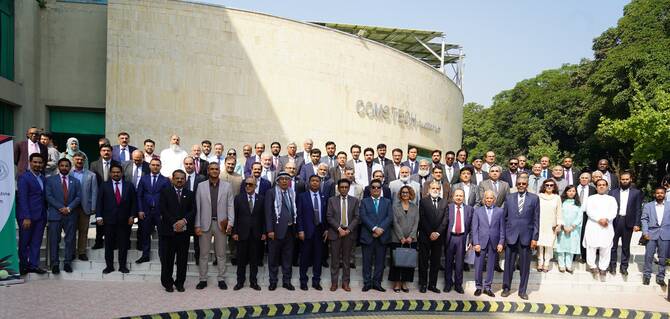
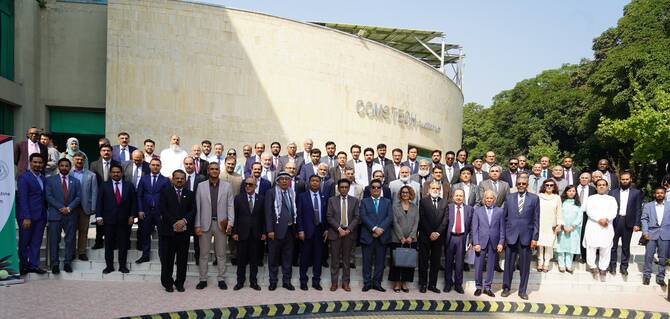
The call was made at the first-ever Palestine-Pakistan Rectors’ Forum, titled “Higher Education and Scientific Research in Gaza: The Way Forward,” held in Islamabad.
Organized by COMSTECH — the Organization of Islamic Cooperation’s Standing Committee on Scientific and Technological Cooperation — the forum aimed to strengthen academic collaboration between Palestinian and Pakistani institutions.
A seven-member Palestinian delegation is on a week-long visit to Pakistan, where it will visit leading universities in Islamabad, Faisalabad and Lahore.
“We urgently need support to cover student tuition fees, volunteer lecturers to deliver online classes, provide research opportunities for faculty members and support the financial needs of research projects,” Dr. Ayman Sobh, President of Al Aqsa University Gaza, said while addressing the ceremony.
He termed it a call for academic solidarity while pointing out that Gaza was witnessing a systematic attempt to dismantle Palestinian society by targeting its institutions.
“Scholarships are needed for postgraduate students and for supporting the universities with laptops, desktops, internet access points and all other e-learning requirements such as solar energy systems, servers and internet access,” he said, adding that virtual laboratories for practical and science-based courses were also needed.
In Gaza Strip, he said, seven universities, served about 90,000 students in medicine, engineering, IT, science, arts and many other disciplines.
“During the war, all universities sustained severe damage affecting academic buildings, laboratories, IT centers, infrastructure and administrative facilities,” Sobh said, adding that despite the destruction and uncertainty, Palestinian universities in the Gaza Strip have remained steadfast in their mission to educate, research and serve society.
Dr. Noha Nijim from Al Azhar University Gaza thanked Pakistan for hosting over 300 Palestinian students on scholarships.
“Those students who were displaced and had their education interrupted by the war were able to resume their studies in Pakistan, which was greatly beneficial given the psychological impact of the war and the consequences of losing a year of academic education,” she told Arab News.
“The Pakistani government has assisted us and supported the resilience of the Palestinian people by providing financial and technical support for higher education,” she added.
Palestinian Ambassador to Pakistan, Dr. Zuhair Mohammad Hamadallah Zaid, said Pakistan had contributed to state-building through education and training, empowering Palestinians to manage their own affairs.
“Many Palestinians graduated from institutions in Pakistan, some became ministers, others secretaries of ministries and many became doctors and engineers,” he told Arab News.
Addressing the ceremony, Pakistan’s Education Minister, Dr. Khalid Maqbool Siddiqui, expressed his deep appreciation for the initiative by COMSTECH, terming it an important step toward rebuilding Gaza’s educational and research landscape.
“Pakistan has already announced 5,000 fellowships for Palestinian youth, which is a remarkable initiative that will empower a new generation of scientists, innovators and leaders from Palestine,” he added.
"Pakistan stands shoulder to shoulder with Palestine in this journey, offering not just solidarity in words, but cooperation through research, innovation and higher education,” he said, expressing confidence that this forum would pave the way for joint research, faculty exchanges, scholarships and innovative academic partnerships between the two nations.
In his welcome remarks, Prof. Dr. Muhammad Iqbal Choudhary, Coordinator General, OIC-COMSTECH, said the forum seeks to formulate a comprehensive roadmap for assisting in the rehabilitation and restructuring of Gaza’s higher education and scientific institutions after two years of educational genocide.
"The systematic destruction of universities, research centres, and schools in Gaza has not only targeted infrastructure but has deeply affected the intellectual and developmental foundations of an entire generation,” he added.
Chaudhary said through joint academic planning, knowledge transfer and institutional support, OIC-COMSTECH, together with partner universities from Pakistan and other OIC member states, aims to restore the academic life of Gaza, rebuild its universities and reignite the flame of learning, research and innovation that no war can extinguish,” he added.