

Trump says Pakistan PM became ‘emotional’ while crediting him with saving millions of lives

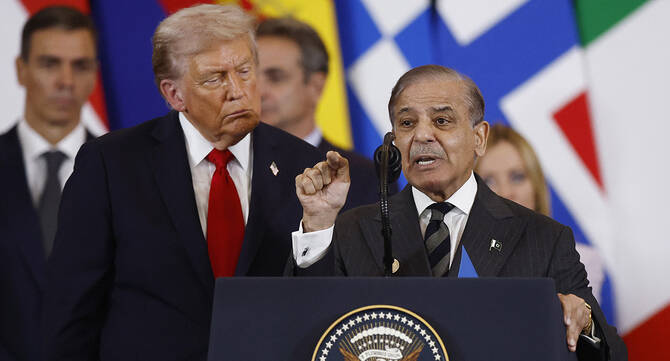
US President Donald Trump (C) listens to Pakistan's Prime Minister Shehbaz Sharif (R) as he delivers a statement during a summit on Gaza in Sharm el-Sheikh on October 13, 2025. (AFP/ file)
Short Url
Updated 16 October 2025
Follow

Trump says Pakistan PM became ‘emotional’ while crediting him with saving millions of lives

  • The US president jokes about Nobel Peace Prize, saying he suspects the next year to be better
  • Venezuelan opposition leader Maria Corina Machado was given the Nobel Peace Prize last week

ISLAMABAD: US President Donald Trump, who has aggressively campaigned for a Nobel Prize, hailed his peace efforts and joked about not getting the prize at a dinner at the White House on Wednesday, saying Pakistan Prime Minister Shehbaz Sharif got “emotional” while crediting him for saving millions of lives.

Venezuelan opposition leader Maria Corina Machado, a 58-year-old industrial engineer, was awarded the Nobel Peace Prize last week. Over the past two years, she has reenergized a politically disengaged population after more than a decade of economic and social collapse.

Speaking at the White House dinner, Trump said Pakistan PM Sharif recently met him and emotionally credited him in front of a group of people for stopping multiple wars and thus saving lives of millions of people that could have been lost to the conflicts.

“In fact, the prime minister of Pakistan came and told me, and he was emotional about it. And in front of a group of people, he said, ‘This man saved 3 million, 5 million, maybe an untold number of lives’,” the US president said.

“And it was just recently that this happened, and we did numerous of them like that. And part of the reason we did it was trade.”

Sharif this week hailed President Trump for his “exemplary” leadership as world leaders signed a declaration meant to cement a ceasefire in Gaza.

“Today is a one of the greatest days in contemporary history, because peace has been achieved after untiring efforts led by President Trump who is genuinely a man of peace, who has relentlessly and untiringly worked throughout these months, day in and day out, to make this world a place to live with peace and prosperity,” he said, standing beside Trump in the Red Sea resort of Sharm El-Sheikh.

Sharif has gained favor with Trump since publicly endorsing him for a Nobel Peace Prize for brokering a ceasefire in a four-day Pakistan-India military standoff in May.

The White House criticized the Nobel Committee’s decision to grant the peace prize to the Venezuelan opposition leader instead of Trump, who aggressively lobbied for the award and touted his role in brokering international ceasefire deals.

Trump has repeatedly said that he has ended eight wars since taking office and that he deserves the peace prize.

“I stopped eight wars in eight months. Did I get a Nobel Prize? No,” he jokingly remarked at the White House dinner on Wednesday.

“I suspect that next year will be better, but I don’t know.”

— With input from Reuters


Pakistan reviews austerity measures amid Middle East crisis, urges strict nationwide implementation

Updated 11 March 2026
Follow

Pakistan reviews austerity measures amid Middle East crisis, urges strict nationwide implementation

  • Deputy Prime Minister Ishaq Dar chairs review meeting of austerity steps
  • Officials briefed on salary cuts, school closures, four‑day week, petrol conservation

ISLAMABAD: Pakistan’s government on Wednesday assessed progress on a sweeping set of austerity measures introduced to mitigate the country’s economic strain from sharply rising global oil prices and supply disruptions linked to the ongoing war in the Middle East.

Prime Minister Shehbaz Sharif this week announced a series of austerity steps, including a four‑day work week for government offices, requiring 50  percent of staff to work from home, cutting fuel allowances for official vehicles by half, grounding up to 60  percent of the government fleet and closing all schools for two weeks to conserve fuel amid the global oil crisis.

The measures were unveiled in response to global oil market volatility triggered by the conflict involving the United States, Israel and Iran, which has disrupted supply routes such as the Strait of Hormuz and pushed crude prices sharply higher, straining Pakistan’s heavily import‑dependent energy sector.

“The meeting stressed the importance of strict and transparent adherence to the austerity measures, promoting fiscal responsibility and prudent use of public resources,” Deputy Prime Minister and Foreign Minister Senator Mohammad Ishaq Dar said in a statement.

He was chairing a meeting of the Committee for Monitoring and Implementation of Conservation and Additional Austerity Measures, constituted under the directions of the PM, bringing together federal and provincial officials to review execution of the broad cost‑cutting plan. 

Dar emphasized the government’s commitment to enforcing the PM’s austerity steps nationwide. The committee’s review also covered reductions in departmental expenditure, deductions from salaries of senior officials earning over Rs. 300,000 ($1,120), and coordination with provincial administrations to ensure uniform implementation of the plan.

Participants at the meeting reiterated that all ministries and divisions must continue strict monitoring and reporting, with transparent oversight mechanisms, as Pakistan navigates the economic pressures from the prolonged Middle East crisis and its fallout on global energy and trade markets.