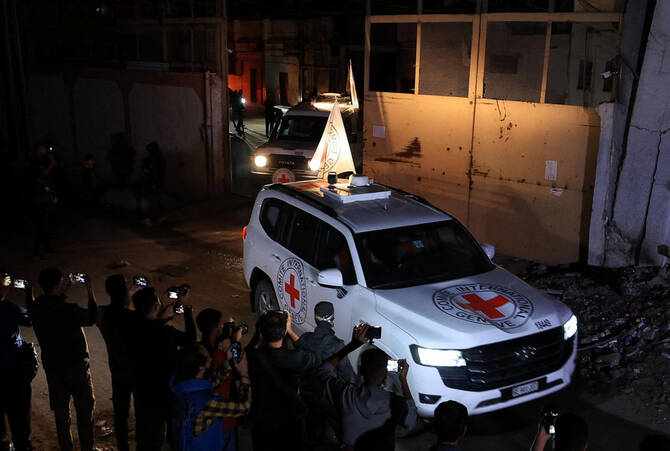
JERUSALEM: The Red Cross received the remains of two more Hamas hostages on Wednesday, hours after the Israeli military said that one of the bodies previously turned over was not that of a hostage. The confusion added to tensions over the fragile truce that has paused the two-year war.
The Israeli military said the International Committee of the Red Cross received the remains, which were to be transferred to Israeli forces in Gaza.
Earlier Wednesday, military officials said one of the bodies previously handed over by Hamas was not that of a hostage who was held in Gaza.
Meanwhile, the Gaza Health Ministry said it received 45 more bodies of Palestinians from Israel, another step in implementation of the ceasefire agreement. That brings to 90 the total number of bodies returned to Gaza for burial. The forensics team examining the remains said they showed signs of mistreatment.
As part of the deal, four bodies of hostages were handed over by Hamas on Tuesday, following four on Monday that were returned hours after the last 20 living hostages were released from Gaza. In all, Israel has been awaiting the return of the bodies of 28 hostages.
The Israeli military said forensic testing showed that “the fourth body handed over to Israel by Hamas does not match any of the hostages.” There was no immediate word on whose body it was.
In exchange for the release of the hostages, Israel freed around 2,000 Palestinian prisoners and detainees Monday.
Unidentified bodies returned to Gaza show signs of abuse
Israel is expected to turn over more bodies, though officials have not said how many are in its custody or how many will be returned. It is unclear whether the remains belong to Palestinians who died in Israeli custody or were taken from Gaza by Israeli troops. Throughout the war, Israel’s military has exhumed bodies as part of its search for the remains of hostages.
As forensic teams examined the first remains returned, the Health Ministry on Wednesday released images of 32 unidentified bodies to help families recognize missing relatives.
Many appeared decomposed or burned. Some were missing limbs or teeth, while others were coated in sand and dust. Health officials have said Israeli restrictions on allowing DNA testing equipment into Gaza have often forced morgues to rely on physical features and clothing for identification.
The forensics team that received the bodies said some arrived still shackled or bearing signs of physical abuse.
Sameh Hamad, a member of a commission tasked with receiving the bodies at Khan Younis’ Nasser Hospital, said some arrived with their hands and legs cuffed.
“There are signs of torture and executions,” he told The Associated Press.
The bodies, he said, belonged to men ages 25 to 70. Most had bands on their necks, including one that had a rope around the neck.
Most of the bodies wore civilian clothing, but some were in uniforms, suggesting they were militants.
Hamad said the Red Cross provided names for only three of the dead, leaving many families uncertain of their relatives’ fate. The fighting has killed nearly 68,000 Palestinians, according to the Health Ministry, which is part of the Hamas-run government in Gaza. The ministry maintains detailed casualty records that are seen as generally reliable by UN agencies and independent experts.
Thousands more people are missing, according to the Red Cross and Palestinian Central Bureau of Statistics.
Rasmiya Qudeih, 52, waited outside Nasser Hospital, hoping her son would be among the 45 bodies transferred from Israel on Wednesday.
He vanished on Oct. 7, 2023, the day of the Hamas-led attack that triggered the war. She was told he was killed by an Israeli strike.
“God willing, he will be with the bodies,” she said.
Netanyahu says Israel won’t compromise
The ceasefire plan introduced by US President Donald Trump had called for all hostages — living and dead — to be handed over by a deadline that expired Monday. But under the deal, if that didn’t happen, Hamas was to share information about deceased hostages and try to hand them over as soon as possible.
Israeli Prime Minister Benjamin Netanyahu said Wednesday that Israel “will not compromise” and demanded that Hamas fulfill the requirements laid out in the ceasefire deal about the return of hostages’ bodies.
Trump, in an interview with CNN, warned that Israel could resume the war if he feels Hamas isn’t upholding its end of the agreement.
“Israel will return to those streets as soon as I say the word,” Trump said.
Hamas’ armed wing said in a statement Wednesday that the group honored the ceasefire’s terms and handed over the remains of the hostages it had access to.
Hamas and the Red Cross have said that recovering the remains of dead hostages was a challenge because of Gaza’s vast destruction, and Hamas has told mediators that some are in areas controlled by Israeli troops.
Two hostages whose bodies were released from Gaza were being buried Wednesday.


![]()

Red Cross has received remains of 2 more Hamas hostages to be given to Israel
Short Url
https://arab.news/z3v4x
Red Cross has received remains of 2 more Hamas hostages to be given to Israel
- The Israeli military said the International Committee of the Red Cross received the remains, which were to be transferred to Israeli forces in Gaza
- The Gaza Health Ministry said it received 45 more bodies of Palestinians from Israel

Latest updates


Recommended


© 2026 SAUDI RESEARCH & PUBLISHING COMPANY, All Rights Reserved And subject to Terms of Use Agreement.