

Jordanian king’s EU tour to attract investment, enhance regional stability

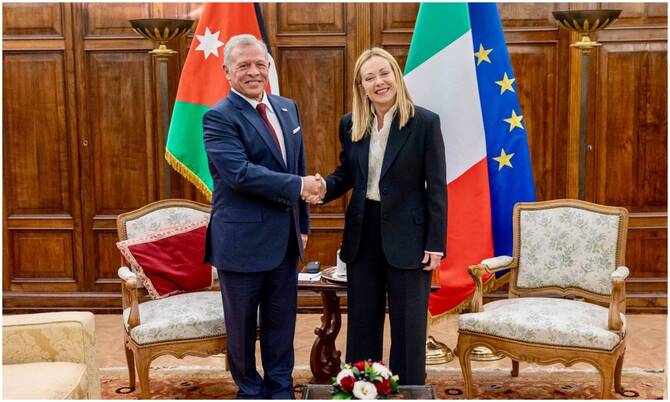
King Abdullah and Italian Prime Minister Giorgia Meloni met in Rome to stress the importance of implementing the Gaza ceasefire agreement. (Petra)
Short Url
Updated 15 October 2025
Follow

Jordanian king’s EU tour to attract investment, enhance regional stability

  • Ali Murad, the head of Eurocham, underscored the European market as vital for Jordan’s economy
  • He said that King Abdullah’s meetings aim to promote regional stability and development through economic and diplomatic cooperation

LONDON: King Abdullah II of Jordan is on a European tour to Italy, Hungary, and Slovenia to enhance the country’s economic, trade, and investment ties with the EU, while also opening new avenues for cooperation, the president of Eurocham said.

Ali Murad, the head of the European Chamber of Commerce in Jordan, said that King Abdullah’s meetings with European leaders will enhance Jordan’s role as a reliable regional partner and attract European investments in key sectors like technology, renewable energy, industry, and tourism.

Murad underscored the European market as vital for Jordan’s economy, emphasizing the need to enhance exports and expand access through new partnerships and tariff measures.

He told Petra news agency on Wednesday that King Abdullah’s meetings aim to promote regional stability and development through economic and diplomatic cooperation between Jordan and Europe.

Eurocham collaborates with Jordan’s public and private sectors to identify investment opportunities in green projects and innovative infrastructure, Petra added.

On Tuesday, the king and Italian Prime Minister Giorgia Meloni met in Rome to stress the importance of implementing the Gaza ceasefire agreement, urging all parties, including Israel and Hamas, to work together until the US-brokered deal is fully completed.

King Abdullah also emphasized the importance of efforts to preserve Christian religious sites in Jordan during a separate meeting on Tuesday with Pope Leo XIV at the Apostolic Palace in Vatican City, accompanied by Queen Rania.


UN rights chief slams dangerous ‘tit-for-tat dynamic’ in Mideast war

Updated 4 sec ago
Follow

UN rights chief slams dangerous ‘tit-for-tat dynamic’ in Mideast war

  • Turk deplored the extensive attacks in residential areas, on health facilities, schools, cultural property and water and energy infrastructure
  • He stressed that “under the laws of war, civilians and civilian infrastructure must be protected at all costs“

GENEVA: The United Nations rights chief voiced alarm Tuesday at the Middle East conflict’s deepening impact on civilians, warning of the dangers of the seeming “tit-for-tat dynamic” between the warring sides.
The United States and Israel began striking Iran on February 28, prompting waves of Iranian strikes across the Gulf.
With hostilities intensifying, UN High Commissioner for Human Rights Volker Turk deplored the extensive attacks in residential areas, on health facilities, schools, cultural property and water and energy infrastructure.
“This apparent tit-for-tat dynamic, involving essential infrastructure with extremely significant civilian impacts, will only increase risks for civilian populations more broadly, with potentially dire consequences across the entire region,” he warned in a statement.
Turk stressed that “under the laws of war, civilians and civilian infrastructure must be protected at all costs.”
“All parties are bound by these rules, and must be held to account if they do not,” he said, warning: “the world is watching.”
The UN rights chief warned that “strikes against vital civilian infrastructure in the Middle East — as well as the widening geographic spread of strikes — are further increasing risks for populations across the region, and beyond.”
He pointed to strikes on a water desalination plant and fuel facilities in Iran over the weekend, igniting fires and reportedly disrupting water access for dozens of villages.
It also prompted warnings of “acid rain” that could cause chemical burns and serious lung damage.
“The foreseeable impacts on civilians and the environment of these strikes raise serious questions as to compliance of these attacks with the requirements of international humanitarian law of proportionality and precaution,” Turk said.
“This warrants careful legal scrutiny.”
He also highlighted the broader impact of the war.
The plunge in commercial shipping activity through the Strait of Hormuz was taking a severe toll on access to energy, food and fertilizer across the region and beyond — hitting the world’s most vulnerable people the hardest.
Turk raised concern about reports of detentions, charges and other forms of repression and intimidation against people in a number of countries, in connection with their expression of opinions around the Middle East conflict.
He demanded that all those arbitrarily detained be released immediately and unconditionally.
“States are reminded of their obligation under international human rights law to respect and protect people’s right to freedom of expression — particularly in times of crisis,” he said.