

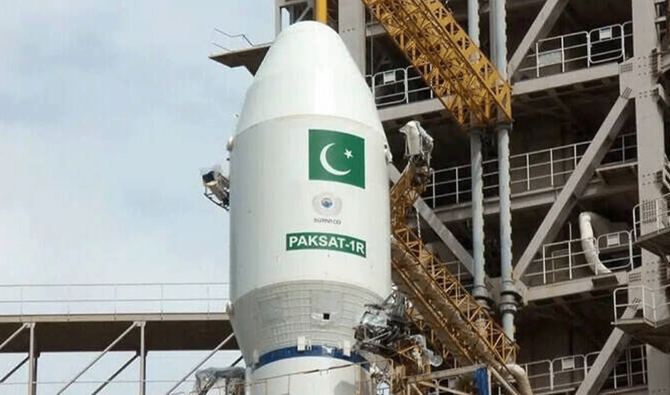
Pakistan to launch first hyperspectral satellite from China to boost agriculture, climate mapping

This screengrab, taken from a handout video released by Pakistan’s Special Investment Facilitation Council on October 17, 2024, shows country’s first multi-mission communication satellite, PAKSAT MM1. (Photo courtesy: SIFC/File)
Short Url
Updated 15 October 2025
Follow

Pakistan to launch first hyperspectral satellite from China to boost agriculture, climate mapping

  • HS-1 satellite to strengthen Pakistan’s space-based monitoring of agriculture, urban growth and climate resilience
  • SUPARCO says data from the mission will improve crop yield estimates and disaster-response capability across the country

ISLAMABAD: Pakistan’s Space and Upper Atmosphere Research Commission (SUPARCO) on Wednesday announced the launch of the country’s first Hyperspectral Satellite (HS-1) from China’s Jiuquan Satellite Launch Center on October 19, marking what officials described as a major leap in national space and climate-monitoring capability.

The HS-1 mission will capture hundreds of spectral bands across visible and infrared wavelengths to help detect changes in soil, vegetation, water bodies and man-made structures with far greater precision than conventional imaging satellites. Officials say the technology will be applied to improve agricultural productivity, monitor environmental degradation and strengthen early-warning systems for floods and landslides.

SUPARCO said the satellite will provide “detailed insights into crop health, soil moisture and irrigation patterns— enhancing yield estimation by 15–20 percent and contributing significantly to food security.” 

The agency added that HS-1’s sensors would also enable mapping of infrastructure and tracking of urban expansion to support sustainable city planning and land-use management.

“The HS-1 launch represents a transformative milestone in Pakistan’s national space program,” SUPARCO said in its statement. “The mission aligns with the National Space Policy and SUPARCO’s Vision 2047, which aim to position Pakistan at the forefront of space technology and innovation for sustainable national development.”

The new satellite will join Pakistan’s growing remote-sensing fleet, which includes PRSS-1 launched in 2018 and two Earth-observation satellites— EO-1 and KS-1— placed in orbit earlier this year. 

Officials said integrating HS-1 will expand Pakistan’s capacity for disaster assessment, water-resource modelling and climate-change monitoring, while deepening collaboration with China in the civilian space sector.



Pakistan rights minister calls for strict action against men for burning woman alive

Updated 5 sec ago
Follow

Pakistan rights minister calls for strict action against men for burning woman alive

  • Kaneez Fatima was burned alive allegedly by her husband last month in eastern Bahawalnagar city, reports say
  • Women in Pakistan face widespread discrimination, domestic violence and workplace harassment, as per rights groups

ISLAMABAD: Pakistan’s Human Rights Minister Azam Nazeer Tarar on Friday urged the Punjab government to take strict legal action against men who are accused of burning a woman alive recently. 

As per local media reports, Kaneez Fatima, a mother of five, was burnt alive allegedly by her husband Muhammad Ashraf and six accomplices in the eastern city of Bahawalnagar on Nov. 30. 

The report said Fatima had married Ashraf, who was already married to another woman, five years ago. It added that Ashraf often fought with Fatima. Police arrested Ashraf and four of his accomplices on Monday and registered a case against all seven suspects under Sections 302 (punishment for murder), 149 (unlawful assembly), and 148 (rioting with a deadly weapon) of the Pakistan Penal Code.

“The federal minister [Tarar] has called on the Punjab government and relevant law enforcement agencies to conduct an immediate and transparent investigation,” Pakistan’s Ministry of Human Rights said in a statement.

“The federal minister [Tarar] expressed hope that the Punjab government and law enforcement agencies will take strict legal action against those involved in the incident.”

Women in Pakistan face widespread discrimination, domestic violence and workplace harassment, according to rights groups. Several women are also killed each year in Pakistan for so-called honor by men of their family for choosing to marry of their own accord. 

Pakistan has introduced several policies to strengthen protections for women, but implementation remains uneven. 

In November, on the International Day for the Elimination of Violence Against Women, Pakistan Prime Minister Shehbaz Sharif said his government was taking legislative, administrative and institutional measures to improve safety and expand access to justice including support centers, dedicated police desks for women, hotlines along with financial and legal assistance for survivors.