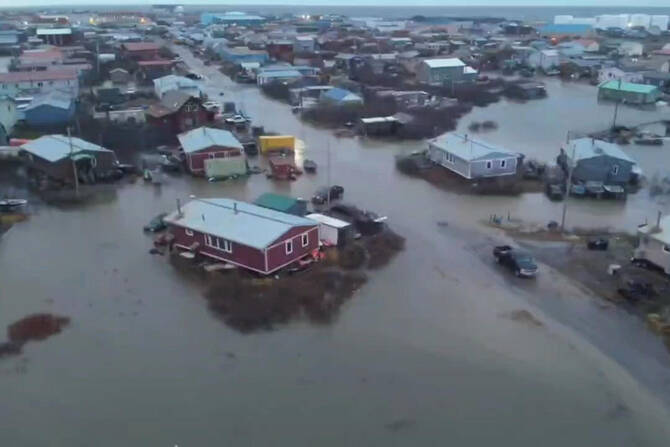
JUNEAU, Alaska: Officials in Alaska rushed Tuesday to evacuate and find housing for people from tiny coastal villages devastated by the remnants of Typhoon Halong. But the remote location and severe damage are limiting their options as they race against other impending storms and the onset of winter.
High winds and surging waters battered low-lying, isolated Alaska Native communities along the Yukon-Kuskokwim Delta in southwest Alaska, nearly 800km from Anchorage, over the weekend. The Coast Guard plucked two dozen people from their homes after the structures floated out to sea in high water, three people were missing or dead, and hundreds of people were staying in school shelters – including one with no working toilets, officials said.
The system followed a storm that struck parts of western Alaska days earlier.
Across the region, more than 1,500 people were displaced. Dozens had been flown to a shelter set up in the National Guard armory in the regional hub city of Bethel, a community of 6,000 people, and officials are considering flying evacuees to longer-term shelter or emergency housing in Fairbanks and Anchorage as they run out of room there.
Fuel storage depots intended to support communities in the region had apparently been damaged, threatening pollution that could harm the fish and game the Alaska Native residents rely on for subsistence. Some people in the area may have lost freezers full of food such as salmon and moose intended to get them through the winter.
The hardest-hit communities included Kipnuk, population 715, and Kwigillingok, population 380. They are off the state’s main road system and reachable this time of year only by water or by air.
“It’s catastrophic in Kipnuk. Let’s not paint any other picture,” Mark Roberts, incident commander with the state emergency management division, told a news conference Tuesday. “We are doing everything we can to continue to support that community, but it is as bad as you can think.”
Heartbreaking moment
Among those awaiting evacuation to Bethel on Tuesday was Brea Paul, of Kipnuk, who said in a text message that she had seen about 20 homes floating away through the moonlight on Saturday night.
“Some houses would blink their phone lights at us like they were asking for help but we couldn’t even do anything,” she wrote.
The following morning, she recorded video of a house submerged nearly to its roofline as it floated past her home.
Paul and her neighbors had a long meeting in the local schoolhouse gym on Monday night, singing songs of praises as they tried to figure out what to do next, she said. Neither she nor most everyone else knows where they will end up.
“It’s so heartbreaking saying goodbye to our community members not knowing when we’d get to see each other,” she said.
One woman was found dead in Kwigillingok, and authorities on Monday night called off the search for two men after their home floated away.
In Kwigillingok, the school was the only facility with full power, but it had no working toilet, and 400 people stayed there Monday night. Workers were trying to fix the bathrooms; a situation report from the state emergency operations center on Tuesday noted that “honey buckets are being used.”
A preliminary assessment showed every home in the village was damaged by the storm, with about three dozen having drifted from their foundations, the emergency management office said.
Power systems flooded in Napakiak, and severe erosion was reported in Toksook Bay. In Nightmute, officials said, fuel drums were reported floating in the community, and there was a scent of fuel in the air and a sheen on the water.
Officials activated members of the National Guard to help with the emergency response, and crews were trying to take advantage of any breaks in the weather to fly in food, water, generators and communication equipment.
Long road to recovery ahead, officials say
Officials warned of a long road to recovery and a need for continued support for the hardest-hit communities. Most rebuilding supplies would have to be transported in, and there is little time left with winter just around the corner.
“Indigenous communities in Alaska are resilient,” said Rick Thoman, an Alaska climate specialist at the University of Alaska Fairbanks. “But, you know, when you have an entire community where effectively every house is damaged and many of them will be uninhabitable with winter knocking at the door now, there’s only there’s only so much that any individual or any small community can do.”
Thoman said the storm was likely fueled by the warm surface waters of the Pacific Ocean, which has been heating up because of human-caused climate change and making storms more intense.
The remnants of another storm, Typhoon Merbok, caused damage across a massive swath of western Alaska three years ago.


Officials airlift evacuees to safety after the remnants of Typhoon Halong devastate Alaska villages
https://arab.news/jefrw
Officials airlift evacuees to safety after the remnants of Typhoon Halong devastate Alaska villages

- High winds and surging waters battered low-lying, isolated Alaska Native communities along the Yukon-Kuskokwim Delta in southwest Alaska


Ahead of strikes, Trump was told Iran attack is high risk, high reward
- Experts caution that the unfolding conflict could take dangerous turns and the first official said the Pentagon’s planning did not appear to guarantee the outcome of any conflict
WASHINGTON: Ahead of the US attack on Iran, President Donald Trump received briefings that not only delivered blunt assessments about the risk of major US casualties but also touted the prospect of a geopolitical shift in the Middle East in favor of US interests, a US official told Reuters. The launch of what the Pentagon called Operation Epic Fury on Saturday plunged the Middle East into a new and unpredictable conflict. The US and Israeli militaries struck sites across Iran, triggering retaliatory Iranian attacks against Israel and nearby Gulf Arab countries.
The official, who spoke on condition of anonymity, said the briefers described the operation to the president as a high-risk, high-reward scenario that could present a once-in-a-generation opportunity for change in the region.
HIGHLIGHTS
• Trump briefings included risks, opportunities in Middle East
• Diplomatic efforts with Iran fail to avert military confrontation
• Iran vows retaliation, targets US and Israeli interests
Trump himself appeared to echo that sentiment when he acknowledged the stakes at the onset of the operation, saying “the lives of courageous American heroes may be lost.”
“But we’re doing this not for now, we’re doing this for the future, and it is a noble mission,” Trump said in a video address announcing the start of major combat operations.
“For 47 years, the Iranian regime has chanted death to America and waged an unending campaign of bloodshed and mass murder ... We’re not gonna put up with it any longer.”
The briefings from Trump’s national security team help explain how the president decided to pursue arguably the riskiest US military operation since the invasion of Iraq in 2003.
Ahead of the strikes, Trump received multiple briefings from officials, including CIA Director John Ratcliffe, US General Dan Caine, the chairman of the Joint Chiefs of Staff, US Secretary of State Marco Rubio and Defense Secretary Pete Hegseth.
On Thursday, Admiral Brad Cooper, who leads US forces in the Middle East as the head of Central Command, flew to Washington to join discussions in the White House Situation Room.
A second US official said that before the strikes, the White House had been briefed on risks associated with operations against Iran, including retaliatory strikes on multiple US bases in the region by Iranian missiles that could overwhelm defenses, as well as Iranian proxies attacking US troops in Iraq and Syria.
The official said that despite the massive military buildup by the United States, there were limits to the air defense systems that had been rushed into the region.
Experts caution that the unfolding conflict could take dangerous turns and the first official said the Pentagon’s planning did not appear to guarantee the outcome of any conflict.
Trump called on Iranians to topple the government but that is easier said than done, said Nicole Grajewski with the Carnegie Endowment for International Peace.
“The Iranian opposition is pretty fragmented. It’s unclear what the population is willing to do in terms of rising up,” Grajewski said.
Both US officials requested anonymity due to the sensitivity of the internal discussions.
The White House did not immediately respond to requests for comment. The Pentagon declined to comment.
TRUMP’S SWEEPING GOALS
In the weeks leading up to the attack, Trump ordered a major military buildup in the Middle East. Reuters reported military planning to carry out a sustained campaign against Iran, if that is what the president chose. Plans included targeting individual officials, officials said.
An Israeli official said Iran’s Supreme Leader Ayatollah Ali Khamenei and President Masoud Pezeshkian were both targeted but the result of the strikes was unclear. Speaking on Saturday, Israeli Prime Minister Benjamin Netanyahu said there were many signs indicating that Khamenei “is no longer” and called on Iranians to “take to the streets to finish the job.”
Trump made clear on Saturday that his objectives in Iran were sweeping, saying he would end the threat posed by Tehran to the United States and give Iranians a chance to topple their rulers. To accomplish this, he outlined plans to lay waste to much of Iran’s military as well as deny it the ability to build a nuclear weapon. Iran denies seeking a nuclear weapon.
“We are going to destroy their missiles and raze their missile industry to the ground... We’re going to annihilate their navy,” he said. “We’re going to ensure that the region’s terrorist proxies can no longer destabilize the region or the world and attack our forces.”
Trump’s decision demonstrates an increasing risk appetite, far greater than when he ordered US special operations forces into Venezuela last month to seize that country’s president in an audacious raid.
The unfolding campaign against Iran is also riskier than when Trump ordered US forces to bomb Iran’s nuclear sites in June.
Iran’s Revolutionary Guards threatened all US bases and interests in the region and said Iran’s retaliation would continue until “the enemy is decisively defeated.”
Experts warn that Iran has many options for retaliation, including missile strikes but also drones and cyber warfare.
Daniel Shapiro, a former senior Pentagon official for Middle East issues, said that despite the US and Israeli strikes, Tehran would still be capable of causing some pain.
“Iran has many more ballistic missiles that can reach US bases than the US has interceptors ... some Iranian weapons will get through,” said Shapiro, also a former US ambassador to Israel. “(The strikes are) a major gamble.”


