Greece to approve disputed 13-hour workday reform

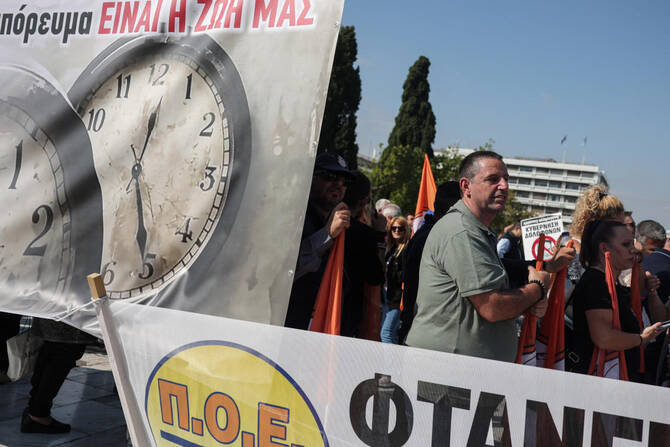
The workday reform is seen as targeted toward Greece’s services sector, especially during the busy summer tourism season, enabling employers to avoid hiring additional staff. Above, protesters in front of the Greek parliament on Oct. 14, 2025. (Reuters)
Short Url
Updated 15 October 2025
Follow

Greece to approve disputed 13-hour workday reform

  • The new law is expected to be passed by parliament, where the ruling conservatives have 156 MPs in the 300-seat chamber
  • Unions have staged two general strikes against the reform this month, the latest of them on Tuesday

ATHENS: Greece’s parliament on Wednesday was to approve a reform allowing workers to work 13-hour days under exceptional circumstances, drawing fire from unions and opposition parties.
The new law is expected to be passed by parliament, where the ruling conservatives have 156 MPs in the 300-seat chamber.
Unions have staged two general strikes against the reform this month, the latest of them on Tuesday.
The government insists that the 13-hour workday is optional, only affects the private sector, and can only be applied up to 37 days a year.
“It requires an employee’s consent,” Labor Minister Niki Kerameus told Skai TV on Tuesday.
The minister has said she has received, and rejected, collective agreement requests proposing even longer hours.
The reform is seen as targeted toward Greece’s services sector, especially during the busy summer tourism season, enabling employers to avoid hiring additional staff.
But opposition parties and unions argue that workers will risk layoffs if they refuse longer hours.
“Our health, both mental and physical, and the balance between personal and professional life are goods that cannot be replaced with money,” Stefanos Chatziliadis, a senior member of civil service union ADEDY, said during a Tuesday protest in Thessaloniki.
“Making it legal to work from morning till night is not normal and cannot be tolerated by our society. It is truly barbaric. It is inhuman,” he said.
The legal working day in Greece is eight hours, with the possibility of performing paid overtime.
According to Eurostat, Greeks work 39.8 hours a week on average compared to the EU average of 35.8 hours.
“This is a first step toward extending the working hours; in the private sector, you can’t really refuse, they always find ways to impose what they want,” said Maria, a 46-year-old construction company employee who declined to give a surname.
The current government has already legalized a six-day working week, especially during high demand in certain sectors including tourism.


Louvre thieves escaped with 30 seconds to spare, probe reveals

Updated 2 sec ago
Follow

Louvre thieves escaped with 30 seconds to spare, probe reveals

  • Probe found only one of two security cameras was working near the site where the intruders broke in on the morning of Sunday October 19
PARIS: The thieves who stole crown jewels from the Louvre in October evaded police with just 30 seconds to spare due to avoidable security failures at the Paris museum, a damning investigation revealed on Wednesday.
The probe, ordered by the culture ministry after the embarrassing daylight heist, revealed that only one of two security cameras was working near the site where the intruders broke in on the morning of Sunday October 19.
Agents in the security control room did not have enough screens to follow the images in real-time, while a lack of coordination meant police were initially sent to the wrong place once the alarm was raised, the report unveiled at the French Senate’s Culture Commission stated.
“It highlights an overall failure of the museum, as well as its supervisory authority, to address security issues,” the head of the commission, Laurent Lafon, said at the start of a hearing.
One of the most startling revelations was that the robbers left only 30 seconds before police and private security guards arrived on the scene.
“Give or take 30 seconds, the Securitas (private security) guards or the police officers in a car could have prevented the thieves from escaping,” the head of the investigation, Noel Corbin, told senators.
He said that measures such as a modern CCTV system, more resistant glass in the door cut open with angle grinders, or better internal coordination could have prevented the loss of the jewels — worth an estimated $102 million — which have still not been found.
Major security vulnerabilities were highlighted in several studies seen by management of the Louvre over the last decade, including a 2019 audit by experts at the jewelry company Van Cleef & Arpels.
Their findings stressed that the riverside balcony targeted by the thieves was a weak point and could be easily reached with an extendable ladder — exactly what transpired in the heist.
‘Stunned’
Corbin confirmed that under-fire Louvre boss Laurence des Cars had not been aware of the audit which was ordered by her predecessor, Jean-Luc Martinez.
“The recommendations were not acted on and they would have enabled us to avoid this robbery,” Corbin said, adding that there had been a lack of coordination between the two government-appointed administrators.
Police believe they have arrested all four intruders, who escaped on powerful motorbikes, having carried out the heist in the Apollo Gallery in around 10 minutes in total, according to the investigation.
The revelations on Wednesday are likely to pile more pressure des Cars, the first woman in the role who was appointed by President Emmanuel Macron in 2021.
Questions have swirled since the break-in over whether it was avoidable and why a national treasure that is the world’s most-visited museum appeared to be so poorly protected.
France’s lower house of parliament is carrying out its own inquiry, while des Cars and Martinez are set to be grilled by senators next week.
Last month, France’s state auditor said security upgrades had been carried out at a “woefully inadequate pace” and the museum had prioritized “high-profile and attractive operations” instead of protecting itself.
Senior police officer Guy Tubiana, a security adviser at the culture ministry who took part in the investigation, told senators he was “stunned” by what he had discovered at the museum.
“There was a succession of malfunctions that led to catastrophe but I never would have thought the Louvre could have so many malfunctions,” he said.
Staff at the Louvre at set to go on strike on Monday to demand management act against what they see as understaffing and overcrowding at the museum, which welcomed 8.7 million people last year.
At the weekend, the museum revealed that a water leak had damaged 300 to 400 journals, books and documents in the Egyptian department in late November.