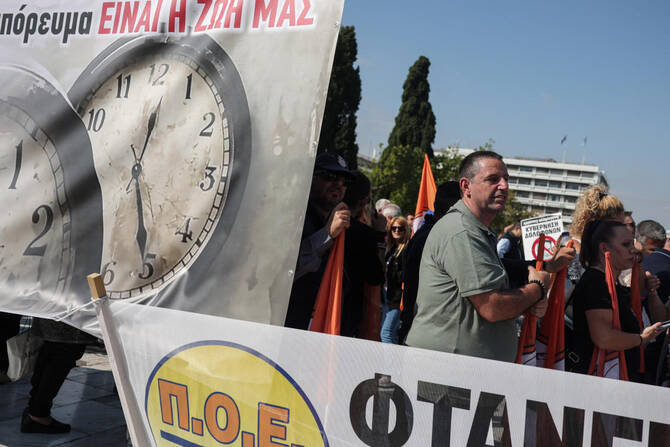
ATHENS: Greece’s parliament on Wednesday was to approve a reform allowing workers to work 13-hour days under exceptional circumstances, drawing fire from unions and opposition parties.
The new law is expected to be passed by parliament, where the ruling conservatives have 156 MPs in the 300-seat chamber.
Unions have staged two general strikes against the reform this month, the latest of them on Tuesday.
The government insists that the 13-hour workday is optional, only affects the private sector, and can only be applied up to 37 days a year.
“It requires an employee’s consent,” Labor Minister Niki Kerameus told Skai TV on Tuesday.
The minister has said she has received, and rejected, collective agreement requests proposing even longer hours.
The reform is seen as targeted toward Greece’s services sector, especially during the busy summer tourism season, enabling employers to avoid hiring additional staff.
But opposition parties and unions argue that workers will risk layoffs if they refuse longer hours.
“Our health, both mental and physical, and the balance between personal and professional life are goods that cannot be replaced with money,” Stefanos Chatziliadis, a senior member of civil service union ADEDY, said during a Tuesday protest in Thessaloniki.
“Making it legal to work from morning till night is not normal and cannot be tolerated by our society. It is truly barbaric. It is inhuman,” he said.
The legal working day in Greece is eight hours, with the possibility of performing paid overtime.
According to Eurostat, Greeks work 39.8 hours a week on average compared to the EU average of 35.8 hours.
“This is a first step toward extending the working hours; in the private sector, you can’t really refuse, they always find ways to impose what they want,” said Maria, a 46-year-old construction company employee who declined to give a surname.
The current government has already legalized a six-day working week, especially during high demand in certain sectors including tourism.

Greece to approve disputed 13-hour workday reform
https://arab.news/4b2vt
Greece to approve disputed 13-hour workday reform
- The new law is expected to be passed by parliament, where the ruling conservatives have 156 MPs in the 300-seat chamber
- Unions have staged two general strikes against the reform this month, the latest of them on Tuesday
Ukraine president to meet European allies after Trump criticism
- Talks between Ukrainian and US officials in Miami ended on Saturday with no apparent breakthrough
- President Donald Trump accuses Ukrainian leader of not reading the US proposal to end the war with Russia
LONDON: Ukrainian leader Volodymyr Zelensky was due to meet with European allies in London on Monday, after President Donald Trump accused him of not reading the US proposal to end the war with Russia.
It comes after days of talks between Ukrainian and US officials in Miami ended on Saturday with no apparent breakthrough, with Zelensky committing to further negotiations.
The Ukrainian president will be received in London by British Prime Minister Keir Starmer, along with the German chancellor and French president to discuss the negotiations.
British Foreign Secretary Yvette Cooper is meanwhile expected in Washington on Monday, where she will meet her American counterpart Marco Rubio.
“The UK and US will reaffirm their commitment to reaching a peace deal in Ukraine,” the Foreign Office in London said, announcing Cooper’s visit.
Moscow has meanwhile continued to strike its neighbor, wounding at least nine people overnight Sunday to Monday, according to Ukrainian officials.

‘Disappointed’
Zelensky said he joined his negotiators for a “very substantive and constructive” call with US envoys Steve Witkoff and Jared Kushner during the Miami negotiations.
“Ukraine is committed to continuing to work honestly with the American side to bring about real peace,” Zelensky said on Telegram, adding that the parties agreed “on the next steps and the format of the talks with America.”
But Trump criticized his Ukrainian counterpart on Sunday, telling reporters “I have to say that I’m a little bit disappointed that President Zelensky hasn’t yet read the proposal, that was as of a few hours ago.”
Witkoff and Kushner had met Russian President Vladimir Putin at the Kremlin last week, with Moscow rejecting parts of the US proposal.
French President Emmanuel Macron ahead of Monday’s talks slammed what he called Russia’s “escalatory path.”
“We will continue these efforts with the Americans to provide Ukraine with security guarantees, without which no robust and lasting peace will be possible,” Macron wrote on X.
He added: “We must continue to exert pressure on Russia to compel it to choose peace.”
Hot and cold
Washington’s initial plan to bring an end to the almost four-year war involved Ukraine surrendering land that Russia has not been able to win on the battlefield in return for security promises that fall short of Kyiv’s aspirations to join NATO.
But the nature of the security guarantees that Ukraine could get has so far been shrouded in uncertainty, beyond an initial plan saying that jets to defend Kyiv could be based in Poland.
Trump has blown hot and cold on Ukraine since returning to office in January, initially embracing Putin and chastising Zelensky for not being grateful for US support.
But he has also grown frustrated that his efforts to persuade Putin to end the war, including a summit in Alaska, have failed to produce results and he recently slapped sanctions on Russian oil firms.