US revokes visas for 6 foreigners over Charlie Kirk-related speech

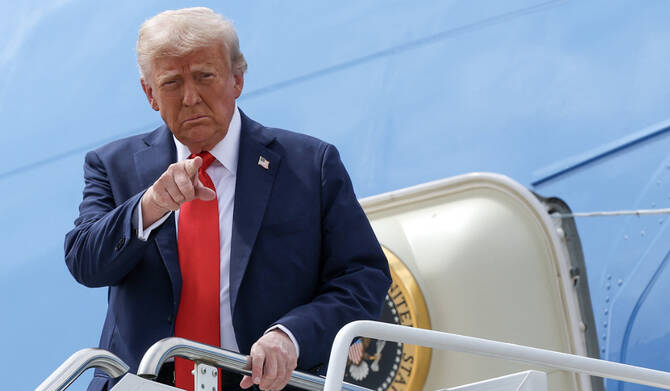
U.S. President Donald Trump steps off Air Force One in Arizona after arriving for the memorial service for political activist Charlie Kirk at State Farm Stadium, on September 21, 2025 in Glendale, Arizona. (AFP)
Short Url
Updated 15 October 2025
Follow

US revokes visas for 6 foreigners over Charlie Kirk-related speech

  • Vice President JD Vance and other top US officials have encouraged people to call out offensive language about Kirk that they see online
  • The administration has ramped up efforts to identify and potentially expel thousands of foreigners in the US, notably students, who it says have either fomented or participated in unrest supported protests against Israel’s military operations in Gaza

WASHINGTON: The Trump administration has revoked the visas of six foreigners deemed by US officials to have made derisive comments or made light of the assassination of conservative activist Charlie Kirk last month.
The State Department said Tuesday it had determined they should lose their visas after reviewing their online social media posts and clips about Kirk, who was killed while speaking at a Utah college campus on Sept. 10.
The announcement came as President Donald Trump was posthumously awarding him America’s highest civilian honor, the Presidential Medal of Freedom. At Kirk’s funeral in September, Trump called him a “great American hero” and “martyr” for freedom.
The administration and its supporters have targeted people for their comments about Kirk, leading to firings or other discipline of journalists, teachers and others, and raising free speech concerns.
The six foreigners who had their visas revoked were from Argentina, Brazil, Germany, Mexico, Paraguay and South Africa. They were not identified.
Trump and Secretary of State Marco Rubio “will defend our borders, our culture, and our citizens by enforcing our immigration laws,” the State Department said. “Aliens who take advantage of America’s hospitality while celebrating the assassination of our citizens will be removed.”
Vice President JD Vance and other top US officials have encouraged people to call out offensive language about Kirk that they see online. In an unusual tweet last month, Deputy Secretary of State Christopher Landau asked social media users to copy him on any relevant posts, saying he was personally “disgusted to see some on social media praising, rationalizing, or making light of the event, and have directed our consular officials to undertake appropriate action.”
In addition to Tuesday’s action, the administration has ramped up efforts to identify and potentially expel thousands of foreigners in the United States, notably students, who it says have either fomented or participated in unrest or publicly supported protests against Israel’s military operations in Gaza. The administration has also denied visas to applicants whose social media histories have been critical of its policies.
Among the higher-profile cases, the administration has expelled South Africa’s ambassador to the United States for comments critical of Trump, revoked a visa for Palestinian President Mahmoud Abbas to attend the UN General Assembly and yanked the visas for British punk-rap duo Bob Vylan. It said it is reviewing the status of the more than 55 million current US visa holders for potential violations of its standards.
Those actions have been criticized by civil rights groups as violations of constitutional protections for freedom of speech, which apply to anyone in the United States and not just to American citizens.


Will Afghanistan’s pledge against cross-border attacks ease tensions with Pakistan?

Updated 8 sec ago
Follow

Will Afghanistan’s pledge against cross-border attacks ease tensions with Pakistan?

  • Afghan clerics’ decree banned use of Afghan soil for cross-border attacks on Wednesday
  • Latest heavy firing between Afghanistan, Pakistan killed at least 5 people 

KABUL: As tensions flare up again between Afghanistan and Pakistan, the Afghan leadership has moved to reaffirm its commitment against cross-border militancy this week in what is seen as Kabul’s attempt to move the needle on peace negotiations, after multiple rounds of talks failed to produce a lasting truce. 

The neighboring countries have struggled to maintain a fragile ceasefire after border clashes killed dozens in October, the worst fighting since the Taliban took control of Afghanistan in 2021.

While subsequent talks toward a permanent ceasefire yielded little progress, the temporary truce brokered by Qatar and Turkiye collapsed last Friday, with heavy firing along the Spin Boldak-Chaman border that killed at least five people. 

Over the years Pakistan has put much of the blame for the border clashes on the government in Kabul allowing Tehreek-e-Taliban Pakistan — an outlawed armed group, which is separate from the Afghan Taliban — to use Afghan territory for cross-border attacks — a claim that Afghanistan has repeatedly denied.

Afghanistan again pledged to prevent its territory from being used to harm other countries on Thursday, with Taliban Foreign Minister Amir Khan Muttaqi highlighting it as a religious duty, as endorsed just a day earlier by around 1,000 Afghan clerics in a fatwa, or religious decree.

“The fatwa was more political than religious,” Kabul University lecturer Abdullah Awwab told Arab News on Friday. 

“I think it was a smooth way out of the pressure put on them by Pakistan and mediators, who were asking for a fatwa against the TTP. The emirate couldn’t issue that, so instead they had scholars issue a fatwa for ordinary Afghans, banning them from jihad abroad.

“The fatwa shows Pakistan that the Taliban can use a fatwa to stop Afghans from joining the war. It demonstrates Kabul’s power and control over its own soil and people — and, at the same time, it shows Pakistan’s weakness in needing to ask Kabul for a religious fatwa.”

Addressing new graduates at a ceremony in Kabul, Muttaqi said the Taliban had not “permitted anyone to carry out military activities in other countries” and that the government had the right to take action against anyone who violated the directive. 

“The leaders and elders of this Islamic emirate have pledged that Afghan soil will not be used to harm anyone. All the scholars and religious leaders affirmed that obeying this commitment is necessary for all Muslims,” he said. 

“Just as this nation has historically acted upon the fatwas and advice of its scholars, so too will (it) act upon them now. This is our shared duty.” 

Asif Durrani, Pakistan’s former special envoy to Afghanistan, said the decree was a “very significant” development.

“Hopefully, the TTP, which owes allegiance to the Taliban’s Supreme Leader Mullah Hibatullah Akhundzada, will now submit to the collective wisdom of the Afghan Taliban ulema and surrender arms,” he wrote on X. 

Though the decree answers one of Pakistan’s demands, Afghan political analyst Wasi Baheer said it had “no direct impact” in the conflict.

“Pakistan’s harsh words and threats to Kabul don’t mean much, because the real issue is inside Pakistan,” he told Arab News.

“They cannot simply force changes in Kabul. The main reason talks collapsed in Qatar, Istanbul, and Saudi Arabia is that Pakistan demanded the Taliban act harshly against the TTP — which makes no sense, because it is an internal Pakistani problem. Using force here in Afghanistan will not bring any relief to Pakistan’s security.”