

China is very concerned about Pakistan-Afghanistan clashes, foreign ministry says

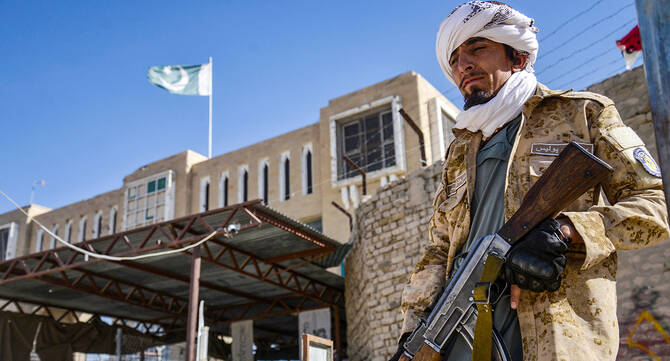
An Armed Taliban security personnel stands guard near the closed gate of the zero point border crossing between Afghanistan and Pakistan at Spin Boldak district in Kandahar province on October 12, 2025. (AFP)
Short Url
Updated 13 October 2025
Follow

China is very concerned about Pakistan-Afghanistan clashes, foreign ministry says

  • Dozens of fighters were killed in overnight clashes in the most serious fighting between Pakistan, Afghanistan since the Taliban came to power
  • China shares a border with Afghanistan and Pakistan in its western region and has sought to play a mediating role in calming hostilities

BEIJING: China is concerned about recent clashes between Pakistan and Afghanistan and has asked the two countries to protect its nationals and investments in the region, Beijing’s foreign ministry said on Monday.

Dozens of fighters were killed in overnight border clashes between Pakistan and Afghanistan, both sides said on Sunday, in the most serious fighting between the neighbors since the Taliban came to power in Kabul.

China shares a border with Afghanistan and Pakistan in its western region and has sought to play a mediating role in calming hostilities between the two sides, who were allies until recently.

“China is willing to continue to play a constructive role in improving and developing Pakistan-Afghanistan relations,” foreign ministry spokesperson Lin Jian said during a regular press briefing.

Beijing hopes that Kabul and Islamabad will “remain calm and restrained, and persist in properly resolving each other’s concerns through dialogue and consultation to avoid escalation of conflicts,” Lin said.

In August, China’s Foreign Minister Wang Yi attended a meeting with Pakistani and Afghan counterparts in Kabul, calling for strengthening exchanges at all levels.

In an informal trilateral meeting weeks earlier, hosted by Beijing, China said Kabul and Islamabad had agreed to upgrade their diplomatic ties.


Islamic military coalition, Pakistan to deepen cooperation to combat ‘terrorism’ — Pakistani military

Updated 02 February 2026
Follow

Islamic military coalition, Pakistan to deepen cooperation to combat ‘terrorism’ — Pakistani military

  • Islamic Military Counter Terrorism Coalition is a 43-member alliance that includes Pakistan, Saudi Arabia, Egypt, Jordan, UAE and other nations
  • The Pakistani military statement comes after a meeting between IMCTC secretary-general and the chief of Pakistani defense forces in Rawalpindi

ISLAMABAD: Pakistan and the Islamic Military Counter Terrorism Coalition (IMCTC) have reaffirmed their commitment to deepening cooperation, including intelligence sharing and capacity building, to jointly combat “terrorism” and “extremism,” the Pakistani military said on Monday.

The IMCTC is a 43-member military alliance that was formed on Saudi Arabia’s initiative in Dec. 2015 to consolidate Muslim countries’ efforts in countering “terrorism.”

A 17-member IMCTC delegation is visiting Pakistan from Feb. 2-6 to conduct a training at National University of Sciences and Technology on “Re-integration and Rehabilitation of Extremist Elements,” according to the Pakistani military.

On Monday, IMCTC Secretary-General Maj. Gen. Mohammed bin Saeed Al-Moghedi held a meeting with Chief of Pakistani Defense Forces Field Marshal Asim Munir to discuss cooperation among IMCTC member states.

“During the meeting, matters of mutual interest were discussed, with particular emphasis on regional security dynamics and enhanced cooperation in counter-terrorism efforts,” the Inter-Services Public Relations (ISPR), the Pakistani military’s media wing, said in a statement.

“Both sides reaffirmed their shared commitment to combating terrorism and extremism through collaborative strategies, intelligence sharing, and capacity building among member states.”

The IMCTC features Pakistan, Saudi Arabia, Türkiye, Afghanistan, Egypt, Jordan, Qatar, Palestine, UAE, Bangladesh and other nations. In 2017, Pakistan’s former army chief Gen. (retd) Raheel Sharif was appointed as the IMCTC commander-in-chief.

During discussions with Major General Al-Moghedi, Field Marshal Munir appreciated the role of IMCTC in fostering stability and promoting coordinated counterterrorism initiatives across the Islamic world, according to the ISPR.

The IMCTC secretary-general acknowledged Pakistan’s significant contributions and sacrifices in the fight against militancy and lauded the professionalism of Pakistan’s armed forces.

“The meeting underscored the resolve of both sides to further strengthen institutional collaboration for peace, stability, and security in the region,” the ISPR added.

Pakistan enjoys cordial ties with most Muslim countries around the world, particularly Gulf Cooperation Council countries. In Sept. 2025, Pakistan signed a landmark defense pact with Saudi Arabia according to which an act of aggression against one country will be treated as an act of aggression against both.