
RIYADH: A global reassessment of the energy transition is underway, with long-term investment in oil and gas expected to remain essential to meet rising global energy demand, Aramco’s chief said.
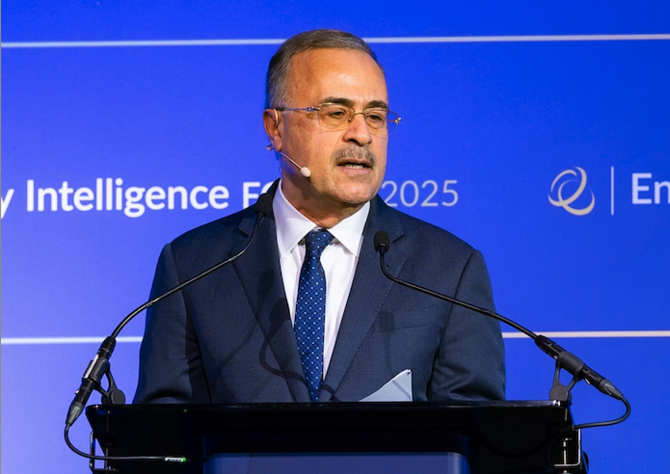
Speaking at the Energy Intelligence Forum in London, Amin Nasser emphasized that future energy policy must be grounded in supply realism and demand growth.
The company’s president and CEO said the company remains focused on expanding its oil, gas, and chemicals businesses while also advancing strategic investments in technology and digital infrastructure to sustain long-term growth in a shifting global market.
“Much of the promised progress has not been delivered, with many unintended consequences,” Nasser said.
“In reality, this is not a true energy transition; it’s an energy addition which requires all hands on deck.”
He added that major forecasters have revised their scenarios, with oil and gas expected to remain core components of the energy mix for decades, which he sees as a signal to support long-term investment in both sectors.
Industry forecasts appear to align with Nasser’s analysis. According to Fitch Ratings, global oil demand is projected to grow by approximately 700,000 to 800,000 barrels per day through 2026, signaling continued reliance on hydrocarbons despite ongoing energy transition efforts.
The International Energy Agency also reported in its Global Energy Review 2025 that energy demand surged in 2024 across all major sources — renewables, fossil fuels, and nuclear — highlighting that current renewable capacity expansion is insufficient to offset rising consumption.
This underscores Nasser’s assertion that the world is not undergoing a true transition, but rather an “energy addition,” where new sources are supplementing rather than replacing traditional fuels.
Meanwhile, the European Environment Agency noted in its latest trends and projections to report that the EU remains off-track on several energy and climate targets, reflecting broader implementation challenges even in advanced economies.
“Even in the Global North, the economic realities, technology limits, and public acceptance of the current transition plan are forcing some welcome policy U-turns,” Nasser said.
On Aramco’s long-term strategy, Nasser reaffirmed the company’s commitment to maintaining dominance in oil production.
“We are determined to remain dominant in oil thanks to a massive resource base, low costs, and one of the lowest upstream carbon intensities across the industry,” he said.
Aramco is also intensifying its investments in natural gas, particularly in unconventional resources, which Nasser described as one of the world’s largest reserves.
He noted that despite market challenges, the company sees chemicals as a strategic growth area, citing its “proven strengths in both feedstocks and conversion.”
In terms of technology, Aramco is expanding its deployment of artificial intelligence and digital solutions to boost efficiency and sustainability.
“We continue to deliver efficiency improvements, and are further reducing our upstream carbon and methane intensities,” Nasser said.
He highlighted Aramco’s $7 billion venture capital program and its focus on developing scalable technologies, particularly in new energies.
“Ultimately, our focus is on value as we invest in technology development, AI, and digital solution. The same approach applies to our careful positioning in new energies, ready to scale up when commercially competitive,” he added.
The Energy Intelligence Forum is an annual event that gathers leaders from energy, politics, finance, and business to address industry challenges and shape the future of global energy.
This year’s forum focuses on the implications of protectionism and the complexities of navigating the global energy transition.