Normalcy returns to Pakistani capital after police disperse pro-Palestine marchers in Punjab

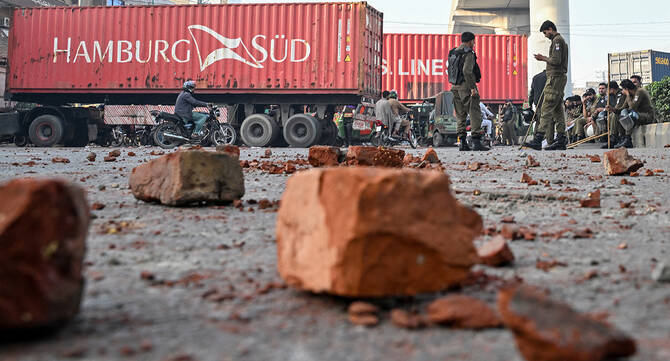
Police personnel stand guard as authorities block the road with shipping containers during a march by activists of the Tehreek-e-Labbaik Pakistan (TLP) party near their party headquarters in Lahore on October 9, 2025, ahead of their pro-Palestinian march towards Islamabad. (AFP)
Short Url
Updated 13 October 2025
Follow

Normalcy returns to Pakistani capital after police disperse pro-Palestine marchers in Punjab

  • Clashes erupted in Punjab’s Muridke after protesters tried to remove roadblocks on way to Islamabad, killing at least five people
  • The TLP party last week announced a protest outside US embassy in Islamabad, triggering clashes, roadblocks, Internet suspension

ISLAMABAD: Public life largely returned to normal in the Pakistani capital of Islamabad and the nearby Rawalpindi garrison city on Monday, the local administration said, following a police crackdown on pro-Palestine marchers camped in the eastern Punjab province.

The march was organized by the Tehreek-e-Labbaik Pakistan (TLP) religio-political party and aimed to stage a protest outside the US embassy in Islamabad to express solidarity with Palestine. It sparked clashes in several cities as authorities attempted to keep the marchers from heading to the capital.

The situation triggered road blockades and prompted authorities to suspend mobile Internet in Islamabad, Rawalpindi and other cities on Friday, paralyzing public life for days. On Monday, police dispersed the marchers who had been camped in Punjab’s Muridke city on their way to Islamabad from Lahore.

A clash between authorities and protesters killed at least five people, including a police officer and injured dozens of others, police and witnesses said on Monday. Punjab Police Chief Usman Anwar said the demonstrators opened fire on authorities, killing the officer and wounding others. Police said three protesters and one passerby also died in the clashes before the demonstrators were dispersed.

“Normal life and business activities have been fully restored in the city,” the Islamabad administration said in a statement on Monday evening. “No protests or demonstrations are taking place in any area of ​​the city.”

It said no roads have been blocked in the capital, however, the flow of traffic was slow due to obstacles at a few places.

“There is a restriction on protests or demonstrations in the city,” the administration. “Citizens are requested not to be a part of any illegal activity.”

Videos released by TLP on Monday showed several vehicles burning, including a truck carrying party officials who were leading what they have called the “long march” to Islamabad.

The TLP said in a statement on Monday that hundreds of march participants were injured and the casualty figure was high among its supporters. Monday’s clashes began when protesters tried to remove shipping containers placed by police to block roads. Supporters clashed with police in Lahore last week, before camping 30 kilometers away in Muridke.

The US Embassy issued a security alert last week ahead of the march, warning of possible disruptions and urging US citizens to exercise caution.

The TLP, known for staging disruptive and sometimes violent demonstrations, has drawn mixed reactions online. Some in Pakistan have accused the government of overreacting to the march by blocking major roads even before the protest began.

Pakistan Deputy Interior Minister Talal Chaudhry said over the weekend that he failed to understand why TLP opted for violence instead of celebrating peace in Gaza.

TLP gained prominence in Pakistan’s 2018 elections by campaigning on the single issue of defending the country’s blasphemy law, which calls for the death penalty for anyone who insults Islam. Since then, the party has staged violent rallies, mainly against desecration abroad of Islam’s holy book, Qur’an.

The party has held pro-Palestinian rallies in recent years in Lahore and other cities. This march was planned to travel toward the US embassy to express support for Palestinians.


Islamabad hits back after Indian minister blames Pakistan army for ‘ideological hostility’

Updated 10 sec ago
Follow

Islamabad hits back after Indian minister blames Pakistan army for ‘ideological hostility’

  • Jaishankar tells a public forum most of India’s problems with Islamabad stem from Pakistan’s military establishment
  • Pakistan condemns the remarks, accusing India of waging a propaganda drive to deflect from its destabilizing actions

ISLAMABAD: Pakistan accused India on Sunday of running a propaganda campaign to malign its state institutions, a day after Indian External Affairs Minister Subrahmanyam Jaishankar attributed what he described as Pakistan’s “ideological hostility” toward New Delhi to the country’s powerful army.

Addressing a public forum in New Delhi, Jaishankar said most of India’s problems with Pakistan stemmed from its military establishment, which he argued had cultivated and sustained an entrenched animosity toward India.

His remarks came months after a brief but intense military confrontation between the nuclear-armed neighbors, during which both sides exchanged artillery and missile fire and deployed drones and fighter jets.

Responding to the comments, Pakistan’s Foreign Office spokesperson Tahir Andrabi called them “highly inflammatory, baseless and irresponsible.”

“Pakistan is a responsible state and its all institutions, including armed forces, are a pillar of national security, dedicated to safeguarding the sovereignty and territorial integrity of the country,” Andrabi said in a statement. “The May 2025 conflict vividly demonstrated Pakistan armed forces’ professionalism as well as their resolve to defend the motherland and the people of Pakistan against any Indian aggression in a befitting, effective yet responsible manner.”

“The attempts by Indian leadership to defame Pakistan’s state institutions and its leadership are a part of a propaganda campaign designed to distract attention from India’s destabilising actions in the region and beyond as well as state-sponsored terrorism in Pakistan,” he said, adding that such “incendiary rhetoric” showed the extent of India’s disregard for regional peace and stability.

Andrabi said that rather than making “misleading remarks about the armed forces of Pakistan,” India should confront the “fascist and revisionist Hindutva ideology that has unleashed a reign of mob justice, lynchings, arbitrary detentions and demolition of properties and places of worship.”

He warned that the Indian state and its leadership had become hostage to “this terror in the name of religion.”

India and Pakistan have fought three wars since independence in 1947. They have also engaged in countless border skirmishes and major military standoffs, including the 1999 Kargil conflict.

The four-day conflict in May 2025 ended with a US-brokered ceasefire, after Washington said both sides had expressed willingness to pursue dialogue.

Pakistan said it was ready to discuss all outstanding issues, but India declined talks.


-End