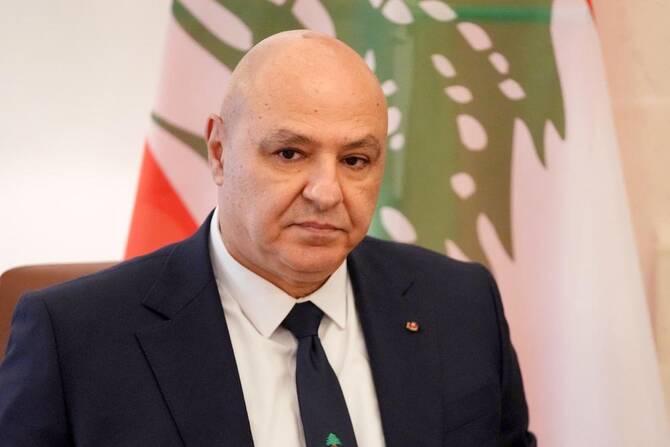

BEIRUT: Lebanese President Joseph Aoun has described the current sentiment in the region as one of reconciliation, and affirmed that Lebanon was not under threat.
But he stressed the urgent need for Israel to halt all military operations against Lebanon so that negotiations between the countries can begin, and warned that progress across the region must not be obstructed.
Aoun underscored the importance of what he described as this moment when dialogue can move forward.
BACKGROUND
President Joseph Aoun says ‘continues to send military and bloody messages to pressure us,’ citing the bombing of bulldozers and excavation equipment in Msaileh last Saturday.
His comments came as US President Donald Trump addressed the Israeli Knesset on Monday. In his speech, Trump highlighted the efforts of the Lebanese government to bring all weapons under state control and build peaceful relations with its neighbors, and affirmed the broad regional support for a plan to disarm Hezbollah.
“Through dialogue and negotiations, the form of which will be determined at the appropriate time, solutions can be reached and Lebanon cannot be excluded from the process of resolving the crises existing in the region,” Trump said.
Addressing the media at the Presidential Palace, Aoun said that “the current situation in the region, and the direction it is taking, reflect the soundness of our decisions and approaches,” and stressed that Lebanon cannot be excluded from regional efforts to resolve ongoing crises.
“That is why we consistently affirm that solutions are achievable through dialogue and negotiation,” he added.
“We cannot remain outside the current regional trajectory, which is focused on resolving crises. We must be part of it, as continued war, destruction, killing and displacement can no longer be tolerated.”
Regarding the official efforts to limit control of arms to the Lebanese state, Aoun said: “Weapons themselves are not the issue; what matters is the intent behind their use.
“Ammunition, like medicine, has an expiration date; once it surpasses its lifespan it becomes a danger to its owner. What’s essential is to neutralize the function of weapons, a process that takes time and cannot be approached with a ‘let it be’ attitude.”
Since the ceasefire agreement with Israel in November last year, Aoun noted, the Lebanese Army has been actively fulfilling its duties in areas south of the Litani River. To date, he said, 12 soldiers, including explosives experts, have lost their lives carrying out this duty.
About 80 to 85 percent of the land south of the Litani has been cleared of militants and their weapons, Aoun said, though he acknowledged that the difficult terrain, comprising valleys, forests and hills, and the approaching winter mean it is challenging to set a definitive timetable for completion.
Elsewhere, he added, the army is engaged along northern and eastern borders, and on the maritime front, where it is conducting missions targeting smugglers and drug traffickers, to maintain security, and fulfill other responsibilities.
The president also highlighted ongoing coordination with Palestinian groups over disarming, and said weapons handovers had begun in several refugee camps. Both the state and the army are handling this issue with equal responsibility, he added.
The army remains fully committed to its responsibilities, Aoun said, and other security agencies, including the Internal Security Forces, General Security and State Security, are also playing their part, particularly in efforts to tackle corruption.
He condemned recent actions by Israel, however, saying that Tel Aviv “continues to send military and bloody messages to pressure us.” He cited the bombing of bulldozers and excavation equipment in Musaylih last Saturday as clear evidence of the ongoing aggressive Israeli stance toward Lebanon.
“We have repeatedly requested American and French intervention but they have not responded,” Aoun said, but reaffirmed that Lebanon remains committed to the peace agreement despite the continuing provocations.
The US began its efforts to help demarcate the land border between Lebanon and Israel in 2023, after sponsoring an agreement on the maritime border between the countries the previous year. However, the subsequent conflict between Hezbollah and Israel froze those efforts.
The current demarcation line between the two countries, set by the UN in 2000, includes 13 disputed points. Following the end of the war with Hezbollah last November, Israel troops also remained deployed at five border points they consider strategically important.
“The Lebanese state has previously negotiated with Israel under the auspices of the UN, which resulted in an agreement on maritime border demarcation,” Aoun said.
“What, then, prevents similar from happening again to address unresolved issues, particularly given that the war did not yield results? Israel entered into negotiations with Hamas (over Gaza) because it had no alternative after it attempted war and destruction.
“Today, the general atmosphere is one of compromise, and negotiations are necessary. However, the framework of the negotiation will be determined in due course.”
Reconstruction in parts of southern Lebanon damaged by conflict is part of the state’s duty toward its citizens, Aoun said, but he admitted that the government does not have the money required to begin the rebuilding process.
“The people of the south have rights that we are working on securing,” he said. “However, I state candidly that there are currently no available funds to initiate the reconstruction process.
“A conference must be convened to support reconstruction, and this is the objective we are currently pursuing.”
He clarified that aid recently approved by the US Congress — $190 million for the Lebanese Army and $40 million for the Internal Security Forces — was not directly linked to disarmament.
“The defense and interior ministries in Lebanon must specify their needs and submit a list accordingly,” he said. “Once approved, the machinery and equipment will be approved and sent to Lebanon.
“There is no financial aid, in the direct sense, but rather the purchase of weapons, vehicles and equipment to be delivered to the army and the security forces.”
Lebanon “is only in danger in the minds of some who take stances opposite to the state and do not want to see Lebanon rise again,” Aoun said, pointing out that economic indicators were increasingly positive.
The Ministry of Economy has projected economic growth of up to 5 percent by the end of this year, with financial inflows potentially reaching $20 billion. This anticipated upswing, coupled with rising consumer spending, represent encouraging signs for economic recovery, he added.
“The security situation in Lebanon is better than in other countries and the summer season was promising, with 1.7 million Lebanese, Arab and foreign visitors recorded in July and August, according to the General Security statistics,” he said. “We await with great anticipation the visit of Pope Leo XIV” at the end of November.
Regarding Syria, Aoun said: “We often hear about crowds at the border; when the army command dispatches patrols, it becomes evident that such information is untrue.
“My meetings with the Syrian president, Ahmad Al-Sharaa, were positive. And during the Syrian foreign minister’s visit to Beirut last week, a number of principles were affirmed in the framework of mutual respect, cooperation, and coordination on security and economic levels.
“We must develop our relations,” he added, as Lebanon awaits “the appointment of a Syrian ambassador to Lebanon, and the formation of joint committees to examine various files, including land and maritime borders, as well as the review of existing agreements between the two countries.”