

Pakistan says implementing national carbon market under German-funded climate initiative

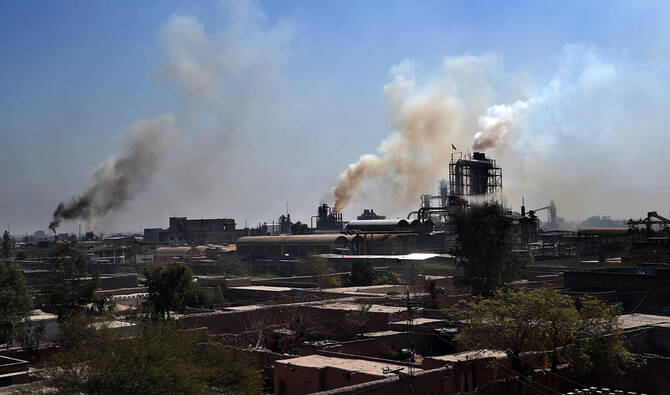
Smoke rises from factories on the outskirts of the north-western city of Peshawar on February 25, 2017. (AFP/File)
Short Url
Updated 13 October 2025
Follow

Pakistan says implementing national carbon market under German-funded climate initiative

  • Move marks shift from readiness to implementation phase under SPAR6C program
  • Initiative aims to strengthen carbon pricing, governance to attract global climate finance

ISLAMABAD: Pakistan has moved to the implementation phase of its national carbon market under a German-funded initiative, the climate ministry said on Monday, as the country seeks to strengthen its climate governance and attract international investment for low-carbon development.

The partnership, under the Supporting Preparedness for Article 6 Cooperation (SPAR6C) program funded by the German Federal Government, aims to help Pakistan transition from policy readiness to practical implementation of market-based climate mechanisms in line with global standards.

Carbon markets allow countries and companies to buy and sell credits that represent reductions in greenhouse gas emissions, creating a financial incentive to cut carbon output. Under Article 6 of the Paris Agreement, nations can trade these credits internationally to help meet their climate targets while funding low-carbon projects in developing countries.

Pakistan faces intensifying climate challenges, from record-breaking heatwaves and glacial melt to catastrophic flooding that has killed over a 1,000 people this monsoon season and displaced millions. Ranked among the world’s most climate-vulnerable nations, Pakistan has been under growing pressure to build resilient, transparent frameworks that can unlock global climate finance and support its transition to a sustainable economy.

“Carbon markets are not just about trading credits, they’re about valuing climate action fairly and ensuring that every ton reduced translates into real benefits for our people and our economy,” Federal Minister for Climate Change and Environmental Coordination Senator Dr. Musadik Malik said followed a meeting with Helene Paust, Deputy Head of Cooperation at the German Embassy in Islamabad, along with representatives from the Global Green Growth Institute (GGGI) and the UN Environment Programme Copenhagen Climate Center (UNEP-CCC).

Officials said the SPAR6C initiative will support Pakistan in developing transparent, high-integrity carbon pricing and trading systems, helping the country achieve its Nationally Determined Contributions (NDCs) under the Paris Agreement. 

The effort also seeks to mobilize new streams of climate finance, foster green innovation, and integrate Pakistan’s emissions reductions into international carbon markets.


Pakistan to begin first phase of Hajj 2026 trainings from today

Updated 31 December 2025
Follow

Pakistan to begin first phase of Hajj 2026 trainings from today

  • Training programs to be held in phases across Pakistan till February, says religion ministry
  • Saudi Arabia allocated Pakistan a total quota of 179,210 pilgrims for Hajj 2026

ISLAMABAD: Pakistan’s religious affairs ministry has said that it will begin the first phase of mandatory Hajj 2026 training for pilgrims intending to perform the pilgrimage from today, Thursday.

The one-day Hajj training programs will be held in phases across the country at the tehsil level until February. The ministry directed intending pilgrims to bring their original identity cards and the computerized receipt of their Hajj application to attend the training sessions.

“Pilgrims should attend the one-day training program according to their scheduled date,” Pakistan’s Ministry of Religious Affairs (MoRA) said in a statement.

The ministry said training schedules are being shared through the government’s Pak Hajj 2026 mobile application as well as via SMS. It added that details of the schedule are also available on its website.

According to the ministry, training programs will be held in Abbottabad on Jan. 2; Ghotki, Thatta and Kotli on Jan. 3; and Tando Muhammad Khan and Khairpur on Jan. 4.

Hajj training sessions will be held in Rawalakot, Badin and Naushahro Feroze on Jan. 5, while pilgrims in Fateh Jang, Dadu and Tharparkar will receive the training on Jan. 6.

The ministry said training programs will be conducted in Umerkot and Larkana on Jan. 7, followed by sessions in Mirpurkhas, Shahdadkot and Mansehra on Jan. 8.

Pakistan’s religious affairs ministry has previously said these trainings will be conducted by experienced trainers and scholars using multimedia.

It said the training has been made mandatory to ensure that intending pilgrims are fully aware of Hajj rituals and administrative procedures.

Saudi Arabia has allocated Pakistan a quota of 179,210 pilgrims for Hajj 2026, of which around 118,000 seats have been reserved under the government scheme, while the remainder will be allocated to private tour operators.

Under Pakistan’s Hajj scheme, the estimated cost of the government package ranges from Rs1,150,000 to Rs1,250,000 ($4,049.93 to $4,236), subject to final agreements with service providers.