

Pakistan police officer among 5 killed as authorities disperse pro-Palestinian march

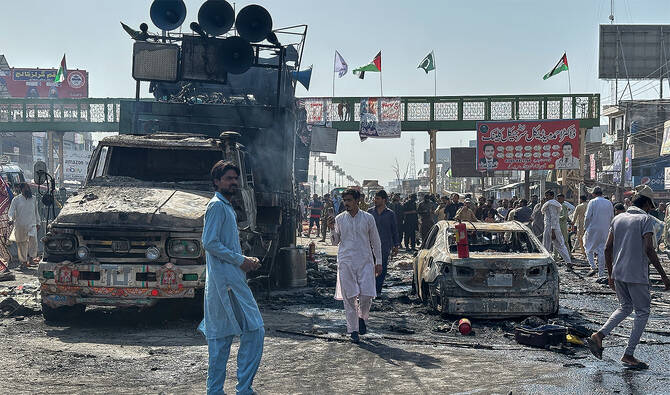
Local residents stand by burnt vehicles after police in Pakistan clashed with thousands of protesters during a march in support of Palestinians, in Muridke near Lahore, Pakistan, on October 13, 2025. (AP)
Short Url
Updated 13 October 2025
Follow

Pakistan police officer among 5 killed as authorities disperse pro-Palestinian march

  • Clashes erupted after protesters tried to remove police roadblocks on route to Islamabad, leaving dozens injured and vehicles torched
  • TLP party says its leader Saad Rizvi was among the wounded as police launched operation to disperse pro-Palestinian marchers

LAHORE, Pakistan: A clash between Pakistan authorities and thousands of protesters marching in support of Palestinians killed at least five people including a police officer and injured dozens of other officers on Monday, police and witnesses said.

Punjab Police Chief Usman Anwar said demonstrators opened fire on authorities, killing the officer and wounding others. Police said three protesters and one passerby also died in the clashes before the demonstrators were dispersed.

The march was organized by political party Tehreek-e-Labbaik Pakistan, or TLP, which said in a statement that hundreds of rally participants were injured and the casualty figure was high among its supporters.

Videos released by TLP on Monday showed several vehicles burning, including a truck carrying party officials who were leading what they have called the “long march,” which started in eastern Pakistan on Friday with demonstrators planning to march from Lahore toward the capital, Islamabad.

The march has resulted in violence between authorities and demonstrators. Police arrested more than 100 people during a protest on Saturday.

The latest clashes Monday began when protesters tried to remove shipping containers placed by police to block roads. Supporters clashed with police in Lahore and later camped in the nearby town of Muridke before resuming the march.

Before dawn Monday, TLP distributed a video of party chief Saad Rizvi urging security forces to stop firing and saying he was ready to negotiate. Gunfire could be heard in the background as Rizvi addressed supporters.

Rizvi was among the wounded Monday, TLP said. There was no information on his whereabouts and police said a search was underway to trace and arrest demonstrators and protest leaders who were hiding in nearby neighborhoods.

The demonstrators were determined to stage a pro-Palestinian rally outside the US Embassy in Islamabad and police came under fire when they launched an operation to disperse the crowd, according to Anwar, who said they were still assessing the damage.

The US Embassy issued a security alert last week ahead of the march, warning of possible disruptions and urging US citizens to exercise caution.

The TLP, known for staging disruptive and sometimes violent demonstrations, has drawn mixed reactions online. Some in Pakistan have accused the government of overreacting to the march by blocking major roads even before the protest began.

Pakistan Deputy Interior Minister Talal Chaudhry said over the weekend that he failed to understand why TLP opted for violence instead of celebrating peace in Gaza.

TLP gained prominence in Pakistan’s 2018 elections by campaigning on the single issue of defending the country’s blasphemy law, which calls for the death penalty for anyone who insults Islam. Since then, the party has staged violent rallies, mainly against desecration abroad of Islam’s holy book, Qur’an.

The party has held pro-Palestinian rallies in recent years in Lahore and other cities. This march was planned to travel toward the US embassy to express support for Palestinians.


Pakistan to launch AI screening in January to target fake visas, agent networks

Updated 5 sec ago
Follow

Pakistan to launch AI screening in January to target fake visas, agent networks

  • New system to flag forged-document travelers before boarding and pre-verify eligibility
  • Move comes amid increasing concern over fake visas, fraudulent agents, forged papers

ISLAMABAD: Pakistan will roll out an AI-based immigration screening system in Islamabad from January to detect forged documents and prevent illegal overseas travel, the government said on Thursday. 

The move comes amid increasing concern over fake visas, fraudulent agents and forged papers, with officials warning that such activity has contributed to deportations, human smuggling and reputational damage abroad. Pakistan has also faced scrutiny over irregular migration flows and labor-market vulnerability, particularly in the Gulf region, prompting calls for more reliable pre-departure checks and digital verification.

The reforms include plans to make the protector-stamp system — the clearance required for Pakistani citizens seeking overseas employment — “foolproof”, tighten labor-visa documentation, and cancel the passports of deportees to prevent them from securing visas again. The government has sought final recommendations within seven days, signalling a rapid enforcement timeline.

“To stop illegal immigration, an AI-based app pilot project is being launched in Islamabad from January,” Interior Minister Mohsin Naqvi said following a high-level meeting chaired by him and Minister for Overseas Pakistanis Chaudhry Salik Hussain.

Naqvi said the new screening technology is intended to determine travelers’ eligibility in advance, reducing airport off-loads and closing loopholes exploited by traffickers and unregistered agents.

The interior minister added that Pakistan remains in contact with foreign governments to improve the global perception and ranking of the green passport, while a uniform international driving license will be issued through the National Police Bureau.

The meeting also approved zero-tolerance measures against fraudulent visa brokers, while the Overseas Pakistanis Ministry pledged full cooperation to streamline the emigration workflow. Minister Hussain said transparency in the protector process has become a “basic requirement,” particularly for labor-migration cases.

Pakistan’s current immigration system has long struggled with document fraud, with repeated cases of passengers grounded at airports due to forged papers or agent-facilitated travel. The launch of an AI screening layer, if implemented effectively, could shift the burden from manual counters to pre-flight verification, allowing authorities to identify risk profiles before departure rather than after arrival abroad.

The reforms also come at a moment when labor mobility is tightening globally. Gulf states have begun demanding greater documentation assurance for imported labor, while European and Asian destinations have increased scrutiny following trafficking arrests and irregular-entry routes from South Asia. For Pakistan, preventing fraudulent departures is increasingly linked to protecting genuine workers, reducing deportation cycles and stabilizing the country’s overseas employment footprint.