

Pakistan police officer among 5 killed as authorities disperse pro-Palestinian march

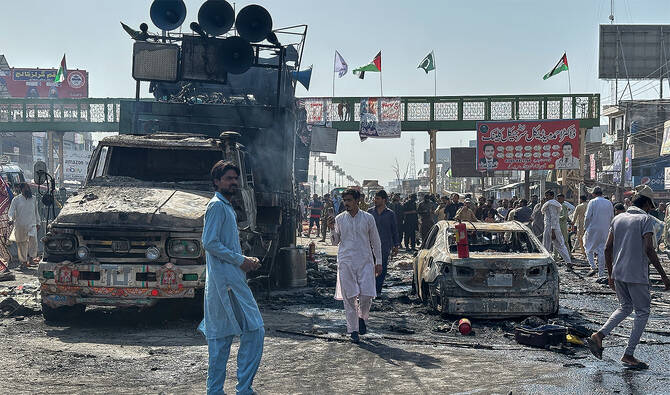
Local residents stand by burnt vehicles after police in Pakistan clashed with thousands of protesters during a march in support of Palestinians, in Muridke near Lahore, Pakistan, on October 13, 2025. (AP)
Short Url
Updated 13 October 2025
Follow

Pakistan police officer among 5 killed as authorities disperse pro-Palestinian march

  • Clashes erupted after protesters tried to remove police roadblocks on route to Islamabad, leaving dozens injured and vehicles torched
  • TLP party says its leader Saad Rizvi was among the wounded as police launched operation to disperse pro-Palestinian marchers

LAHORE, Pakistan: A clash between Pakistan authorities and thousands of protesters marching in support of Palestinians killed at least five people including a police officer and injured dozens of other officers on Monday, police and witnesses said.

Punjab Police Chief Usman Anwar said demonstrators opened fire on authorities, killing the officer and wounding others. Police said three protesters and one passerby also died in the clashes before the demonstrators were dispersed.

The march was organized by political party Tehreek-e-Labbaik Pakistan, or TLP, which said in a statement that hundreds of rally participants were injured and the casualty figure was high among its supporters.

Videos released by TLP on Monday showed several vehicles burning, including a truck carrying party officials who were leading what they have called the “long march,” which started in eastern Pakistan on Friday with demonstrators planning to march from Lahore toward the capital, Islamabad.

The march has resulted in violence between authorities and demonstrators. Police arrested more than 100 people during a protest on Saturday.

The latest clashes Monday began when protesters tried to remove shipping containers placed by police to block roads. Supporters clashed with police in Lahore and later camped in the nearby town of Muridke before resuming the march.

Before dawn Monday, TLP distributed a video of party chief Saad Rizvi urging security forces to stop firing and saying he was ready to negotiate. Gunfire could be heard in the background as Rizvi addressed supporters.

Rizvi was among the wounded Monday, TLP said. There was no information on his whereabouts and police said a search was underway to trace and arrest demonstrators and protest leaders who were hiding in nearby neighborhoods.

The demonstrators were determined to stage a pro-Palestinian rally outside the US Embassy in Islamabad and police came under fire when they launched an operation to disperse the crowd, according to Anwar, who said they were still assessing the damage.

The US Embassy issued a security alert last week ahead of the march, warning of possible disruptions and urging US citizens to exercise caution.

The TLP, known for staging disruptive and sometimes violent demonstrations, has drawn mixed reactions online. Some in Pakistan have accused the government of overreacting to the march by blocking major roads even before the protest began.

Pakistan Deputy Interior Minister Talal Chaudhry said over the weekend that he failed to understand why TLP opted for violence instead of celebrating peace in Gaza.

TLP gained prominence in Pakistan’s 2018 elections by campaigning on the single issue of defending the country’s blasphemy law, which calls for the death penalty for anyone who insults Islam. Since then, the party has staged violent rallies, mainly against desecration abroad of Islam’s holy book, Qur’an.

The party has held pro-Palestinian rallies in recent years in Lahore and other cities. This march was planned to travel toward the US embassy to express support for Palestinians.


Pakistan says defense pact with Saudi Arabia elevated brotherly ties to ‘new heights’

Updated 25 February 2026
Follow

Pakistan says defense pact with Saudi Arabia elevated brotherly ties to ‘new heights’

  • Pakistan, Saudi Arabia signed strategic defense pact last year pledging aggression against one will be treated as attack on both
  • Deputy PM Ishaq Dar says enduring bonds with Islamic and Arab nations form vital pillar of Pakistan’s foreign policy 

ISLAMABAD: Deputy Prime Minister Ishaq Dar said on Wednesday that Pakistan’s defense pact with Saudi Arabia elevated its brotherly ties with the Kingdom to “new heights,” stressing that close ties with Arab and Islamic nations form a key pillar of Islamabad’s foreign policy. 

Pakistan and Saudi Arabia signed a Strategic Mutual Defense Agreement on Sept. 17 last year, pledging that aggression against one country would be treated as an attack on both, enhancing joint deterrence and formalizing decades of military and security cooperation.

Both nations agreed in October 2025 to launch an economic cooperation framework to strengthen trade and investment ties. 

“In the Middle East, our landmark Strategic Mutual Defense Agreement with Saudi Arabia has elevated our brotherly ties to new heights,” Dar said while speaking at the Pakistan Governance Forum 2026 event in Islamabad. 

The Pakistani deputy prime minister was speaking on the topic “Navigating International Relations Amidst Changing Geo-Politics.”

Dar noted that Pakistan has reinforced partnerships with other Middle Eastern nations such as the UAE, Qatar, Jordan, Oman, Egypt and Bahrain. He said these partnerships have yielded “concrete agreements” in investment, agriculture, infrastructure, and energy sectors. 

“Our enduring bonds with Islamic and Arab nations form a vital pillar of our foreign policy, and we will continue to expand our partnerships across Asia, Latin America, and Africa,” he said. 

Dar pointed out that the presidents of Kazakhstan, Uzbekistan and Kyrgyzstan have undertaken visits to Pakistan in recent months, reflecting Central Asian nations’ desire to boost cooperation with Islamabad.

On South Asia, the Pakistani deputy PM said Pakistan has successfully transformed its fraternal ties with Bangladesh into “a substantive partnership.”

“Similarly, the trilateral mechanism involving China, Pakistan, and Bangladesh has been launched with a view to expanding and deepening regional cooperation and synergy,” the Pakistani minister said. 

He said Islamabad has strengthened its “all-weather” partnership with China via the second phase of the multi-billion-dollar China-Pakistan Economic Corridor agreement and “unwavering support” from both sides for each other’s core interests. 

Dar said Pakistan had also reinvigorated its partnership with the US, advancing cooperation in trade, technology, investment, and regional stability. 

“This calibrated approach has enhanced our ability to navigate complexity with skill and confidence, ensuring that our national interests are served without compromising our core foreign policy principles,” he said.