

Syrian Kurdish leader says reached first deal on merging forces with regular army

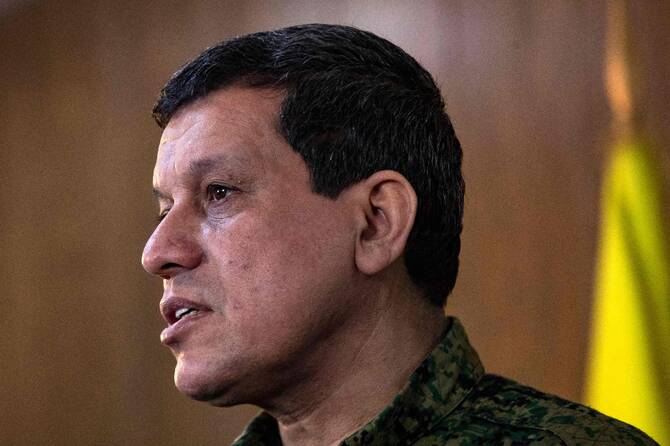
Syrian Democratic Forces (SDF) commander-in-chief Mazloum Abdi, speaks during a press conference in Syria's northeastern city of Hasakeh. (AFP)
Short Url
Updated 13 October 2025
Follow

Syrian Kurdish leader says reached first deal on merging forces with regular army

  • SDF leader Abdi said that military and security delegations from his forces are currently in Damascus to discuss the mechanism for their integration

HASAKEH: Syrian Kurdish leader Mazloum Abdi has announced to AFP that he had reached a “preliminary agreement” with Damascus on the integration of his troops into Syria’s military and security forces.
Abdi, who heads the powerful Syrian Democratic Forces (SDF), had met Syrian interim President Ahmed Al-Sharaa in Damascus last week, along with US envoy Tom Barrack and US commander Brad Cooper.
While the Kurdish forces — who control large swathes of Syria’s oil-rich northeast — had signed an agreement with the new Syrian authorities in March to merge their civil and military institutions, the deal’s terms were not implemented.
“What is new in our recent talks in Damascus is the shared determination and strong will to accelerate the implementation of the terms” of the agreement, Abdi told AFP in an interview at a military base in the northeastern city of Hasakah on Sunday.
“The most important point is having reached a preliminary agreement regarding the mechanism for integrating the SDF and the (Kurdish) Internal Security Forces within the framework of defense and interior ministries,” he added.
The Washington-backed SDF and Kurdish security forces consist of around 100,000 male and female members, according to them.
The SDF played a vital role in the fight against the Daesh group in Syria, which ultimately led to the jihadist organization’s territorial defeat in the country in 2019.
Abdi said that military and security delegations from his forces are currently in Damascus to discuss the mechanism for their integration.

- Disagreements -

After the fall of longtime leader Bashar Assad in December, Sharaa announced the dissolution of all armed groups, to be absorbed by state institutions.
Abdi explained that “the SDF will be restructured through its integration into the defense ministry,” as part of several formations.
However, some disagreements remain.
“We demand a decentralized system in Syria... we have not agreed on it,” he added, as they are “still discussing finding a common formula acceptable to all.”
He stressed that they “agree on the territorial integrity of Syria, the unity of national symbols, the independence of political decision-making in the country, and the fight against terrorism.”
“We all agree that Syria should not return to the era of war, and that there should be stability and security. I believe these factors are sufficient for us to reach a permanent agreement.”
During the last meeting with Sharaa, Abdi said he had called for “modifying or adding some clauses to the existing constitutional declaration” announced in March, particularly those related to “guaranteeing the rights of the Kurdish people in the constitution.”
“There was a positive response to this matter, and we hope this will happen soon,” he added.
Abdi also expressed his gratitude to the United States and France for facilitating negotiations with Damascus.
Asked about Damascus’s main backer Turkiye, which has always been hostile to the SDF, Abdi said “any success of the negotiations will certainly depend on Turkiye’s role,” expressing hope that it will play a “supportive and contributing role in the ongoing negotiation process.”
Turkish President Recep Tayyip Erdogan urged the SDF on Wednesday to “keep their word” and “complete their integration with Syria.”
When questioned on the region’s fossil fuel reserves, Abdi noted they “have not yet discussed the oil issue, but it will certainly be addressed in upcoming meetings.”
“Oil and other underground resources in northeastern Syria to belong to all Syrians, and their revenues and revenues must be distributed fairly across all Syrian provinces.”


’Blood oozing from corpses’ haunts escapees from Sudan’s El-Fasher

Updated 3 sec ago
Follow

’Blood oozing from corpses’ haunts escapees from Sudan’s El-Fasher

TINE: It took 16-year-old Mounir Abderahmane 11 days to reach the Tine refugee transit camp in Chad, crossing arid plains after fleeing the bloodshed in the Sudanese city of El-Fasher.
When the Rapid Support Forces (RSF) entered the city in late October, Abderahmane was at the Saudi hospital, watching over his father, a soldier in the regular army who had been wounded fighting the militia several days earlier.
“They summoned seven nurses and ushered them into a room. We heard gunshots and I saw blood seeping out for under the door,” he told AFP, his voice cracking with emotion.
Abderahmane fled the city the same day with his father, who died several days on the route westwards to Chad.
The RSF, locked in civil war with the army since April 2023, captured El-Fasher, the army’s last stronghold in the vast western Darfur region, on October 26 after an 18-month siege.
Both sides have been accused of atrocities.
The RSF traces its origins back to the Janjaweed, a largely Arab militia armed by the Sudanese government to kill mainly black African tribes in Darfur two decades ago.
Between 2003 and 2008, an estimated 300,000 people were slaughtered in those campaigns of ethnic cleansing and nearly 2.7 million were displaced.

- ‘Never look back’ -

At the Tine camp in eastern Chad — more than 300 kilometers (185 miles) from El-Fasher — escapees said drone attacks had intensified in the city on October 24, just before it fell to the RSF.
Locals crammed into makeshift shelters to escape the bombs, with only “peanut shells” for food, 53-year-old Hamid Souleymane Chogar said.
“Every time I went up to get some air, I saw new corpses in the street, often those of local people I knew,” he shuddered.
Chogar took advantage of a lull to flee in the night.
Crippled, he said, by the Janjaweed in 2011, he had to be hoisted onto a cart that zigzagged through the city between the debris and corpses.
They moved without speaking or lights to avoid detection.
When the headlights of an RSF vehicle swept the night, Mahamat Ahmat Abdelkerim, 53, dived into a nearby house with his wife and six children.
The seventh child had been killed by a drone days earlier.
“There were about 10 bodies in there, all civilians,” he said. “The blood was still oozing from their corpses.”
Mouna Mahamat Oumour, 42, was fleeing with her family when a shell struck the group.
“When I turned round, I saw my aunt’s body torn to pieces. We covered her with a cloth and kept going,” she said through tears.
“We walked on without ever looking back.”

- Extortion -

At the southern edge of the city, they saw corpses piled up in the huge trench the RSF had dug to surround it.
Samira Abdallah Bachir, 29, said she and her three young children had to climb down into the ditch to escape, negotiating the morass of bodies “so we wouldn’t step on them.”
Once past the trench, refugees had to negotiate checkpoints on the two main roads leading out of El-Fasher, where witnesses reported rape and theft.
At each roadblock, the fighters demanded cash — $800 to $1,600 — for safe passage.
The United Nations estimates nearly 90,000 have fled El-Fasher in the past two weeks, many going days without food.
“People are being relocated from Tine to reduce crowding and make room for new refugees,” said Ameni Rahmani, 42, of medical charity Doctors Without Borders (MSF).
The power struggle between the RSF and the army — in part to control Sudan’s gold and oil — has killed tens of thousands of people since April 2023, displaced nearly 12 million and triggered what the UN calls the world’s most extensive hunger crisis.