



FAISALABAD: Interloop Holdings, a Pakistani conglomerate that mainly supplies textile products to global sportswear giants, is expanding its footprint into the dairy sector with plans to export premium mozzarella cheese to the Gulf region through a Turkish joint venture (JV), the group’s chairman has said.
The conglomerate, best known globally for manufacturing socks and leggings for brands such as Nike, Adidas, Puma, Target, H&M, Marks & Spencer and Zara, operates large-scale textile and apparel units in Pakistan, China, Sri Lanka and Bangladesh. It now aims to diversify its portfolio and boost Pakistan’s non-textile exports through its dairy arm, IRC Dairy Products Ltd.
IRC and its Turkish JV Rella Gida are processing 120,000 liters of milk daily to produce Turkish mozzarella cheese and butter for clients in Pakistan, Eurasia and the Far East.
Interloop Holdings Chairman Musadaq Zulqarnain told Arab News in an interview he will travel to Turkiye this month to discuss with Rella Gida the prospects of starting exports to the Gulf Cooperation Council (GCC) market, which he says spends more than $2 billion on cheese and butter imports annually.
In 2024, GCC countries imported cheese and butter worth $2.3 billion, with Saudi imports alone amounting to $980 million, said Zulqarnain, whose IRC Dairy gets nearly 10 percent of its revenues from exports and plans to boost them.
“We would be producing about 7–8 percent of the cheese which the entire Gulf Cooperation [Council] countries import,” Zulqarnain told Arab News in an interview in the Pakistani city of Faisalabad, where the company’s multiple manufacturing units are based.
IRC Dairy, whose sales are projected to reach Rs10 billion ($36 million) this fiscal year through June, expects them to surge to Rs40 billion ($142 million) once its expansion plans materialize.
“We are going to triple its [IRC Dairy’s] capacity in the next three years,” Zulqarnain said.
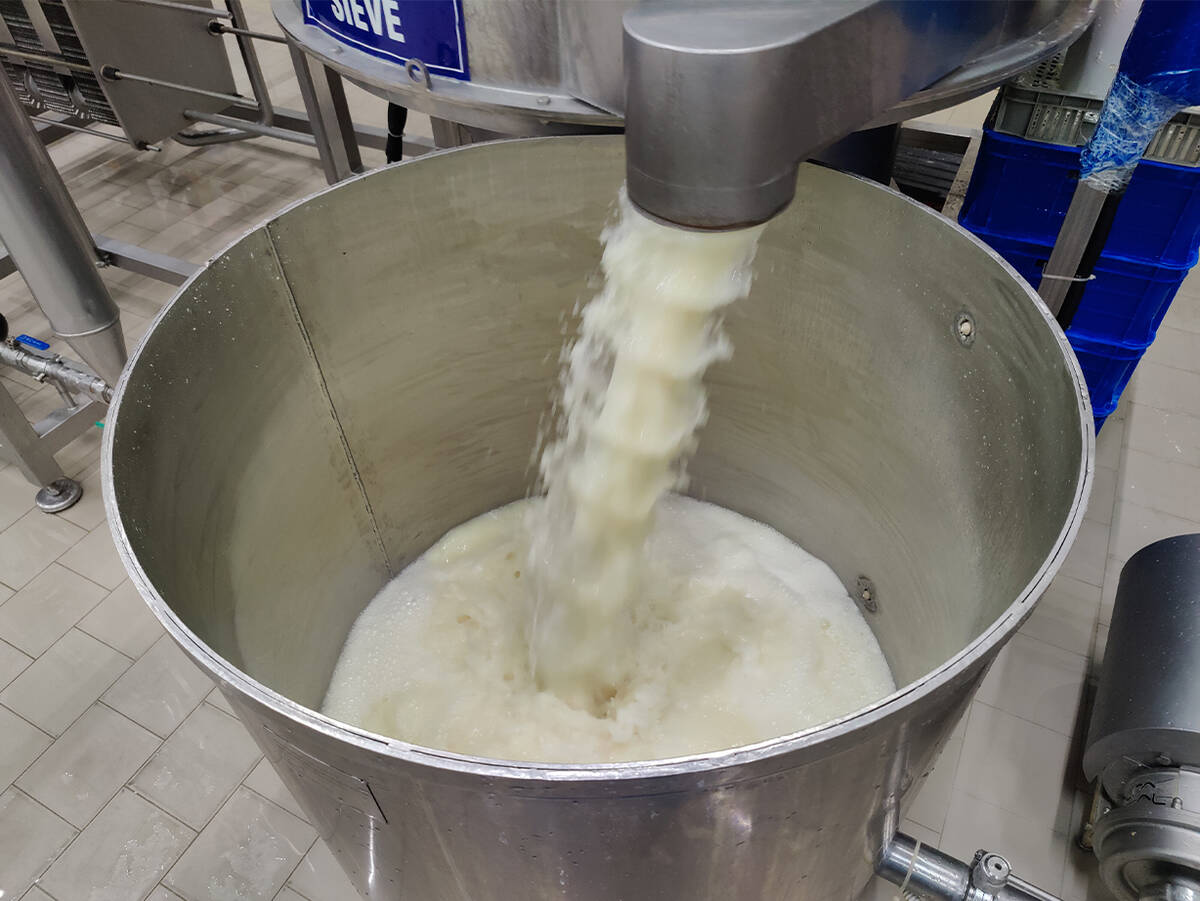
The picture taken on October 10, 2025, shows cheese being produced at an Interloop plant in Faisalabad, Pakistan. (AN photo)
IRC currently produces 6,000 tons of cheese, 1,000 tons of butter and 2,400 tons of whey powder annually, which it expects will surge to 21,000 tons, 3,500 tons, and 8,400 tons respectively by calendar year 2028.
“We have ambition that part of the cheese which we manufacture here… we would be exporting to the Gulf,” Zulqarnain said.
“We could even consider installing a plant in Saudi Arabia with a joint venture with any Saudi investor,” he added, emphasizing the Kingdom’s growing demand.
Interloop’s expansion into dairy exports is in line with the Pakistani government’s broader strategy to boost exports to revitalize the economy. Islamabad recently secured a tariff concession from the US, from 29 percent to 19 percent, aiming to improve export competitiveness.
To IRC Dairy CEO Matloob Hussain, Pakistan’s geographical proximity to the Gulf is a logistical advantage.
“The shipping lead time to reach the market from Pakistan is way lesser as compared to any other Western country,” Hussain, who has worked at Coca-Cola and Friesland Campina, told Arab News.
“It gives an advantage to us to reach the Middle Eastern market.”
EXPANDING INTO TECH AND LOGISTICS
Interloop Holdings is also diversifying into logistics and IT services, with a sister tech company already active in the United Arab Emirates (UAE) while it explores partnerships in Saudi Arabia.
“Our IT company is now already discussing partnerships in Saudi Arabia so that we can provide AI, cloud services, data centers and end-to-end software production,” said Zulqarnain, who is also eyeing apparel exports to Saudi Arabia, which accounts for half of the GCC’s $35 billion market.
His group now plans to raise funds through the Pakistani bourse to finance business expansion.
“You will see our dairy products company go to the stock exchange to raise funds,” he said.
CHALLENGES AND OUTLOOK
The announcement comes as Pakistan struggles with a widening trade deficit and sluggish exports.
Last month, the country’s exports dropped 12 percent year-on-year to $2.5 billion, while imports surged by 14 percent, widening the trade gap by 46 percent to $3.3 billion, according to the Pakistan Bureau of Statistics (PBS). The July–September quarterly trade gap widened 33 percent to $9.4 billion.
Pakistan’s food exports accounted for 23 percent of total exports and dropped 3 percent to $7.1 billion last year, according to the PBS.
Milk production rose 3 percent to 72 million tons, partly because of expansion in commercial dairy operations, according to the Economic Survey 2024–25. Pakistanis consumed 58.3 million tons of milk in the last fiscal year.
Asked about challenges, Zulqarnain pointed to persistent structural issues in Pakistan’s economy as the main hurdles.
“We have to bring our laws and our policies in line with other competitor countries,” he said, adding that Pakistan’s businesses needed competitive prices because of “higher” energy and labor costs.
This, coupled with global trade uncertainty created by US tariffs, is weighing on Interloop’s profits.
Zulqarnain also complained about the country’s taxation rate of as much as 40 percent.
“The taxation rate is very high in Pakistan because the government was unable to expand its tax net to the undocumented sector.”
Still, Zulqarnain sees his company expanding into the Gulf market once he finds “the right partners” there.
“I am very certain that with this increased defense cooperation between Pakistan and Saudi Arabia… there is a lot of scope in Saudi Arabia,” he added, referring to a landmark defense pact signed between the two nations last month, deepening decades of military and security cooperation.
Top Pakistani government officials, including National Food Security Minister Rana Tanveer, have said that following the defense agreement, Islamabad and Riyadh will now sign a wide-ranging economic pact as early as the end of October.



