

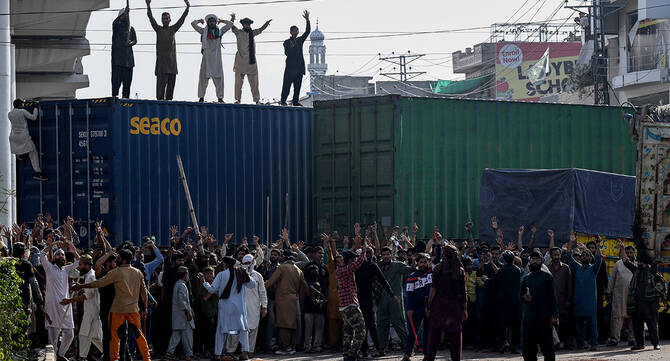

ISLAMABAD: Pakistan’s government on Sunday urged the religious-political Tehreek-e-Labbaik Pakistan (TLP) party to call off or postpone its protest march toward Islamabad, saying the country needed national unity as its military confronted heightened security challenges along the Afghan border.
The march, which began in the eastern city of Lahore earlier this week, has advanced to the town of Muridke, about 33 kilometers away, as TLP supporters vow to continue toward the capital. The group says it plans to stage a demonstration outside the US embassy to express solidarity with Palestinians.
On Sunday, authorities partially reopened key highways and restored mobile Internet in parts of Islamabad and the adjoining city of Rawalpindi after days of restrictions. However, several major intersections, including Faizabad, remained closed for a third consecutive day.
The TLP’s protest march is taking place amid an unprecedented escalation of hostilities between Pakistan and Afghanistan. Earlier in the week, Afghan authorities accused Pakistan of bombing the capital, Kabul, and a market in the country’s east. Pakistan did not claim responsibility for the assault. On Sunday, the Afghan Taliban said they had killed 58 Pakistani soldiers in overnight border operations in response to what it said were repeated violations of its territory and airspace. Pakistan’s army has confirmed 23 of its soldiers were killed and 29 wounded.
“At this critical time, when Pakistan is focused on safeguarding its borders and avenging the blood of its brave martyrs, the TLP should cancel or postpone its protest in the name of the martyrs,” Adviser to the Prime Minister on Political Affairs, Rana Sanaullah, told reporters in Islamabad.
He said the Gaza issue, which the march was meant to highlight, was already nearing diplomatic resolution, referring to a ceasefire between Israel and Hamas that held in Gaza for a third day on Sunday.
“This march should instead have been carried as an expression of solidarity with the government of Pakistan for its efforts [in securing Gaza peace] which are being recognized by the whole world,” Sanaullah said.
Defying the government’s appeal, TLP spokesperson Rehan Khan told Arab News the group would press on if talks with officials failed to reach a settlement.
“We would proceed with the march as planned if negotiations failed to produce any result,” he said.
He said the government had not made contact with TLP since talks were last held on Saturday.
“TLP is still waiting for the government to resume talks, but the lack of communication from them is extremely concerning,” Khan said. “Even before the start of the march, there was no contact made with TLP, and as soon as the dialogue process began, the party halted its march at Muridke.”
Khan said more than 15 of the group’s supporters had been killed and over 70 critically injured since the march began. The figures could not been independently verified, and both the federal and Punjab provincial governments have yet to comment on the reported casualties.
Police in Punjab province meanwhile say nearly 100 personnel were injured in clashes with TLP supporters as the group attempted to move toward the capital from Lahore and other cities.
Islamabad Police spokesperson Taqi Jawad told Arab News some roads in the capital had been reopened on Sunday while others remained closed for security reasons.
“A few roads have been fully reopened, while others remain partially open. Only key points are completely blocked,” he said.
The TLP, a religious political party founded in 2015, has gained notoriety for large-scale street demonstrations that often turn violent. It has staged several sit-ins in Islamabad since its rise to prominence, mobilizing tens of thousands of followers on issues related to the blasphemy laws and foreign policy.


