

Over 40 Pakistani universities rank among Times Higher Education 2026 rankings

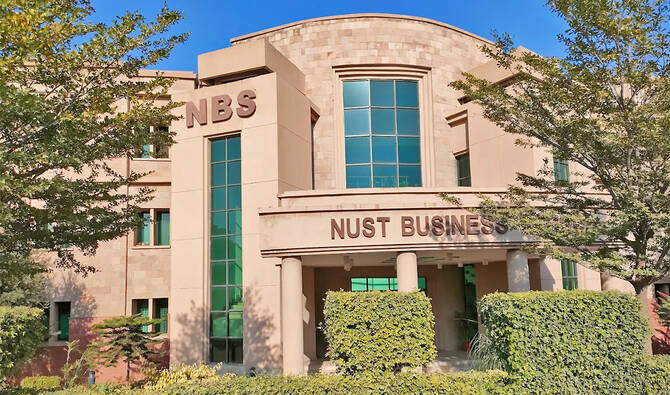
The picture taken on November 23, 2021, shows exterior view of NUST University in Islamabad, Pakistan. (Hassan Farooq)
Short Url
Updated 12 October 2025
Follow

Over 40 Pakistani universities rank among Times Higher Education 2026 rankings

  • The 2026 global university rankings feature 2,191 institutions from 115 countries and territories
  • Quaid-e-Azam University in Pakistani capital of Islamabad ranks among top 500 global institutions

ISLAMABAD: More than 40 Pakistani universities have made it to the Times Higher Education World University Rankings (THEWUR) 2026, it emerged this week, with Quaid-e-Azam University in Islamabad ranking among top 500 global institutions.

The THEWUR annually assesses universities on teaching, research, employability and sustainability. Ranking them enhances a university’s reputation and underscores its academic and global impact.

Pakistani universities that secured a spot in the 601–800 band included Bahauddin Zakariya University, Air University, COMSATS University Islamabad, Government College University Faisalabad, National University of Sciences and Technology, Sukkur IBA University, the University of Lahore and the University of Veterinary and Animal Sciences Lahore.

“We use 18 carefully calibrated performance indicators to provide the most comprehensive and balanced comparisons, trusted by students, academics, university leaders, industry and governments,” THEWUR said in a statement on Oct. 9.

The 2026 global university rankings feature 2,191 institutions from 115 countries and territories.

Fifteen Pakistani institutions, placed in the 801–1000 band, included Abdul Wali Khan University Mardan, Capital University of Science and Technology, Ghulam Ishaq Khan Institute of Engineering Sciences and Technology, Government College

University Lahore, International Islamic University Islamabad, Iqra University, Khwaja Fareed University of Engineering and Technology, Lahore University of Management Sciences, The Islamia University of Bahawalpur, University of Central Punjab, University of Engineering and Technology Taxila, University of Gujrat, University of Malakand, University of Management and Technology and the University of the Punjab.

Similarly, 10 Pakistani universities were ranked in the 1,001–1,200 band, including Bahria University, Hazara University Mansehra, Institute of Space Technology, PMAS Arid Agriculture University Rawalpindi, Riphah International University, University of Haripur, University of Education Lahore, University of Engineering and Technology Peshawar, University of Okara and the University of Peshawar. Another eight Pakistani institutions were placed in the 1,201–1,500 category, while six ranked in the 1,501+ band.


Pakistan’s OGDC ramps up unconventional gas plans

Updated 4 sec ago
Follow

Pakistan’s OGDC ramps up unconventional gas plans

  • Pakistan has long been viewed as having potential in tight and shale gas but commercial output has yet to be proved
  • OGDC says has tripled tight-gas study area to 4,500 square km after new seismic, reservoir analysis indicates potential

ISLAMABAD: Pakistan’s state-run Oil & Gas Development Company is planning a major expansion of unconventional gas developments from early next year, aiming to boost production and reduce reliance on imported liquefied natural gas.

Pakistan has long been viewed as having potential in both tight and shale gas, which are trapped in rock and can only be released with specialized drilling, but commercial output has yet to be proved.

Managing Director Ahmed Lak told Reuters that OGDC had tripled its tight-gas study area to 4,500 square kilometers (1,737 square miles) after new seismic and reservoir analysis indicated larger potential. Phase two of a technical evaluation will finish by end-January, followed by full development plans.

The renewed push comes after US President Donald Trump said Pakistan held “massive” oil reserves in July, a statement analysts said lacked credible geological evidence, but which prompted Islamabad to underscore that it is pursuing its own efforts to unlock unconventional resources.

“We started with 85 wells, but the footprint has expanded massively,” Lak said, adding that OGDC’s next five-year plan would look “drastically different.”

Early results point to a “significant” resource across parts of Sindh and Balochistan, where multiple reservoirs show tight-gas characteristics, he said.

SHALE PILOT RAMPS UP

OGDC is also fast-tracking its shale program, shifting from a single test well to a five- to six-well plan in 2026–27, with expected flows of 3–4 million standard cubic feet per day (mmcfd) per well.

If successful, the development could scale to hundreds or even more than 1,000 wells, Lak said.

He said shale alone could eventually add 600 mmcfd to 1 billion standard cubic feet per day of incremental supply, though partners would be needed if the pilot proves viable.

The company is open to partners “on a reciprocal basis,” potentially exchanging acreage abroad for participation in Pakistan, he said.

A 2015 US Energy Information Administration study estimated Pakistan had 9.1 billion barrels of technically recoverable shale oil, the largest such resource outside China and the United States.

A 2022 assessment found parts of the Indus Basin geologically comparable to North American shale plays, though analysts say commercial viability still hinges on better geomechanical data, expanded fracking capacity and water availability.

OGDC plans to begin drilling a deep-water offshore well in the Indus Basin, known as the Deepal prospect, in the fourth quarter of 2026, Lak said. In October, Turkiye’s TPAO with PPL and its consortium partners, including OGDC, were awarded a block for offshore exploration.

A combination of weak gas demand, rising solar uptake and a rigid LNG import schedule has created a surplus of gas that forced OGDC to curb output and pushed Pakistan to divert cargoes from Italy’s ENI and seek revised terms with Qatar.