


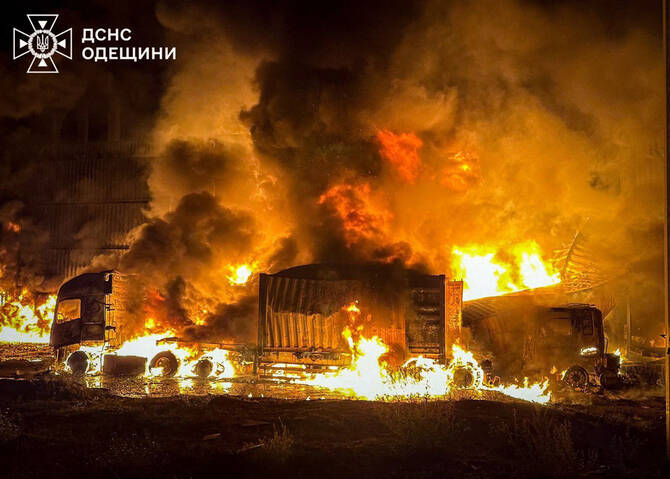

KYIV: Emergency crews restored power to many parts of Ukraine on Friday after a Russian drone and missile attack struck energy facilities, plunging large parts of Kyiv and other areas into darkness and cutting water supplies.
In the latest mass attack targeting the energy system as winter approaches, electricity was interrupted in nine regions and over a million households and businesses were temporarily without power across the country.
In southeastern Ukraine, a seven-year-old was killed when his home was hit and at least 20 people were injured.
Officials reported Russian attacks in different parts of the country throughout Friday. An official near the Russian border in Chernihiv region said one person was killed when a car belonging to the local energy utility was hit by a drone.
In Kyiv, an apartment block in the city center was damaged by a projectile, while on the left bank of the Dnipro that divides the capital, crowds waited at bus stops with the metro out of action. People filled water bottles at distribution points.
“We didn’t sleep at all,” said Liuba, a pensioner, as she collected water. “From 2:30 a.m. there was so much noise. By 3:30 we had no electricity, no gas, no water. Nothing.”
By evening, the private power company DTEK said electricity had been restored to all Kyiv residents. It said power had also been restored in areas outside the capital and in Dnipropetrovsk region in the southeast.
Ukraine’s energy ministry said more than 800,000 customers had at one point suffered power cuts in Kyiv.
Calls for air defenses
Ukrainians are bracing for a tough winter, as the full-scale war launched by Russia’s February 2022 invasion nears its fourth anniversary. Russia has intensified attacks on the energy system in recent weeks, striking power plants and gas production facilities, and local authorities are struggling with the scale of repairs.
“They can’t demonstrate anything real on the battlefield... so they will attack our energy sector,” President Volodymyr Zelensky told reporters in Kyiv.
Calling for more support from allies, he said that 203 main energy facilities in the country needed air-defense protection.
Energy Minister Svitlana Hrynchuk met G7 ambassadors and representatives of some of Ukraine’s biggest energy companies to discuss how allies could help protect the country against further attacks and repair the damage.
“The blow is strong, but it is definitely not fatal,” Zelensky said.
Speaking later in his nightly video address, Zelensky said Putin had deliberately launched the overnight attacks when world attention was focused on the “valuable opportunity” to move toward Middle East peace after the ceasefire agreement in Gaza.
“This marks a new record of Russian depravity, to intensify terrorist strikes and target civilian lives at such a moment,” he said.
Ukraine’s air force said it had downed 405 of 465 drones and 15 of 32 missiles in this attack. Ukraine’s stretched air defenses are no match for regular barrages on such a scale.
According to Zelensky, Russia deliberately waited for bad weather to attack and the inclement conditions reduced the efficiency of Ukraine’s air defenses by between 20 percent and 30 percent.
Russia said its overnight strikes were in response to Ukraine’s attacks on Russian civilian facilities.
Ukraine regularly launches drone strikes against Russia’s military and oil installations, although they are generally on a far smaller scale. Kyiv says it wants to force Moscow to negotiate a peace deal in good faith.
Commuters stranded
For many Kyiv residents, the day started with power cuts, disruptions in the water supply and transport delays.
“We had no power or water when I left my house. I can’t get to work because the subway is not operating and buses are overflowing,” Anatoliy, a 23-year-old student, told Reuters.
Prime Minister Yulia Svyrydenko said the assault was among the heaviest concentrated strikes on energy infrastructure and reported significant damage.
Her deputy, Oleksiy Kuleba, said two million customers in Kyiv temporarily faced problems with water supplies.
DTEK said its thermal power plants had suffered significant damage without providing details.


