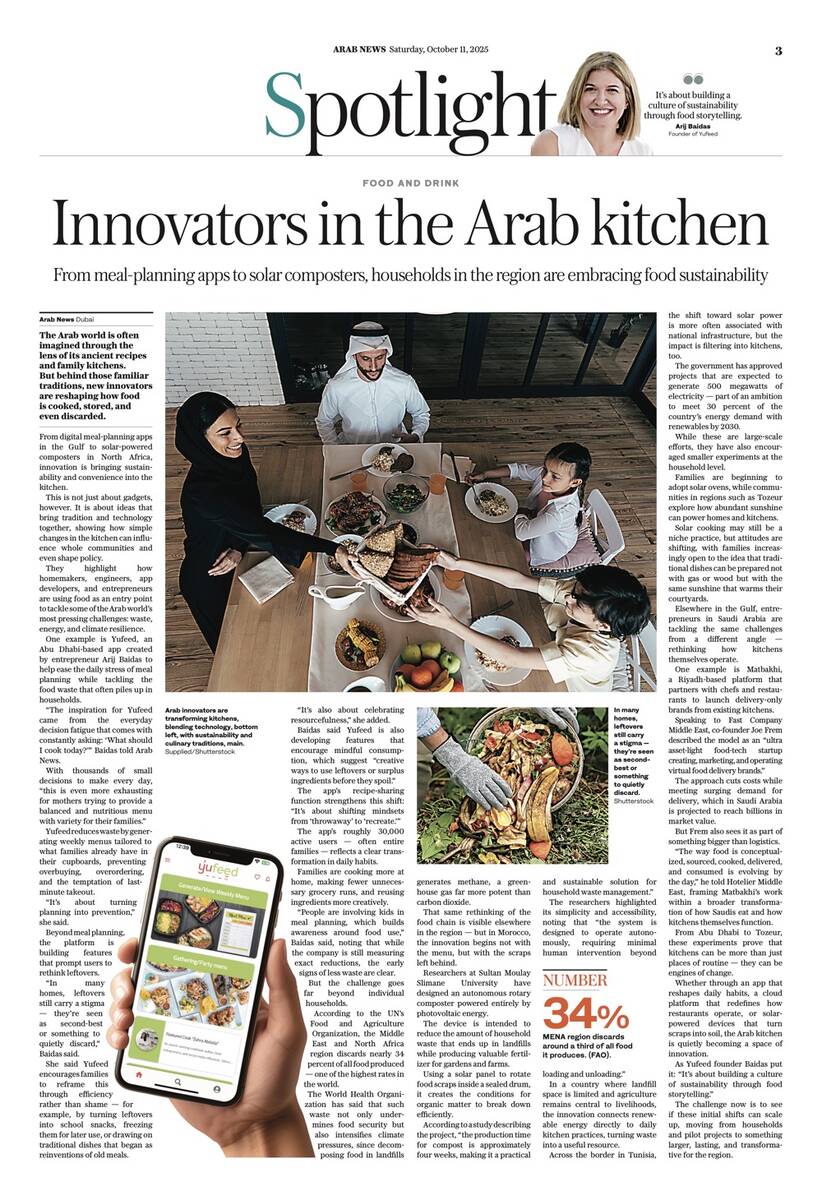
- From meal-planning apps to solar composters, households are joining the fight against food waste
- Arab innovations are shifting national attitudes and even shaping climate policies across the region
DUBAI: The Arab world is often imagined through the lens of its ancient recipes and family kitchens. But behind those familiar traditions, new innovators are reshaping how food is cooked, stored, and even discarded.
From digital meal-planning apps in the Gulf to solar-powered composters in North Africa, innovation is bringing sustainability and convenience into the kitchen.
This is not just about gadgets, however. It is about ideas that bring tradition and technology together, showing how simple changes in the kitchen can influence whole communities and even shape policy.
They highlight how homemakers, engineers, app developers, and entrepreneurs are using food as an entry point to tackle some of the Arab world’s most pressing challenges: waste, energy, and climate resilience.
One example is Yufeed, an Abu Dhabi-based app created by entrepreneur Arij Baidas to help ease the daily stress of meal planning while tackling the food waste that often piles up in households.
“The inspiration for Yufeed came from the everyday decision fatigue that comes with constantly asking: ‘What should I cook today?’” Baidas told Arab News.
With thousands of small decisions to make every day, “this is even more exhausting for mothers trying to provide a balanced and nutritious menu with variety for their families.”
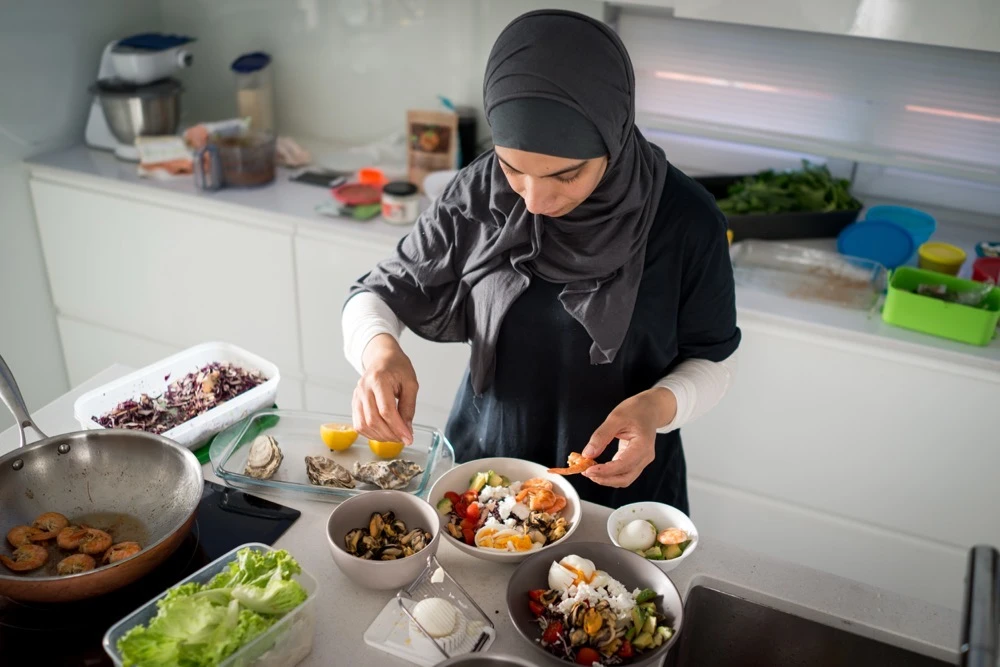
Yufeed reduces waste by generating weekly menus tailored to what families already have in their cupboards, preventing overbuying, overordering, and the temptation of last-minute takeout.
“It’s about turning planning into prevention,” she said.
Beyond meal planning, the platform is building features that prompt users to rethink leftovers.
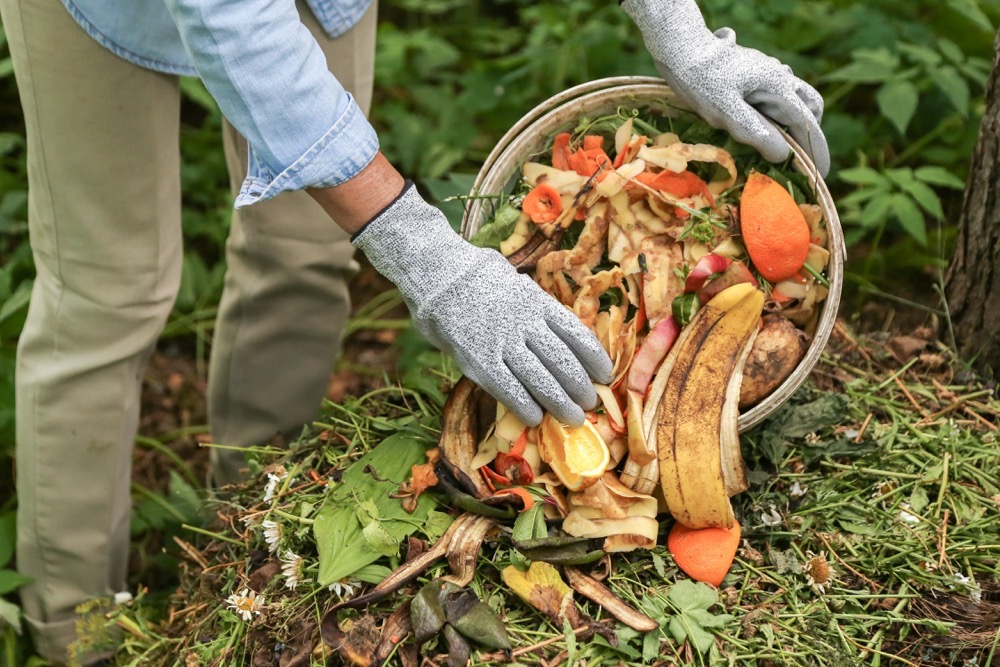
“In many homes, leftovers still carry a stigma — they’re seen as second-best or something to quietly discard,” Baidas said.
She said Yufeed encourages families to reframe this through efficiency rather than shame — for example, by turning leftovers into school snacks, freezing them for later use, or drawing on traditional dishes that began as reinventions of old meals.
“It’s also about celebrating resourcefulness,” she added.
Baidas said Yufeed is also developing features that encourage mindful consumption, which suggest “creative ways to use leftovers or surplus ingredients before they spoil.”
The app’s recipe-sharing function strengthens this shift: “It’s about shifting mindsets from ‘throwaway’ to ‘recreate.’”
The app’s roughly 30,000 active users — often entire families — reflects a clear transformation in daily habits.
Families are cooking more at home, making fewer unnecessary grocery runs, and reusing ingredients more creatively.
“People are involving kids in meal planning, which builds awareness around food use,” Baidas said, noting that while the company is still measuring exact reductions, the early signs of less waste are clear.
But the challenge goes far beyond individual households.
According to the UN’s Food and Agriculture Organization, the Middle East and North Africa region discards nearly 34 percent of all food produced — one of the highest rates in the world.
The World Health Organization has said that such waste not only undermines food security but also intensifies climate pressures, since decomposing food in landfills generates methane, a greenhouse gas far more potent than carbon dioxide.
That same rethinking of the food chain is visible elsewhere in the region — but in Morocco, the innovation begins not with the menu, but with the scraps left behind.
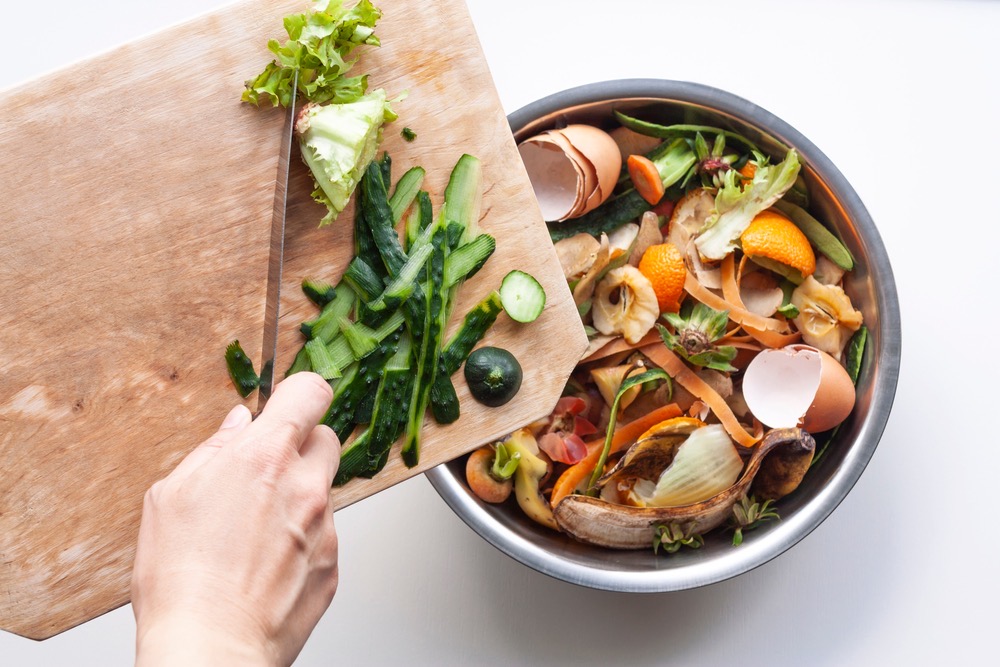
Researchers at Sultan Moulay Slimane University have designed an autonomous rotary composter powered entirely by photovoltaic energy.
The device is intended to reduce the amount of household waste that ends up in landfills while producing valuable fertilizer for gardens and farms.
Using a solar panel to rotate food scraps inside a sealed drum, it creates the conditions for organic matter to break down efficiently.
According to a study describing the project, “the production time for compost is approximately four weeks, making it a practical and sustainable solution for household waste management.”
The researchers highlighted its simplicity and accessibility, noting that “the system is designed to operate autonomously, requiring minimal human intervention beyond loading and unloading.”
In a country where landfill space is limited and agriculture remains central to livelihoods, the innovation connects renewable energy directly to daily kitchen practices, turning waste into a useful resource.
Across the border in Tunisia, the shift toward solar power is more often associated with national infrastructure, but the impact is filtering into kitchens, too.
The government has approved projects that are expected to generate 500 megawatts of electricity — part of an ambition to meet 30 percent of the country’s energy demand with renewables by 2030.
While these are large-scale efforts, they have also encouraged smaller experiments at the household level.
Families are beginning to adopt solar ovens, while communities in regions such as Tozeur explore how abundant sunshine can power homes and kitchens.
Solar cooking may still be a niche practice, but attitudes are shifting, with families increasingly open to the idea that traditional dishes can be prepared not with gas or wood but with the same sunshine that warms their courtyards.
Elsewhere in the Gulf, entrepreneurs in Saudi Arabia are tackling the same challenges from a different angle — rethinking how kitchens themselves operate.
One example is Matbakhi, a Riyadh-based platform that partners with chefs and restaurants to launch delivery-only brands from existing kitchens.
Speaking to Fast Company Middle East, co-founder Joe Frem described the model as an “ultra asset-light food-tech startup creating, marketing, and operating virtual food delivery brands.”
The approach cuts costs while meeting surging demand for delivery, which in Saudi Arabia is projected to reach billions in market value.
But Frem also sees it as part of something bigger than logistics.
“The way food is conceptualized, sourced, cooked, delivered, and consumed is evolving by the day,” he told Hotelier Middle East, framing Matbakhi’s work within a broader transformation of how Saudis eat and how kitchens themselves function.
From Abu Dhabi to Tozeur, these experiments prove that kitchens can be more than just places of routine — they can be engines of change.
Whether through an app that reshapes daily habits, a cloud platform that redefines how restaurants operate, or solar-powered devices that turn scraps into soil, the Arab kitchen is quietly becoming a space of innovation.
As Yufeed founder Baidas put it: “It’s about building a culture of sustainability through food storytelling.”
The challenge now is to see if these initial shifts can scale up, moving from households and pilot projects to something larger, lasting, and transformative for the region.