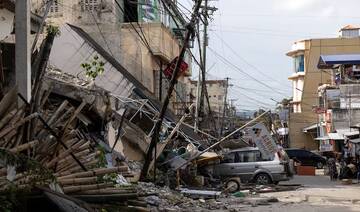
MANILA: A 7.4-magnitude earthquake Friday morning off the southern Philippines killed at least five people, set off landslides, damaged hospitals and schools and prompted evacuations of coastal areas nearby because of a tsunami warning, which was later lifted.
President Ferdinand Marcos Jr., facing his latest natural disaster after a recent deadly quake and back-to-back storms, said the potential damage was being assessed and rescue teams and relief operations were being prepared and would be deployed when it was safe to do so.
The Philippine Institute of Volcanology and Seismology said that it was expecting damage and aftershocks from the temblor, which was centered at sea about 43 kilometers (27 miles) east of Manay town in Davao Oriental province and was caused by movement in the Philippine Trench at a depth of 23 kilometers (14 miles).
At least five people were killed, including two patients who died of heart attacks at a hospital during the earthquake and a resident who was hit by debris in Mati city in Davao Oriental, Ednar Dayanghirang, regional director of the government’s Office of Civil Defense, told The Associated Press by telephone.
Two villagers died and several others were rescued with injuries by army troops and civilian volunteers in a landslide set off by the quake in a remote gold-mining village in Pantukan town in Davao de Oro province near Davao Oriental, Dayanghirang said.
Office of Civil Defense deputy administrator Bernardo Rafaelito Alejandro IV said that several buildings sustained cracks in their walls, including an international airport in Davao city, but it remained operational without any flights being canceled, Alejandro said.
“I was driving my car when it suddenly swayed and I saw power lines swaying wildly. People darted out of houses and buildings as the ground shook and electricity came off,” Jun Saavedra, a disaster mitigation officer of Governor Generoso town in Davao Oriental, told The Associated Press by cellphone.
“We’ve had earthquakes in the past, but this was the strongest,” Saavedra said, adding that the intense ground swaying caused cracks in several buildings, including a high school, where about 50 students were brought to a hospital by ambulance after sustaining bruises, fainting or becoming dizzy because of the quake.
Governor Generoso is a town about 100 kilometers (62 miles) south of Manay, where school classes in all levels were also suspended.
Children evacuated schools in Davao city, which has about 5.4 million people and is the biggest city near the epicenter, about 250 kilometers (155 miles) west of Davao Oriental province.
The Pacific Tsunami Warning Center in Honolulu said that small waves were detected on the coasts of the Philippines and Indonesia before the threat passed about two hours after the quake. It said that small sea fluctuations may continue.
A tsunami warning that set off evacuations in six coastal provinces near Davao Oriental was later lifted without any major waves being detected, chief government seismologist Teresito Bacolcol said.
Indonesia’s Meteorology, Climatology and Geophysics Agency said that small tsunami waves were detected in North Sulawesi province with heights ranging from 3.5 to 17 centimeters (1.3 to 6.7 inches) in Melonguane, Beo, Essang and Ganalo in Talaud Islands districts.
The Philippines is still recovering from a Sept. 30 earthquake with a 6.9 magnitude that left at least 74 people dead and displaced thousands of people in the central province of Cebu, particularly in Bogo city and outlying towns.
The archipelago also is lashed by about 20 typhoons and storms each year, making disaster response a major task of the government and volunteer groups.
Also Friday, an earthquake with a preliminary magnitude of 6.0 struck Friday off the coast of Papua New Guinea. The US Geological Survey said that it was centered in the Bismarck Sea 414 kilometers (257 miles) northeast of Lae, the South Pacific island nation’s second-most populous city.
Lae police official Mary Jane Huafilong said that no damage was reported.

Powerful earthquake off southern Philippines kills 5 people, causes damages and tsunami evacuations
https://arab.news/mfm5f
Powerful earthquake off southern Philippines kills 5 people, causes damages and tsunami evacuations
- At least five people were killed, including two patients who died of heart attacks at a hospital during the earthquake and a resident who was hit by debris in Mati city in Davao Oriental
- A tsunami warning that set off evacuations in six coastal provinces near Davao Oriental was later lifted without any major waves being detected, chief government seismologist Teresito Bacolcol said
Ahead of strikes, Trump was told Iran attack is high risk, high reward
- Experts caution that the unfolding conflict could take dangerous turns and the first official said the Pentagon’s planning did not appear to guarantee the outcome of any conflict
WASHINGTON: Ahead of the US attack on Iran, President Donald Trump received briefings that not only delivered blunt assessments about the risk of major US casualties but also touted the prospect of a geopolitical shift in the Middle East in favor of US interests, a US official told Reuters. The launch of what the Pentagon called Operation Epic Fury on Saturday plunged the Middle East into a new and unpredictable conflict. The US and Israeli militaries struck sites across Iran, triggering retaliatory Iranian attacks against Israel and nearby Gulf Arab countries.
The official, who spoke on condition of anonymity, said the briefers described the operation to the president as a high-risk, high-reward scenario that could present a once-in-a-generation opportunity for change in the region.
HIGHLIGHTS
• Trump briefings included risks, opportunities in Middle East
• Diplomatic efforts with Iran fail to avert military confrontation
• Iran vows retaliation, targets US and Israeli interests
Trump himself appeared to echo that sentiment when he acknowledged the stakes at the onset of the operation, saying “the lives of courageous American heroes may be lost.”
“But we’re doing this not for now, we’re doing this for the future, and it is a noble mission,” Trump said in a video address announcing the start of major combat operations.
“For 47 years, the Iranian regime has chanted death to America and waged an unending campaign of bloodshed and mass murder ... We’re not gonna put up with it any longer.”
The briefings from Trump’s national security team help explain how the president decided to pursue arguably the riskiest US military operation since the invasion of Iraq in 2003.
Ahead of the strikes, Trump received multiple briefings from officials, including CIA Director John Ratcliffe, US General Dan Caine, the chairman of the Joint Chiefs of Staff, US Secretary of State Marco Rubio and Defense Secretary Pete Hegseth.
On Thursday, Admiral Brad Cooper, who leads US forces in the Middle East as the head of Central Command, flew to Washington to join discussions in the White House Situation Room.
A second US official said that before the strikes, the White House had been briefed on risks associated with operations against Iran, including retaliatory strikes on multiple US bases in the region by Iranian missiles that could overwhelm defenses, as well as Iranian proxies attacking US troops in Iraq and Syria.
The official said that despite the massive military buildup by the United States, there were limits to the air defense systems that had been rushed into the region.
Experts caution that the unfolding conflict could take dangerous turns and the first official said the Pentagon’s planning did not appear to guarantee the outcome of any conflict.
Trump called on Iranians to topple the government but that is easier said than done, said Nicole Grajewski with the Carnegie Endowment for International Peace.
“The Iranian opposition is pretty fragmented. It’s unclear what the population is willing to do in terms of rising up,” Grajewski said.
Both US officials requested anonymity due to the sensitivity of the internal discussions.
The White House did not immediately respond to requests for comment. The Pentagon declined to comment.
TRUMP’S SWEEPING GOALS
In the weeks leading up to the attack, Trump ordered a major military buildup in the Middle East. Reuters reported military planning to carry out a sustained campaign against Iran, if that is what the president chose. Plans included targeting individual officials, officials said.
An Israeli official said Iran’s Supreme Leader Ayatollah Ali Khamenei and President Masoud Pezeshkian were both targeted but the result of the strikes was unclear. Speaking on Saturday, Israeli Prime Minister Benjamin Netanyahu said there were many signs indicating that Khamenei “is no longer” and called on Iranians to “take to the streets to finish the job.”
Trump made clear on Saturday that his objectives in Iran were sweeping, saying he would end the threat posed by Tehran to the United States and give Iranians a chance to topple their rulers. To accomplish this, he outlined plans to lay waste to much of Iran’s military as well as deny it the ability to build a nuclear weapon. Iran denies seeking a nuclear weapon.
“We are going to destroy their missiles and raze their missile industry to the ground... We’re going to annihilate their navy,” he said. “We’re going to ensure that the region’s terrorist proxies can no longer destabilize the region or the world and attack our forces.”
Trump’s decision demonstrates an increasing risk appetite, far greater than when he ordered US special operations forces into Venezuela last month to seize that country’s president in an audacious raid.
The unfolding campaign against Iran is also riskier than when Trump ordered US forces to bomb Iran’s nuclear sites in June.
Iran’s Revolutionary Guards threatened all US bases and interests in the region and said Iran’s retaliation would continue until “the enemy is decisively defeated.”
Experts warn that Iran has many options for retaliation, including missile strikes but also drones and cyber warfare.
Daniel Shapiro, a former senior Pentagon official for Middle East issues, said that despite the US and Israeli strikes, Tehran would still be capable of causing some pain.
“Iran has many more ballistic missiles that can reach US bases than the US has interceptors ... some Iranian weapons will get through,” said Shapiro, also a former US ambassador to Israel. “(The strikes are) a major gamble.”