

Pakistan faces worsening hunger crisis as floods devastate Punjab crops, Islamic Relief warns

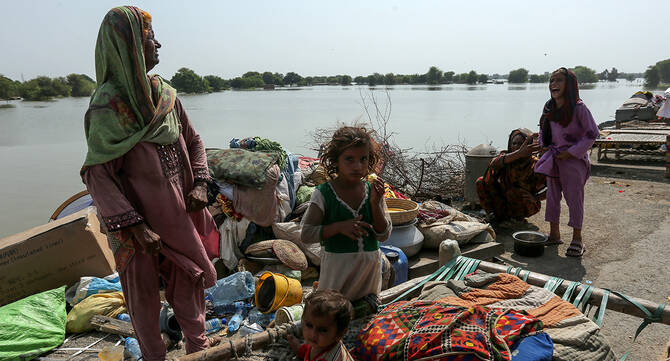
A flood-affected family gathers in a safer place near a closed motorway damaged by floodwater in Jalalpur Pirwala, in the Multan district of Punjab province on September 17, 2025, after the Chenab River overflowed following heavy monsoon rains. (AFP/ file)
Short Url
Updated 09 October 2025
Follow

Pakistan faces worsening hunger crisis as floods devastate Punjab crops, Islamic Relief warns

  • NGO says floods have destroyed up to 70 percent of Punjab’s farmland, threatening national food supplies
  • Over 4.5 million people affected across Pakistan, nearly 1,000 killed since monsoon season began in June 

ISLAMABAD: A hunger crisis is looming in Pakistan as catastrophic floods have wiped out vast stretches of farmland in Punjab province, which produces around half of the country’s staple crops, the aid agency Islamic Relief warned on Thursday.

The charity said the floods, which began in June, have inundated about 1.8 million acres of agricultural land across Punjab, affecting up to 70 percent of the province, and are likely to disrupt at least two crop cycles, raising fears of severe food shortages and surging prices nationwide.

Nationwide, over 1,000 people have been killed and more than 4.5 million people affected since the monsoon season began on June 26. Many farmers in Punjab have lost all their crops, grain stocks and livestock — their only source of income — while some remain in damaged or flooded homes to protect surviving cattle.

“Punjab province is the most important food-producing region in Pakistan, but 70 percent of it has been flooded and crops and livelihoods have been washed away. It will have an impact across Pakistan and national food shortages are now looming,” said Raza Narejo, acting country director of Islamic Relief Pakistan.

“Many people here depend on agriculture, but now they have almost nothing. They are now completely dependent on government and humanitarian support. They urgently need food, water and sanitation services, and when they can return to their homes they will need seeds, fertilizer and further support to re-establish their crops on their land once more,” Narejo added.

Islamic Relief said it has so far provided assistance to more than 140,000 flood-affected people across Pakistan, distributing food, water, tents and hygiene supplies, and helping farmers to replant through seeds and other agricultural support.

Abdul Rehman, a 55-year-old farmer from Muradabad in Punjab province, said the floods came at night and left his family destitute.

“The floods came at night and we had to run away in a hurry. We couldn’t grab anything to take with us because we were in fear. In the morning everything was destroyed,” he told Islamic Relief. “We had two goats and two sheep but they all drowned.”

Pakistan, among the world’s most climate-vulnerable countries, has seen repeated bouts of destructive monsoon flooding. 

In 2022, similar deluges killed more than 1,700 people and caused economic losses exceeding $30 billion, according to government and UN estimates.


Pakistan offers seaport for global cargo transshipment amid Gulf conflict escalation

Updated 12 sec ago
Follow

Pakistan offers seaport for global cargo transshipment amid Gulf conflict escalation

  • Karachi Port Trust says its services can ensure ‘continuity and stability’ of maritime trade
  • The region is currently witnessing significant disruptions to global trade and oil shipments

KARACHI: Pakistan has offered its Karachi seaport for uninterrupted global cargo transshipments as escalating Middle East tensions threaten maritime trade, the country’s largest port operator said on Friday.

Iran has been rocked by joint US and Israeli strikes since Feb. 28 that killed Supreme Leader Ayatollah Ali Khamenei. Tehran retaliated with missile and drone attacks on US, Israeli and allied targets across the Gulf, plunging the region into conflict and uncertainty.

The escalation disrupted air travel, heightened military activity, and disrupted shipping through the Strait of Hormuz, a key route carrying roughly 20 percent of global oil shipments.

The Karachi Port Trust (KPT) said in a statement it was ready to support international shipping lines by offering transshipment services to regional ports, helping ensure the “continuity and stability” of global maritime trade.

“Karachi Port Trust remains fully prepared to support the international maritime community and to provide reliable, efficient, and secure port services in the interest of sustaining regional trade connectivity,” KPT Chairman Shahid Ahmed said, according to a statement circulated by the port authority.

It added the facility could help stabilize maritime trade by offering transshipment services for cargo destined for ports across the region.

The statement said as a demonstration of its capability, international vessels MV TS TACOMA and MV TS SYDNEY arrived in Karachi and discharged large number of containers as transshipment cargo.

“The containers will subsequently be transshipped from Karachi to Jebel Ali in the Middle East,” it continued.

Pakistan Maritime Affairs Minister Junaid Anwar Chaudhry on Thursday highlighted the importance of the Gwadar port city’s transshipment role as major shipping routes face disruption from the ongoing conflict.

The developments come as the Strait of Hormuz, a strategic waterway between Iran and Oman and one of the world’s most critical oil transit routes, has been blocked by Iran which has threatened to attack ships that attempt to transit through it.

US President Donald Trump has assured shipping companies of naval escorts and insurance support to protect vessels.

The escalating tensions have contributed to a sharp rise in energy prices and significant disruptions to tanker traffic through the strategic waterway.

Pakistan has long viewed its seaports as strategic assets that could boost trade with Central Asia and the Gulf region, while helping the country earn valuable foreign exchange.