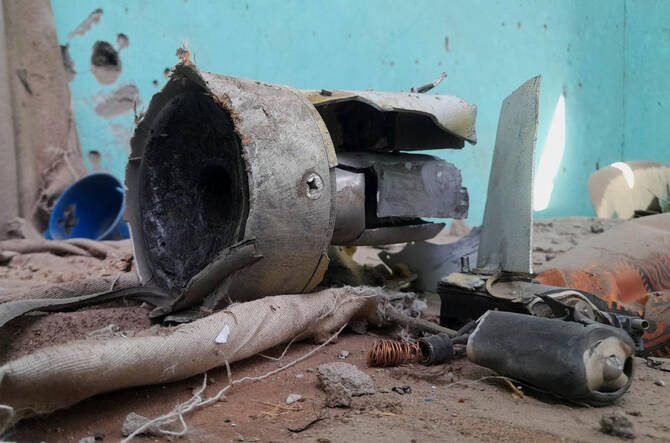
PORT SUDAN: An artillery attack by Sudan’s paramilitary Rapid Support Forces killed 13 people in a mosque where displaced families were sheltering in the besieged city of El-Fasher, two eyewitnesses told AFP on Thursday.
The strike on the mosque came from the north, both sources said on condition of anonymity, where the RSF has overrun the Abu Shouk displacement camp and set up positions in an attempt to wrest control of the city from the Sudanese army.
“After the shelling in the afternoon, we pulled 13 bodies from under the rubble and buried them,” one man who lives in the area said of the attack which occurred Wednesday.
A survivor of the strike said: “We were 70 families inside the mosque’s walls after the Rapid Support Forces entered our homes. Yesterday, artillery shells fell, killing 13 of us, wounding 20, and destroying part of the mosque.”
The RSF’s current assault on El-Fasher is its fiercest since war began with the army in April 2023.
The North Darfur state capital, besieged by the RSF since May of last year, is the last major city still under army control, though the territory controlled by the military and its allies has progressively shrunk.
The RSF has launched near-daily artillery and drone strikes and overrun the displacement camps surrounding the city, reportedly killing hundreds and extorting survivors for safe passage.
Millions displaced
Between Tuesday and Wednesday, 20 people were killed in RSF strikes on El-Fasher Hospital, one of the last functioning health facilities in the city.
Last month, at least 75 people were killed in a single drone strike on a mosque.
Across Sudan, the war has displaced millions and pushed nearly 25 million into acute hunger, creating what the United Nations says are the world’s largest hunger and displacement crises.
It has also killed tens of thousands of people, but there is no official toll, with most of the wounded unable to access hospitals and survivors forced to bury their dead wherever they can.
The RSF’s siege on El-Fasher has caused mass starvation in the city, where families have for months survived on animal feed, but even that has grown scarce and now costs hundreds of dollars per sack.
If the city falls to the paramilitaries, the RSF will be in control of the entire Darfur region, where they have sought to establish a rival administration.
The army holds the country’s north, center and east.

Sudan paramilitary strike on mosque kills 13 in El-Fasher: Eyewitnesses
https://arab.news/zesg9
Sudan paramilitary strike on mosque kills 13 in El-Fasher: Eyewitnesses
- Across Sudan, the war has displaced millions and pushed nearly 25 million into acute hunger
Lebanon warns Israeli violations threaten stability as UN peacekeepers enter final phase of mission
- UN envoy accuses Israel of jeopardizing ‘hard-won progress’ by undermining Lebanese sovereignty and territorial integrity through airstrikes and border violations
- He says Lebanon’s army commander has presented to ministers his second progress report on a plan to extend state authority country-wide and limit weapons to state control
NEW YORK CITY: Lebanon has warned that Israeli airstrikes and border violations risk undermining progress toward achieving stability in southern Lebanon, as the UN peacekeeping mission in the country begins preparations for its withdrawal.
Speaking before the UN General Assembly’s Fourth Committee, Lebanon’s permanent representative to the organization, Ahmad Arafa, welcomed the recent renewal of the UN Interim Force in Lebanon’s mandate under Security Council Resolution 2790. This authorized the extension of the force’s operations until Dec. 31, 2026, followed by an “orderly, safe and coordinated” drawdown within a year.
“The Lebanese Armed Forces have been working tirelessly to ensure full implementation of Resolution 1701,” Arafa said, referring to the 2006 resolution that ended the war that year between Israel and Hezbollah.
It calls for the disarmament of all militias in Lebanon, including Hezbollah. The US has consistently pressured Lebanese authorities to disarm the group, designating it a terrorist organization.
The November 2024 ceasefire deal with Israel also requires Lebanon to disarm Hezbollah and establish a state monopoly on arms. The agreement states that only state security forces should bear arms, which is interpreted by Israel and others as requiring the full disarmament of Hezbollah. The group insists it applies only to southern Lebanon.
Arafa said the commander of the Lebanese army has presented to the Council of Ministers his second progress report on a plan to extend state authority throughout the country and confine possession of weapons to legitimate state institutions.
However, he accused Israel of jeopardizing the “hard-won progress” that has been made, through what he described as ongoing violations of Lebanon’s sovereignty and territorial integrity, including airstrikes, the continued occupation of Lebanese territory, and the creation of “so-called buffer zones.”
UNIFIL spokesperson Dany Ghafri said last week that Israel had carried out more than 7,000 airspace violations since the cessation of hostilities in November last year, Arafa noted. UNIFIL has warned that the airstrikes breach Resolution 1701, “threaten the safety of civilians, and undermine progress toward a political and diplomatic solution,” he added
Lebanon also condemned Israeli attacks on UNIFIL personnel and positions, describing them as “a blatant violation of international law.”
Arafa expressed gratitude to the leadership of the UN force, and the countries that contribute troops, for their “dedication and sacrifice” since the mission was established in 1978. He called for the avoidance of any “security vacuum” during the upcoming transitional period, while maintaining stability and respect for Lebanon’s sovereignty.