

Mooney ton rescues Australia in stunning World Cup win over Pakistan

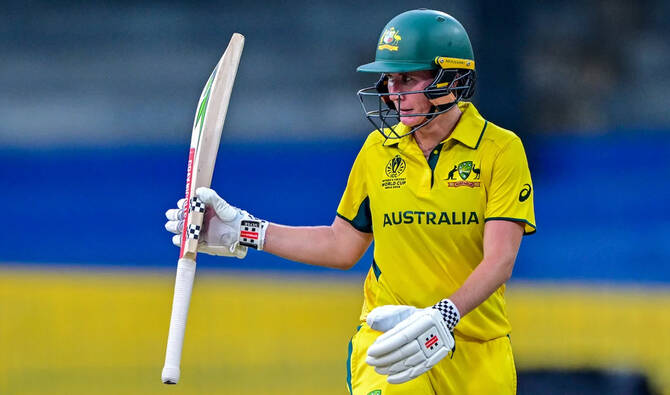
Australia’s Beth Mooney celebrates after scoring a fifty against Pakistan in a Women’s Cricket World Cup match in Colombo, Sri Lanka, on October 8, 2025. (AFP)
Short Url
Updated 08 October 2025
Follow

Mooney ton rescues Australia in stunning World Cup win over Pakistan

  • Mooney’s brilliant 109 and record ninth-wicket stand with King rescue Australia from 115-8 to 221-9 in Colombo
  • Pakistan crumble for 114 as Australia seal 107-run victory to return to the top of the Women’s World Cup table

COLOMBO: A superb century from Beth Mooney dragged defending champions Australia back from the brink of disaster before they completed a crushing 107-run win over Pakistan in a Women’s World Cup clash in Colombo on Wednesday.

The Aussies were staring down the barrel at 76-7 and then 115-8 after being asked to bat first with the Pakistan bowlers causing mayhem, left-arm spinner Nashra Sandhu finishing with 3-37 from her 10 overs.

But a record ninth-wicket stand between Mooney, who was dismissed off the final ball of the innings for 109, and Alana King, who made 51 not out, turned the tide.

The pair dragged their side from the doldrums to a competitive 221-9 and that proved plenty as Pakistan’s brittle batting folded meekly for 114 all out in 36.3 overs.

Sidra Amin was the only Pakistan batter to put up a fight with 35 while opening bowler Kim Garth, who used to compete for Ireland, was the pick of the Australian attack with 3-14.

In the end it was a comfortable win for the Australians but it hadn’t looked like that a little earlier.

After a top order collapse that left the dugout stunned, Australia needed a savior and up stepped the ever reliable Mooney.

The left-hander produced her fifth ODI hundred while King played the perfect foil, matching grit with gumption in a 106-run partnership off 97 balls that breathed new life into the innings.

It was not just a rescue act, it was record breaking. The partnership eclipsed Australia’s previous best for the ninth wicket — 77 between Garth and Ashleigh Gardner — and also set a new Women’s World Cup benchmark, surpassing South Africa’s 66-run effort by Yulandi van der Merwe and Kim Price back in 2000.

Mooney’s innings was a masterclass in temperament, a classic backs-to-the-wall knock. She farmed the strike smartly, ran fast between the wickets and only unfurled the big shots toward the end.

“It was a pretty tricky situation. We wanted to get a partnership going and really had to grind to reach 221,” said Mooney.

“Alana King was incredible tonight. We’ve seen her do it before and it was nice to share that stand with her.”

Having rebuilt brick by brick, Mooney brought up her century with a nudge to mid-on off Fatima Sana, while King capped her maiden fifty in style, hoisting the Pakistan captain for six as Australia plundered 21 runs off the final over.

Mooney’s 109 off 114 deliveries, laced with 11 boundaries, ended when she holed out to cover off the final ball of the innings.

King remained unbeaten on 51 off 49, peppered with three fours and as many sixes, the highest score ever made by a number 10 or lower in women’s ODIs.

Pakistan never found their footing in reply, undone by Australia’s relentless discipline with the ball.

The seven-time world champions climbed back to the top of the points table, while Pakistan’s third straight defeat leaves their knockout hopes hanging by a thread.


Pakistan joins regional talks on Afghanistan in Iran as Kabul stays away

Updated 15 December 2025
Follow

Pakistan joins regional talks on Afghanistan in Iran as Kabul stays away

  • China, Pakistan, Pakistan, Tajikistan, Uzbekistan, Turkmenistan all joined talks organized by Iran, as did Russia
  • Afghanistan was invited but decided not to attend, Taliban-led government was tight-lipped on the reasons

TEHRAN, Iran: Afghanistan’s neighbors met in Iran and agreed to deepen regional coordination to address political, economic and security challenges, as well as calling for sanctions on Afghanistan to be lifted. 

The only absent party? Afghanistan itself.

China, Pakistan, Pakistan, Tajikistan, Uzbekistan and Turkmenistan all joined the talks organized by Iran, as did Russia, according to a statement released after the meeting on Sunday.

Afghanistan was invited but decided not to attend. Its Taliban-led government was tight-lipped on the reasons, with the foreign ministry saying only that it would not participate because Afghanistan “currently maintains active engagement with regional countries through existing regional organizations and formats, and has made good progress in this regard.”

The statement from the talks in Iran stressed the importance of maintaining economic and trade ties with Afghanistan to improve living conditions and called for the country’s integration into regional political and economic processes.

The Taliban were isolated after they retook power in Afghanistan in August 2021, but in the past year, they have developed diplomatic ties. They now raise several billion dollars every year in tax revenues to keep the lights on.

However, Afghanistan is still struggling economically. Millions rely on aid for survival, and the struggling economy has been further impacted by the international community not recognizing the Taliban government’s seizure of power in the wake of the chaotic withdrawal of US-led troops in 2021. Natural disasters and the flow of Afghans fleeing Pakistan under pressure to return home have underlined Afghanistan’s reliance on foreign aid to meet essential needs.

The countries at the talks also voiced security concerns and pledged cooperation in combating terrorism, drug trafficking and human smuggling, while opposing any foreign military presence in Afghanistan. They underscored the responsibility of the international community to lift sanctions and release Afghanistan’s frozen assets, and urged international organizations to support the dignified return of Afghan refugees from neighboring countries.

The participants backed efforts to reduce tensions between Afghanistan and Pakistan, which have been particularly strained, with border clashes between the two sides killing dozens of civilians, soldiers and suspected militants and wounding hundreds more.

The violence followed explosions in Kabul on Oct. 9 that Afghan authorities blamed on Pakistan. A Qatar-mediated ceasefire has largely held since October, although there have been limited border clashes. The two sides failed to reach an overall agreement in November despite three rounds of peace talks.

Asif Durrani, Pakistan’s former special representative for Afghanistan, said the Taliban government’s decision to skip the meeting reflected a “lack of political maturity.” 

Writing on X, Durrani said the move reinforced concerns that the Taliban were unwilling to negotiate, instead adopting an “I don’t accept” stance that he said would do little to resolve serious regional problems.

Mohammad Sadiq, the current Pakistani special representative for Afghanistan who attended the talks, wrote on X that the Afghan people had already suffered enough and deserved better.

Only an Afghanistan that does not harbor militants would inspire confidence among neighboring and regional countries to engage meaningfully with Kabul and help unlock the country’s economic and connectivity potential, he wrote.

Participants agreed to hold the next meeting of foreign ministers of Afghanistan’s neighboring countries as soon as possible in Ashgabat, Turkmenistan, and welcomed Pakistan’s offer to host the next round of special envoys’ talks in Islamabad in March.

Iran’s foreign ministry spokesman, Esmail Baghaei, on Sunday said that the meeting had not been held for about two years and marked the first such gathering attended by special envoys on Afghanistan from neighboring countries as well as Russia. Russia and Uzbekistan sent the special envoys of their presidents, while Pakistan was represented by a delegate from the prime minister’s office.

Landlocked Afghanistan is sandwiched between the Middle East, Central Asia, and South Asia, making it strategically located for energy-rich and energy-hungry nations.