Putin lands in Tajikistan to shore up Russia’s regional influence

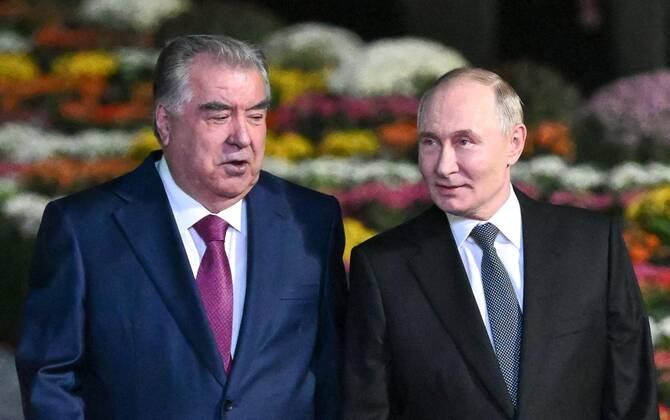
Russia’s President Vladimir Putin walks with his Tajik counterpart Emomali Rakhmon upon the Russian leader’s arrival at the airport in Dushanbe. (Kristina Kormilitsyna / AFP)
Short Url
Updated 08 October 2025
Follow

Putin lands in Tajikistan to shore up Russia’s regional influence

  • Putin will meet on Thursday with the heads of Central Asia’s five ex-Soviet states
  • He is accompanied by the Russian Defense Minister Andrey Belousov

MOSCOW: Russian President Vladimir Putin touched down Wednesday in Tajikistan for a three-day visit dominated by talks with the leaders of a region where Moscow’s historic dominance is under threat.
The Kremlin strongman is set to meet on Thursday with the heads of Central Asia’s five ex-Soviet states where China and Europe have been vying for influence in Russia’s backyard.
Tajik leader Emomali Rakhmon welcomed Putin on arrival in the capital Dushanbe, according to images broadcast on Russian television.
Putin is accompanied by his Defense Minister Andrey Belousov, who visited a Russian military base in the country Wednesday.
Kremlin spokesman Dmitri Peskov told Russian news agencies that Putin is also set to meet Azerbaijan’s President Ilham Aliyev on Thursday, following months of frostiness in Moscow-Baku relations.
Russia has attempted to maintain its grip on Central Asia through deals on energy, including gas deliveries and the building of nuclear reactors.
Though Moscow denies the existence of any tensions with China, Beijing has seen its presence in the region wax, while the European Union has made overtures to Central Asia’s leaders.
This year has seen two regional summits, with the EU in April followed by one with China in June, after a similar meeting with Turkiye in 2024.


US judge rejects Trump administration’s halt of wind energy permits

Updated 5 sec ago
Follow

US judge rejects Trump administration’s halt of wind energy permits

  • 17 Democratic-led states challenged the suspension
  • Offshore wind group supports ruling for economic and energy priorities
BOSTON: A federal judge on Monday struck down an order by US President Donald Trump’s administration to halt all federal approvals for new wind energy projects, saying that agencies’ efforts to implement his directive were unlawful and arbitrary.
Agencies including the US Departments of the Interior and Commerce and the Environmental Protection Agency have been implementing a directive to halt all new approvals needed for both onshore and offshore wind projects pending a review of leasing and permitting practices.
Siding with a group of 17 Democratic-led states and the District of Columbia, US District Judge Patti Saris in Boston said those agencies had failed to provide reasoned explanations for the actions they took to carry out the directive Trump issued on his first day back in office on January 20.
They could not lawfully under the Administrative Procedure Act indefinitely decline to review applications for permits, added Saris, who was appointed by Democratic President Bill Clinton.
New York Attorney General Letitia James, a Democrat whose state led the legal challenge, called the ruling “a big victory in our fight to keep tackling the climate crisis” in a social media post.
White House spokeswoman Taylor Rogers said in a statement that Trump through his order had “unleashed America’s energy dominance to protect our economic and national security.”
Trump has sought to boost government support for fossil fuels and maximize output in the United States, the world’s top oil and gas producer, after campaigning for the presidency on the refrain of “drill, baby, drill.”
The states, led by New York, sued in May, after the Interior Department ordered Norway’s Equinor to halt construction on its Empire Wind offshore wind project off the coast of New York.
While the administration allowed work on Empire Wind to resume, the states say the broader pause on permitting and leasing continues to have harmful economic effects.
The states said the agencies implementing Trump’s order never said why they were abruptly changing longstanding policy supporting wind energy development.
Saris agreed, saying the policy “constitutes a change of course from decades of agencies issuing (or denying) permits related to wind energy projects.”
The defendants “candidly concede that the sole factor they considered in deciding to stop issuing permits was the President’s direction to do so,” Saris wrote.
An offshore wind energy trade group welcomed the ruling.
“Overturning the unlawful blanket halt to offshore wind permitting activities is needed to achieve our nation’s energy and economic priorities of bringing more power online quickly, improving grid reliability, and driving billions of new American steel manufacturing and shipbuilding investments,” Oceantic Network CEO Liz Burdock said in a statement.