

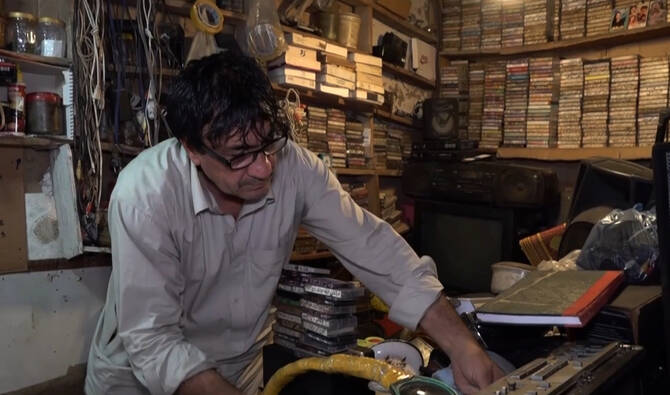

PESHAWAR: A faint Pashto melody drifts through the dense alleyways of Board Bazaar in the northwestern Pakistani city of Peshawar, growing clearer as one leaves behind the clatter of shopkeepers and motorbikes.
At the far end of a narrow five-foot lane in this neighborhood long known as Mini Kabul, the song becomes distinct: Afghan folk tales echoing from an old cassette player inside a mud-brick shop with wooden gates flung wide.
Inside, shelves are stacked with hundreds of cassette tapes, some cracked, others faded, alongside battered televisions and radios that fill every corner. Bent over an old radio under the glow of a small lamp is Muhammad Hassan, known locally as Azmari, or “tiger” in Pashto. The 50-year-old Afghan refugee has spent thirty-five years collecting and repairing what may be one of Pakistan’s largest archives of Afghan folk music.
In the small shop he rents, Hassan has preserved around 2,000 master cassettes featuring legendary Afghan musicians like Shah Wali, Nawab, Munawar, Said Alam, many of whom are no longer alive.
“All these cassettes are of Afghans [musicians],” he said as he carefully adjusted a stack of cassettes at his shop earlier this month. “They are Afghan folk music.”
His devotion to the collection has turned the shop into an informal archive of Afghan cultural memory — a treasure now at risk as Pakistan presses ahead with its most aggressive deportation campaign in decades.
The government began expelling undocumented foreigners in November 2023, after ordering all Afghans without valid documents to leave by October 31 that year. The UN estimates more than 800,000 Afghans have since returned to Taliban-ruled Afghanistan, many under duress.
Thousands more remain in limbo, fearing detention or forcible repatriation as Pakistan widens the crackdown in 2025.
For Hassan, deportation would mean the loss not only of his livelihood but of his life’s work.
“A lot of people tell me not to abandon this work and not to sell it,” he said. “I have a passion for it myself. If I were to sell it, I would have done it before, as some people came from Jalalabad [Afghanistan] to purchase it.”
When the Taliban seized Kabul in August 2021, they swiftly banned music, calling it un-Islamic.
For Hassan, that decree turned his passion into potential evidence. The cassettes he treasures could be used against him under Taliban rule where he to return to Afghanistan with them:
“If I take all these cassettes to Afghanistan, they [the Taliban] will burn or destroy them and there is a threat to my life as well.”
Asked what he would do if forced to leave Pakistan, Hassan looked down at the radios and reels surrounding him.
“I don’t know what I will do,” he said, his voice trailing. “I am not going to sell them even if I am forced to go to Afghanistan. I will see, I have some friends in Pakistan and I will keep these cassettes with them.”
“THESE SONGS WILL REMAIN”
Hassan’s story, like that of millions of Afghans in Pakistan, began in exile.
He came to Pakistan in the early 1980s, when military ruler General Zia-ul-Haq’s government opened the border to millions of Afghans escaping the Soviet invasion of their homeland. He apprenticed under his uncle for three years to learn radio repair, but his life changed when a local merchant decided to sell off his entire cassette inventory before emigrating to Iran.
“A person who was in the cassette business had decided to go to Iran. He asked us to buy his cassettes,” Hassan recalled. “We didn’t have much money to buy them but thought it was a profitable business.”
That decision set him on a lifelong mission. Through the 1990s, Board Bazaar thrived as a hub for Afghan music, films, and trade and Hassan made a steady living from his cassettes.
“By God, I didn’t do anything great in my life but just managed my household expenses through this business for 35 years,” he said softly. “May god not be upset with us, but this is how we spent our life, whether you call it good or bad.”
Though modern technology and mobile phones have rendered the cassette business obsolete, Hassan still attracts loyal customers, mostly Afghan men in their fifties and sixties, who come to copy music onto tape. He charges around 250 rupees per recording.
Among them is Sher Ali, a 60-year-old refugee from Jalalabad now living in Nowshera, who has ordered a dozen cassettes.
“I come at least once a month to pay salam and copy some cassette recordings from him [Azmari],” Sher Ali said. “If he is not present in the shop, I really get upset and return home sadly from Board Bazaar.”
For Hassan, such devotion affirms the worth of his work, even as time and politics conspire against it.
“We have spent our lives in this,” he said, glancing at the wall of tapes that define his existence. “Whatever happens next, these songs will remain.”


