Madagascar protesters reject president’s offer of talks

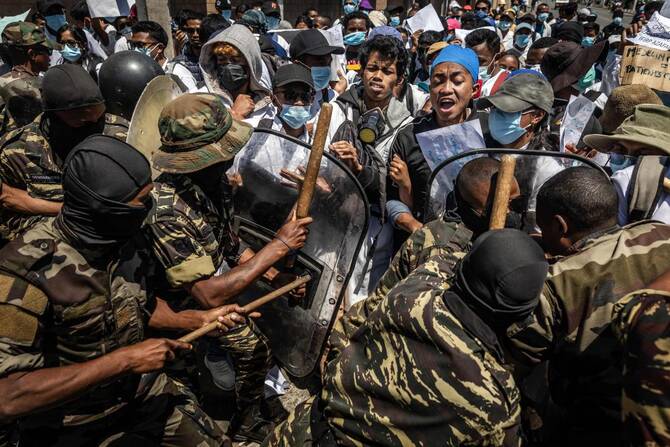
Medical students react as they are pushed with shields and clubs by Malagasy security forces during a demonstration in Antananarivo on Oct. 7, 2025. (AFP)
Short Url
Updated 08 October 2025
Follow

Madagascar protesters reject president’s offer of talks

  • Demonstrations sparked by water and power shortages
  • Threat of national strike looms after ultimatum by protesters

ANTANANARIVO: Youth protesters in Madagascar on Wednesday rejected an offer to join President Andry Rajoelina’s “national dialogue” with various groups, accusing his government of repression after weeks of demonstrations in the African island nation.
Inspired by similar “Gen Z” movements in Kenya and Nepal, the protests that started on September 25 pose the biggest challenge to Rajoelina’s government since his re-election in 2023, giving voice to widespread discontent over rampant poverty and high-level corruption.
Rajoelina fired his cabinet last week in a bid to quell the unrest, appointing a new prime minister and announcing plans for a national dialogue due to commence on Wednesday afternoon. He said the talks would be attended by spiritual leaders, students, youth representatives, and others.
But the moves have failed to ease public anger, and the so-called Gen Z movement said they would not hold talks with the government as long as authorities respond to their demonstrations with force.
“We reject this mockery of dialogue,” the protesters said in the statement posted on their verified Facebook page.
“We refuse the president’s invitation to talks. We will not engage in dialogue with a regime that represses, assaults, and humiliates its youth in the streets.”
University students were expected to take to the streets again on Wednesday following a 48-hour ultimatum issued by the protesters on Monday night for Rajoelina to agree to their demands or face a national strike.
Although the demonstrations were initially sparked by water and electricity shortages, demands have now expanded to include calls for Rajoelina to leave office, apologize to the nation, and dissolve the senate and the election commission.
At least 22 people have been killed while 100 others have been injured in the unrest, according to the United Nations. The government has rejected those figures, without offering any of its own.
Late on Tuesday Rajoelina appointed new ministers for defense and public security and asked them to restore public order.
“Do not tolerate the incitement of unrest,” he said, without elaborating further on possible measures.
Madagascar’s protests are taking place at a vulnerable time for its export-reliant economy. While the country is best known for producing most of the world’s vanilla, other exports, including of nickel, cobalt, textiles and shrimp – are also vital to foreign earnings and employment.
The country’s per capita GDP plunged by 45 percent between 1960 and 2020, according to the World Bank.


Modi starts Mideast-Africa tour as India-Oman free-trade pact nears completion

Updated 6 sec ago
Follow

Modi starts Mideast-Africa tour as India-Oman free-trade pact nears completion

  • Oman’s Shoura Council approved the trade deal’s draft last week
  • Modi begins trip in Amman, heading to Addis Ababa and Muscat

NEW DELHI: Prime Minister Narendra Modi left New Delhi on Monday for a tour covering Jordan, Oman and Ethiopia, as his government looks to strengthen partnerships with West Asia and Africa and finalize a free-trade deal with Muscat.

Modi’s four-day trip will start in Amman, at the invitation of King Abdullah.

“I am sure this visit will boost bilateral linkages between our nations,” Modi said on social media upon his arrival in Jordan, where he was received by Prime Minister Jafar Hassan.

On Tuesday, he is scheduled to arrive in Addis Ababa for his first state visit to Ethiopia. A day later, he will be in Muscat, where the Shoura Council last week approved the draft Comprehensive Economic Partnership Agreement with India.

“If it is signed during this visit, it will significantly deepen the economic ties between India and Oman. And it will open up a new chapter in the history of India-Oman trade and commercial relationship,” Ministry of External Affairs Secretary Arun Chatterjee told reporters ahead of Modi’s departure.

He said Modi would be accompanied by a high-level delegation for his second visit to Oman, after his last trip in February 2018. It also follows the visit of Oman’s Sultan Haitham bin Tariq to India in December 2023.

Free-trade negotiations between India and Oman began in November 2023, with the first round in New Delhi and the second in Muscat.

When the talks concluded in March 2024, Oman sought revisions on market-access terms and the final signature was postponed.

Announcements of the deal’s possible finalization have been made in the past few months by India’s Commerce and Industry Minister Piyush Goyal and the Omani ambassador to New Delhi, Issa Saleh Al-Shibani.

It would be its second with a GCC country after a 2022 trade deal with the UAE, as India has been trying to reach a similar agreement with the whole bloc.

“The framework is expected to be the same as the UAE’s, that is, a Comprehensive Economic Partnership Agreement. This is significant given that the progress on India-GCC FTA has been slow and non-consequential so far,” said Muddassir Quamar, associate professor at the School of International Studies, Jawaharlal Nehru University.

While Oman is one of Delhi’s smaller GCC trading partners — trailing behind the UAE and Saudi Arabia, with bilateral trade about $10 billion — it remains strategically important, particularly in energy and logistics.

“The FTA is likely to give a boost to India-Oman economic and trade relations, especially of goods and services. (It is) important given India has worked to enhance its trade and economic relations with the Gulf countries that are (among) the most dynamic and fast-expanding global economies,” Quamar told Arab News.

“It is also important because there is immense potential for Indian businesses and industries to partner with their Gulf and Omani partners in contributing to the diversification and economic growth plans.”