

Army says 11 soldiers, including two officers, killed in major gunbattle in northwest Pakistan

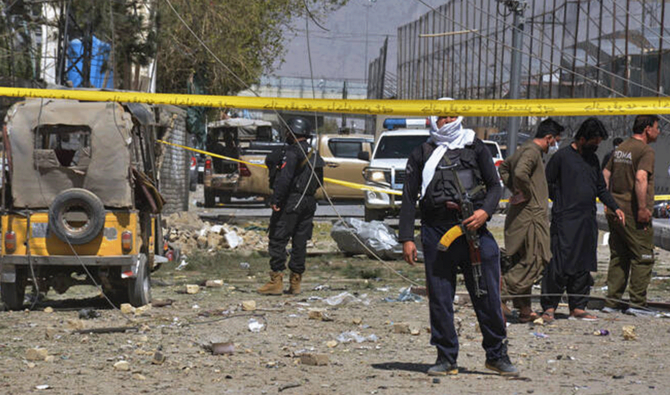
Security officials examine damaged vehicles at the site of a powerful car bombing, in Quetta, Pakistan, on September 30, 2025. (AP)
Short Url
Updated 08 October 2025
Follow

Army says 11 soldiers, including two officers, killed in major gunbattle in northwest Pakistan

  • Overnight intelligence raid in Orakzai also killed 19 militants linked to Tehreek-e-Taliban Pakistan
  • Pakistan blames India and Afghan-based militants as violence surges across its western provinces

ISLAMABAD: Nineteen militants and eleven security personnel, including a lieutenant colonel and a major, were killed in an overnight gunbattle in Pakistan’s northwestern Orakzai district, the military’s media wing said on Wednesday, in one of the deadliest clashes of this year.

Pakistan has witnessed a surge in militant violence in recent years, with proscribed groups such as the Tehreek-e-Taliban Pakistan (TTP) and the separatist Baloch Liberation Army (BLA) targeting security forces and civilians in the western provinces of Khyber Pakhtunkhwa and Balochistan, which border Afghanistan.

According to the Islamabad-based Center for Research and Security Studies (CRSS), militant attacks rose sharply in the past three months, resulting in a 46-percent increase in fatalities — including civilians, soldiers and insurgents — compared to the previous quarter.

The think tank said the year 2025 is on track to become deadlier than 2024, already the most violent year in a decade.

“On night 7/8 October 2025, Security Forces conducted an intelligence-based operation in Orakzai District on reported presence of Khwarij belonging to Indian Proxy, Fitna al Khwarij,” the Inter-Services Public Relations (ISPR) said. “During the conduct of operation, nineteen Indian-sponsored khwarij were sent to hell due to effective engagement by own troops.”

“However, during the intense fire exchange, Lt. Col. Junaid Arif (age 39, resident of Rawalpindi), leading his troops from the front, along with second-in-command Major Tayyab Rahat (age 33, Rawalpindi), having fought gallantly, paid the ultimate sacrifice and embraced shahadat [martyrdom] along with his nine men,” it added.

Pakistan refers to the TTP, an umbrella network of various armed groups, as “khawarij,” a term rooted in early Islamic history and used to describe an extremist sect that rebelled against legitimate authority and declared other Muslims to be apostates.

The army said a “sanitization operation” was underway to clear the area and eliminate any remaining fighters.

Orakzai is part of Pakistan’s northwestern tribal districts, which turned into militant hotspots after the US invasion of Afghanistan in the wake of the September 11, 2001, attacks.

Pakistan launched multiple military operations to dismantle insurgent networks there, but the threat has persisted even after the US withdrawal from Afghanistan in August 2021.

Islamabad has repeatedly accused India of backing insurgent proxies and Afghanistan of allowing militants to use its territory for attacks inside Pakistan. Kabul and New Delhi have both denied the allegations, though the United Nations has warned of a continued risk of cross-border violence emanating from Afghanistan.


Pakistan’s Mahnoor Omer named among TIME’s ‘Women of the Year’ for 2026

Updated 01 March 2026
Follow

Pakistan’s Mahnoor Omer named among TIME’s ‘Women of the Year’ for 2026

  • Omer moved a Pakistani court against the so-called ‘period tax’ in Sept. 2025 which has since sparked a national debate
  • Taxes on sanitary pads in Pakistan can add up to 40 percent to retail price, UNICEF says only around 12 percent women use such products

ISLAMABAD: Pakistani women’s rights activist Mahnoor Omer, who fought against taxes on menstrual products, has been named among the TIME magazine’s ‘Women of the Year’ for 2026.

Omer’s efforts have been recognized alongside 16 activists, artists, athletes and businesswomen in the TIME’s Women of the Year 2026 list, including Olympic gold medalist Sydney McLaughlin-Levrone and Oscar-nominated filmmaker Chloe Zhao.

Dissatisfied with the efforts to educate Pakistani girls about sexual violence, Omer founded the Noor Foundation at the age of 14 and held her own workshops with village girls about everything from climate change to menstruation, according to the TIME magazine.

Two years later, a conversation with a domestic worker about the price of pads made her realize that not everyone could afford these essentials. She moved a court against the so-called “period tax” in Sept. 2025 and the case has sparked a national debate on the subject, considered a taboo by many in Pakistan, since its first hearing late last year.

“A decade and one law degree after her interest in activism was sparked, Omer, now 25, is putting her passion and expertise to work in the name of gender equity,” TIME wrote about Omer on its website.

Taxes imposed on sanitary products in Pakistan can add up to 40 percent to the retail price. UNICEF estimates just 12 percent of women in the country use commercially produced pads or tampons. The alternative, using cloth, risks health impacts including rashes and infections, and can make it impossible for girls to attend school while menstruating.

Omer’s suit, which awaits the government response, has sparked a national discussion. She says she spoke about menstruation to her father and male cousins, who thanked her for standing up for their daughters.
The 25-year-old, who is currently enrolled in a master’s degree in gender, peace, and security at the London School of Economics, sees this case as just the first of many.

“I’m not free until every woman is free,” she was quoted as saying by TIME. “I want to leave no stones unturned in terms of what I can do with the next few decades, as a lawyer for the women in my country and gender minorities in general.”