


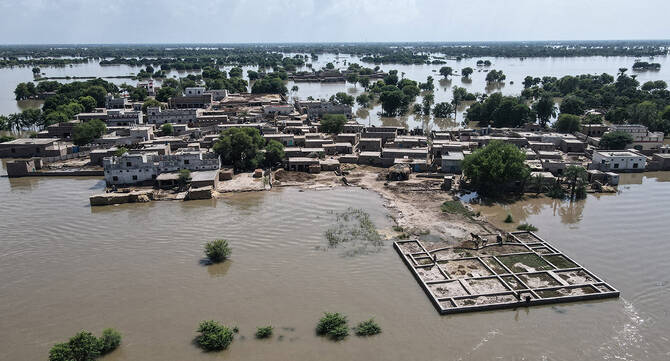
ISLAMABAD: Authorities in Pakistan’s Punjab province have launched the largest post-flood damage survey in the province’s history, the region’s disaster management agency said on Wednesday, to assess the full impact of this year’s devastating monsoon rains, which inundated large parts of the country’s agricultural heartland.
The Provincial Disaster Management Authority (PDMA) of Punjab said in a statement that more than 2,200 field teams were conducting door-to-door assessments across flood-affected districts.
“Our teams are working across all affected districts to collect reliable, verifiable data that will guide rehabilitation and compensation efforts,” PDMA Director General Irfan Ali Kathia said in a statement. “The survey will help identify the hardest-hit families and areas so assistance can be prioritized effectively.”
So far, 24 percent of the survey has been completed, the statement said, covering over 200,000 affected residents, 56,735 damaged houses, and 7,293 dead livestock, including nearly 5,800 large animals.
Survey teams have also identified around 600,000 acres of flood-hit farmland, much of it in southern and central Punjab, where river overflows and breaches displaced thousands of families and destroyed major crops, including rice and sugarcane.
On Tuesday, the PDMA reported that major rivers were flowing at normal levels after weeks of dangerously high water.
The Sutlej carried 108,000 cusecs at Ganda Singh Wala — a medium-level flood — and 81,000 cusecs at Sulemanki, categorized as a low-level flood.
Flows in the Ravi and Chenab rivers have largely subsided as well, while no significant flow was reported in the hill torrents of the Dera Ghazi Khan region.
Punjab was among the worst-hit provinces during this year’s monsoon season, with intense rainfall and riverine floods damaging infrastructure, homes, and farmland across multiple districts.
More than 1,000 people have died nationwide in monsoon-related incidents, including landslides, flash floods and roof collapses.


