

World Bank cuts Pakistan’s growth forecast to 2.6 percent amid flood devastation

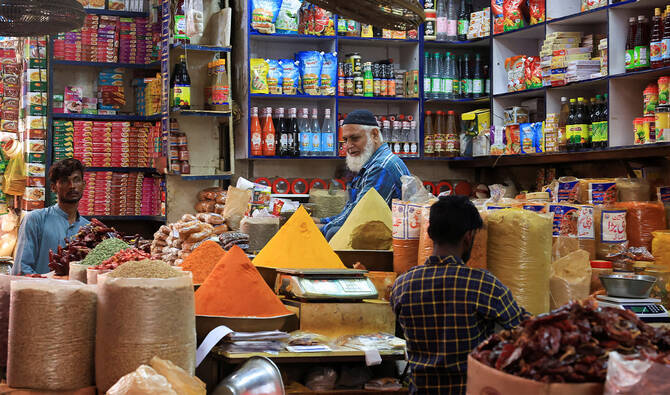
A man and workers are seen at a spice and grocery shop in a market in Karachi, Pakistan, on June 10, 2025. (REUTERS/File)
Short Url
Updated 08 October 2025
Follow

World Bank cuts Pakistan’s growth forecast to 2.6 percent amid flood devastation

  • Monsoon floods in Pakistan have damaged crops, homes and infrastructure while affecting millions
  • Bank says economic recovery will depend on agricultural rebound and lower inflation in coming years

ISLAMABAD: The World Bank on Tuesday projected Pakistan’s economy to grow by 2.6 percent in the ongoing fiscal year (FY2025/26), lowering its earlier estimate due to the recent monsoon floods that inundated large parts of Punjab and Khyber Pakhtunkhwa, damaging homes, infrastructure and farmland.

The monsoon season, which began in late July, has claimed at least 1,037 lives in incidents including roof collapses, landslides and flash floods.

Punjab, the country’s agricultural heartland, experienced one of its worst floods in years after neighboring India released excess water into three major rivers, affecting millions of people across the province.

“In Pakistan, real GDP at factor cost is expected to have grown by 2.7 percent year-on-year in FY 2024/25, slightly above FY 2023/24’s 2.5 percent expansion,” the World Bank said in its Regional Economic Outlook for the Middle East, North Africa, Afghanistan and Pakistan (MENAAP). “For FY 2025/26, real GDP growth is projected to remain around 2.6 percent, as ongoing catastrophic floods have damped the forecast.”

Earlier this year, the Bank had projected 3.1 percent growth for Pakistan before the monsoon season.

“Early estimates suggest a drop of at least 10 percent in agricultural output in Punjab, affecting major crops such as rice, sugarcane, cotton, wheat, and maize,” the report said. “For FY 2026/27, growth is expected to accelerate to 3.4 percent, supported by higher agricultural output, lower inflation and interest rates, recovering consumer and business confidence, and a rebound in private consumption and investment.”

Pakistan has been striving to recover from a prolonged economic crisis that brought it to the verge of default in mid-2023, when it secured a short-term $3 billion International Monetary Fund (IMF) loan.

Since then, the country has undertaken stringent reforms recommended by the Fund, with global credit rating agencies acknowledging progress amid improving macroeconomic indicators.

An IMF mission is currently in Islamabad for talks with the government under the Extended Fund Facility (EFF) of $7 billion agreed last September.

Prime Minister Shehbaz Sharif said during his visit to New York in September that the recent flood damages should be “factored in” as the IMF reviews Pakistan’s fiscal performance, arguing that the scale of the disaster underscores the need for flexibility in the assessment process.

The World Bank added in its report that Pakistan, which has historically maintained high tariffs with a complex structure, stands to benefit in terms of exports and growth from a newly approved five-year reform plan (2025–2030) to cut tariffs by half.



Pakistan moves to digitize payments for 10 million women under flagship poverty initiative

Updated 5 sec ago
Follow

Pakistan moves to digitize payments for 10 million women under flagship poverty initiative

  • BISP Official says accounts will be linked to phones to boost financial inclusion and curb payment deductions
  • Over 1.9 million SIMs issued as the nationwide rollout continues across provinces ahead of the March deadline

ISLAMABAD: Pakistan’s flagship poverty alleviation initiative, the Benazir Income Support Program (BISP), plans to equip 10 million women with digital bank accounts linked to their phone numbers within four months in one of the largest such exercises in the world, one of its top officials said on Wednesday.

Launched in 2008, the initiative is named after the late former prime minister Benazir Bhutto and has a budget of Rs716 billion ($2.5 billion) during the current fiscal year. Through its Benazir Kafaalat — or financial assistance — program, BISP provides quarterly stipends of Rs13,500 ($48) to around 10 million women.

In an exclusive interview with Arab News, BISP Secretary Amir Ali Ahmed said the opening of digital bank accounts for the beneficiaries was part of Prime Minister Shehbaz Sharif’s initiative related to a cashless economy and digital transformation of the country.

“I’m glad to share that 10 million bank accounts, wallet accounts were created,” he said. “This is a follow-up of the same exercise whereby now 10 million SIMs are being distributed.

“It is significant to share that the entire beneficiary network that we have is female-centric,” he continued. “So these are 10 million female accounts that have been created.”

Ahmed said the process of issuing mobile phone SIM cards to BISP beneficiaries had started on November 17 and would be completed by March next year.

“Let me share that this is one of the largest such exercises to be conducted in the world which is female-centric, linked with financial inclusion and financial empowerment.”

The BISP official added that out of the more than 10 million beneficiaries, only five to 10 percent had bank accounts, but nearly 90 to 95 percent were excluded from the system.

He said they were being linked to the banking system with cellphone SIMs that are being distributed with the help of the IT ministry, Pakistan Telecommunication Authority, National Database and Registration Authority and telecom companies across the country.

“We feel that this initiative of the government of Pakistan will not only result in financial empowerment of our beneficiaries, it will also result in financial inclusion of a segment which was not part of the banking sector in Pakistan,” he said, adding that the move will also lead to transparency.

In the past, there have been complaints of women not getting their full payment from bank officials in the absence of their own accounts, but Ahmed said this was going to change.

“They will be free from any exploitation at the agent networks, the queues that one would witness, the complaints of corruption or deductions that would emerge,” he continued.

According to official data, more than 1.9 million SIMs have so far been issued for BISP beneficiaries across the country.

The province of Punjab leads the rollout with 810,597 SIMs, followed by Sindh with 523,629 and Khyber Pakhtunkhwa with 371,427 SIMs.

In other regions, Azad Jammu and Kashmir has received 59,617, Balochistan 82,826, Gilgit-Baltistan 45,184, and Islamabad 4,508 SIMs.