BROADVIEW, Illinois: Federal officials reported the arrests of 13 people Friday protesting near an immigration facility outside Chicago that has been frequently targeted during President Donald Trump’s administration’s surge of immigration enforcement this fall.
As Homeland Security Secretary Kristi Noem met with employees inside the US Immigration and Customs Enforcement processing facility in Broadview, a crowd grew over several hours, some riled by newly installed barricades to separate them from law enforcement officers stationed outside.
Noem also accompanied agents Friday on a raid near a local Walmart store and later engaged in a tit-for-tat over unannounced visits — and even bathroom use — with the Broadview mayor.
Immigrants’ rights advocates and residents separately reported that federal agents had used tear gas near grocery or hardware stores they had targeted for enforcement elsewhere in Chicago on Friday and detained a city council member as she questioned the attempted arrest of a man. The federal government has restricted airspace over Broadview, officials said Friday, and Gov. JB Pritzker called for an investigation into an immigration raid on the city’s South Side early Tuesday morning.
Objections to barricades, local police step up
At the ICE facility, some protesters have aimed to block vehicles from going in or out of the area in recent weeks, part of growing pushback to a surge of immigration enforcement that began in early September. Called “Midway Blitz,” the US Department of Homeland Security announced Friday that it has resulted in more than 1,000 immigration arrests.
Federal agents have repeatedly fired tear gas, pepper balls and other projectiles toward crowds in response and at least five people have faced federal charges after being arrested in those clashes.
While Friday’s demonstration was quieter at Broadview, about 12 miles west of Chicago, Homeland Security Assistant Secretary Tricia McLaughlin reported 13 protesters were arrested. Charges were not released but McLaughlin said they included alleged assaults on federal officers.
The Illinois State Police, whose officers patrolled the grounds wearing riot helmets and holding batons, set up concrete barriers Thursday night to segregate protesters and designate spaces to demonstrate, with several adjacent streets being closed. Many demonstrators ignored the zones to protest on the other side of the building, saying the corrals prevented free speech rights.
Others were angered by local and state officers standing shoulder-to-shoulder with federal agents, including Homeland Security Investigations, ICE, the Bureau of Prisons and others. At one point, Illinois State Police joined Border Patrol in pushing back a crowd.
Jonny Bishop, a 28-year-old former teacher from Palatine, Illinois, and from a Mexican immigrant family, said the cooperation concerned him.
“ICE acts with impunity,” said Bishop, who’s previously encountered tear gas and pepper balls. “They know that they can shoot at us. They can tear gas us. And Broadview Police Department is not going to do anything.”
The Federal Aviation Administration confirmed it has restricted Chicago airspace, with Border Patrol citing “a credible threat” against law enforcement amid ongoing clashes with protesters at the Broadview site. The restriction, which is in effect from Oct. 1-12 and targets drones, extends in a radius of 15 nautical miles and includes Broadview. Critics question the length of time and the geographic breadth of the prohibition, worried about oversight of ICE operations.
Tear gas used on quiet street; city council member handcuffed at hospital
In a Chicago neighborhood, Andrew Denton, 39, stopped at a grocery store for lunch and heard honking from an SUV stopped behind a motorcycle parked in the middle of the street. He realized ICE agents were in the SUV and started shooting video just before the agents threw canisters of gas near passersby.
“There was no reason to use tear gas on the crowd,” he said. “No one was threatening them in any way.”
Denton said he immediately began tearing up. His nose began running, and he felt like he was choking. He said the 20 or so people in the area included seniors, families with children and children outside at recess at an adjacent elementary school.
“Every week, ICE escalates its violence against us,” said Demi Palecek, a military veteran and candidate for state representative. “With this level of escalation, it’s only a matter of time before someone is killed.”
In a near West Side neighborhood a few miles away, Chicago Alderperson Jessie Fuentes shared video appearing to show her being handcuffed as she confronted federal agents at a hospital. She said a resident had fallen and broken his leg while chased by ICE agents who then transported him to the emergency room.
Fuentes arrived after an emergency room staff member called to say there were ICE agents in the room with him. In the video, none of them answers when she asks if they have a signed warrant. One agent then says, “You need to leave,” and handcuffs her from behind as she repeats her question about a warrant and then says, “You’re hurting me.” Fuentes said agents escorted her outside and released her.
Noem participates in raid, engages in restroom dispute
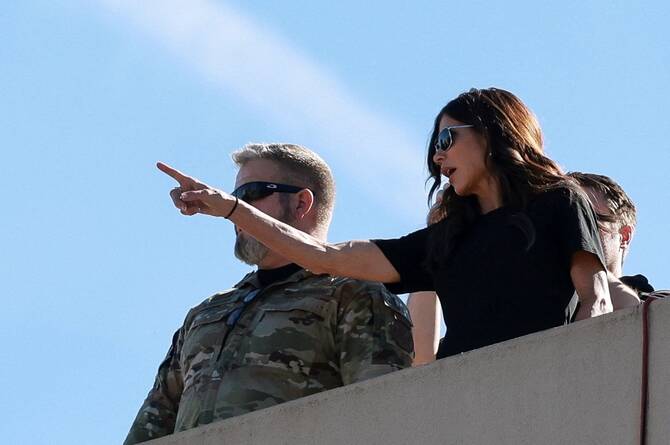
Noem, alongside Gregory Bovino, chief patrol agent of the US Border Patrol’s El Centro Sector, appeared on the Broadview building’s roof, surrounded by armed agents and a camera crew while standing beside a sniper’s post, according to footage shared online by conservative media personality Benny Johnson.
Johnson also posted video outside a Walmart store where he said agents, accompanied by Noem, had conducted a raid. Another video showed detainees in a parking lot where Noem noted “consequences for breaking the law and jeopardizing our law enforcement.”
Noem attempted to visit Broadview Mayor Katrina Thompson at the village hall, but she was not there, and Noem was turned away when she asked to use the facilities.
“The city police wouldn’t even let us use the restroom,” she said in a video.
Broadview village spokesperson David Ormsby said Thompson later “returned her visit” at the ICE facility, where she too was refused access.
“We are distressed to hear that the bathrooms are unavailable at the ICE facility,” Ormsby said in a statement.
Governor decries anonymous, ‘inhumane’ tactics
Pritzker, the governor, lashed out at the Trump administration for the way federal agents, many of them masked to hide their faces, have treated protesters over the past month. He castigated officers’ “inhumane” tactics including slamming protesters to the ground, arresting a reporter and firing chemical agents into the crowds.
“It is clear federal agents cannot be trusted to act to protect the safety and constitutional rights of the public,” the Democrat said.
Pritzker also ordered state agencies to coordinate possible action to “hold federal agents accountable” for a raid on an apartment building in the city’s South Shore neighborhood early this week in which residents, regardless of status and including children, were detained for hours, some handcuffed. Children were separated from their parents, while officers smashed windows and tore through apartments, leaving piles of debris in the hallways.
Homeland Security officials said 37 undocumented immigrants were arrested, some with criminal histories and two allegedly members of a criminal Venezuelan gang.


![]()

US Homeland Security chief visits Chicago area ICE facility as agents arrest 13, raid city neighborhoods
Short Url
https://arab.news/pe3cc
US Homeland Security chief visits Chicago area ICE facility as agents arrest 13, raid city neighborhoods


Latest updates


© 2026 SAUDI RESEARCH & PUBLISHING COMPANY, All Rights Reserved And subject to Terms of Use Agreement.