LEARN 2025 boosts Saudi Arabia’s digital transformation through smart learning

1 / 7
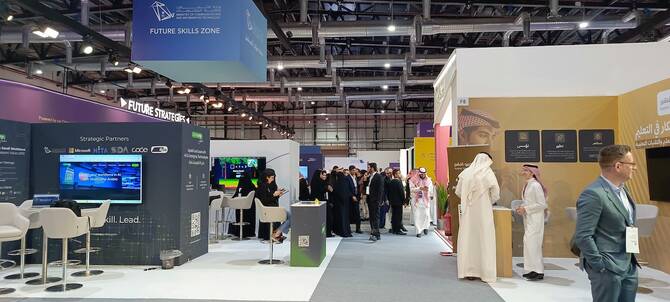
The LEARN 2025 conference opened on Tuesday, shaping the future of the knowledge economy and showcasing the latest tech solutions in training and education. (AN photo by Rashid Hassan)
2 / 7
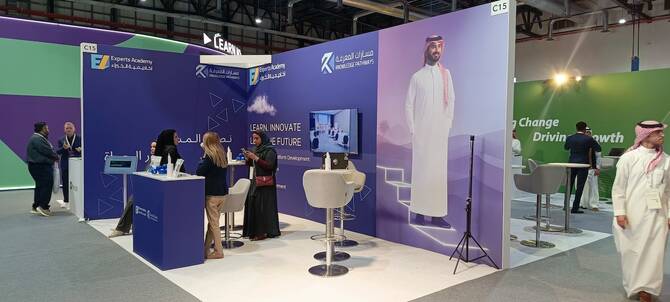
The LEARN 2025 conference opened on Tuesday, shaping the future of the knowledge economy and showcasing the latest tech solutions in training and education. (AN photo by Rashid Hassan)
3 / 7
The LEARN 2025 conference opened on Tuesday, shaping the future of the knowledge economy and showcasing the latest tech solutions in training and education. (AN photo by Rashid Hassan)
4 / 7
The LEARN 2025 conference opened on Tuesday, shaping the future of the knowledge economy and showcasing the latest tech solutions in training and education. (AN photo by Rashid Hassan)
5 / 7
The LEARN 2025 conference opened on Tuesday, shaping the future of the knowledge economy and showcasing the latest tech solutions in training and education. (AN photo by Rashid Hassan)
6 / 7
The LEARN 2025 conference opened on Tuesday, shaping the future of the knowledge economy and showcasing the latest tech solutions in training and education. (AN photo by Rashid Hassan)
7 / 7
The LEARN 2025 conference opened on Tuesday, shaping the future of the knowledge economy and showcasing the latest tech solutions in training and education. (AN photo by Rashid Hassan)
Short Url
Updated 07 October 2025
Follow

LEARN 2025 boosts Saudi Arabia’s digital transformation through smart learning

  • On its opening day, conference attracted global experts in enhancing digital skills and capabilities, who participated in sessions

RIYADH: Designed to support Saudi Arabia’s digital transformation through smart learning, the LEARN 2025 conference opened on Tuesday, shaping the future of the knowledge economy and showcasing the latest tech solutions in training and education.

The conference, held at the Mohammed bin Salman Nonprofit City in Riyadh from Oct. 7-9, was organized in strategic partnership with the Ministry of Communications and Information Technology.

On its opening day, it attracted global experts in enhancing digital skills and capabilities, who participated in sessions addressing capacity development and the adoption of innovative methods for empowering human capital.

Speaking to Arab News, Solveig Nicklos, senior adviser to the CEO and chief transformation officer at Zayed University, said: “Saudi Vision 2030 is shaping the future of education. (The) LEARN conference and similar events are all critical for us to have. People talk about the fourth industrial revolution and (its) impacts in education, but simply nothing is going to impact teaching, learning and student development the way that technology is now.

“Vision 2030 has for a long time been setting the platform for a mindset shift that is required in the whole world, but certainly in Saudi Arabia, and developing individuals with the creativity and the agility necessary to pivot at this critical time…

“While the leadership is embedding technology into the classroom, there is a generation of teachers that have to be trained on how to think, learn and teach with innovative technology.”

On supporting the rise of women in digital and technology-driven careers, Nicklos said: “Education for all is hugely fundamental, and women in particular. In the age of AI, we are already seeing women using technology 20 percent less than men because they feel guilty in a situation where there is already a monumental divide between the access to education for many women and access to technology for many people in general.

“We cannot be further stifled by self-imposing limitations on a technology that is going to be ubiquitous very soon,” she added.

Abdulaziz Al-Suayri, chief product officer at Tatweer Educational Technologies, spoke to Arab News on the importance of proper nutrition for students: “I talked about the impact of nutrition on the students’ learning behavior and performance … It is important to identify current challenges in nutrition programs in our schools and education system.”

Tatweer Educational Technologies, in partnership with the Ministry of Education, developed the Masroof app, which connects parents, schools, and students to set spending limits, track nutrition, and make cashless school purchases.

At Masroof-enabled schools, parents can set flexible spending limits to encourage healthy financial habits and track their child’s nutrition, making the spending experience more transparent.

“Masroof was launched this year and in a short span has more than 250,000 students already using it. We have more than 220,000 parents, we have more than 30 qualified suppliers and operators, and we have more than 1,350 schools already using the app,” Al-Suayri said.

The conference also featured specialized workshops highlighting how to use modern technologies to continue the journey of development and training, alongside an exhibition showcasing local and global entities offering products and services in the field.

Mays Al-Salah, product manager at Experts Academy and Knowledge Pathway and an exhibitor at the conference, told Arab News that this was their second time participating in the conference: “We connect with a lot of people in the same edutech industry. We are here with solutions and (to) answer the questions of the visitors and exhibitors. It’s a good networking opportunity.”  

The LEARN conference is a unique opportunity to foster influential partnerships, drive innovation in training, and strengthen integration across the government, private, and education sectors, crucial for equipping national talents with the necessary digital skills.
 
The effort supports the digital economy and stimulates innovation, especially by encouraging artificial intelligence skill adoption, and accelerates the shift toward a knowledge economy committed to inclusive, sustainable, lifelong capability development.


Trump designates Saudi Arabia as major non-NATO ally

Updated 19 November 2025
Follow

Trump designates Saudi Arabia as major non-NATO ally

  • Announcement came during black-tie White House dinner honoring crown prince
  • Mohamed bin Salman hails new phase in bilateral cooperation, economic ties

WASHINGTON: President Donald Trump on Tuesday announced that the US will formally designate Saudi Arabia a major non-NATO ally, marking a significant elevation in defense ties between the two countries.
He revealed the decision during a black-tie White House dinner honoring Crown Prince Mohammed bin Salman.
“Tonight, I’m pleased to announce that we’re taking our military cooperation to even greater heights by formally designating Saudi Arabia as a major non-NATO ally — something that’s very important to them,” Trump said.
“And I’m telling you now for the first time, because they wanted to keep a little secret for tonight.”
The new status paves the way for deeper military cooperation and carries strong symbolic weight, with Trump saying it will advance US-Saudi defense coordination “to even greater heights.”


The crown prince thanked Trump for a “warm and great welcome,” adding: “We feel home.” He referenced the historic foundations of the US-Saudi relationship, noting that the partnership dates back nearly nine decades to the meeting between President Franklin D. Roosevelt and King Abdulaziz, the founder of modern Saudi Arabia.

He also pointed to upcoming milestones for both nations, the US approaching its 250th anniversary and Saudi Arabia nearing its 300th, saying these celebrations underscore the long arc of shared cooperation.
Reviewing the history of the alliance, the crown prince highlighted joint efforts across the Second World War, the Cold War, and the long fight against extremism and terrorism.
Yet he stressed that today marks a new phase in bilateral cooperation, with economic ties expanding across unprecedented sectors.
“Today is a special day,” the crown prince said. “We think the horizon of economic cooperation between Saudi Arabia and America is bigger and wider in many areas.
“We’ve been signing a lot of agreements that can open the door to develop the relationship deeper in many areas, and we’re going to work on it.”
He added: “We believe the opportunities are huge, so we have to focus on implementation and keep increasing the opportunities between our two countries.”
Trump repeatedly expressed appreciation for the crown prince’s partnership and leadership, highlighting major agreements signed during the visit, including on civil nuclear energy, critical minerals and artificial intelligence, describing the scale of investment as unprecedented.
Trump emphasized that Saudi Arabia is undertaking a major expansion of its defense capabilities, referencing the Kingdom’s plans for nearly $142 billion in purchases of US military equipment and services, which he called “the largest arms purchase in history.”
He framed the acquisition as part of a broader strategy to enhance Middle East security and reinforce the Kingdom’s role as a stabilizing force.
In addition to the major non-NATO ally designation, Trump announced that the US and Saudi Arabia had signed a historic strategic defense agreement that would create “a stronger and more capable alliance” and support what he called the closest the Middle East has ever come to “truly everlasting peace.”
Trump thanked the crown prince “for all the help” in shaping what he described as a historic moment for regional peace and US-Saudi cooperation, and for playing a central role in recent diplomatic breakthroughs, including steps that contributed to ending the war in Gaza.
“Even the great experts … are calling it a miracle,” he said of recent regional shifts. Both leaders framed the moment as the beginning of a new chapter.