- Statement comes after Trump said US seeks to “get Bagram back” for strategic location near China
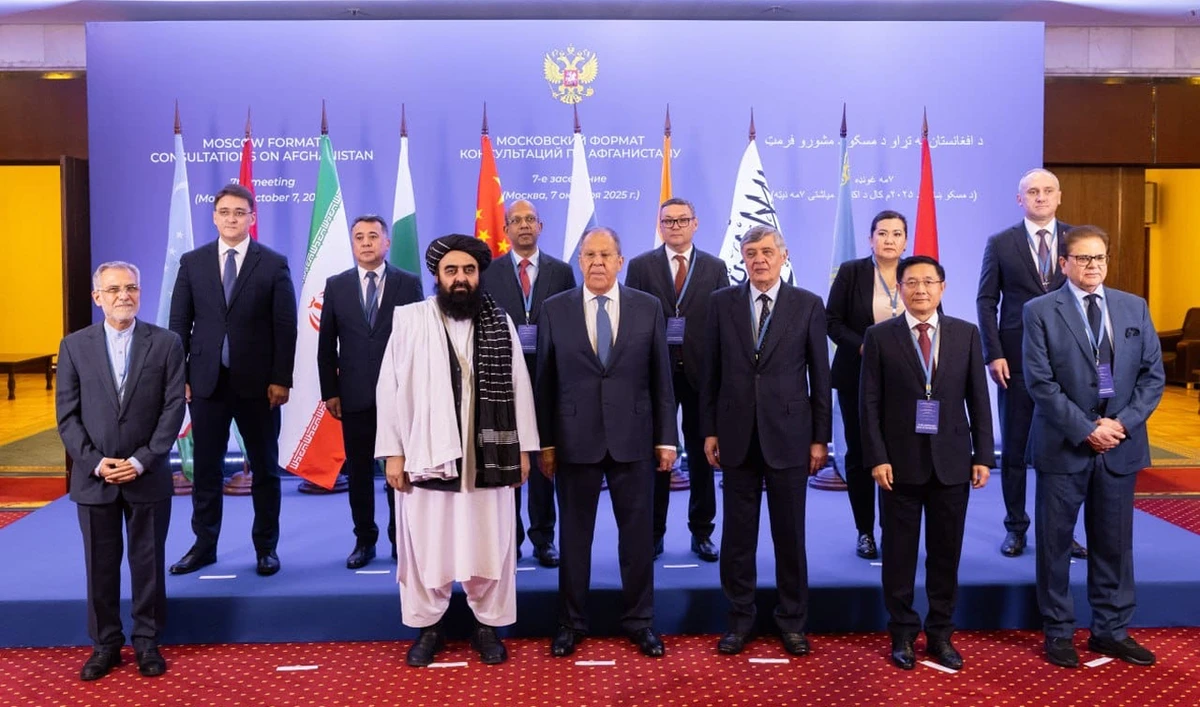
- Statement was issued by regional powers after a Moscow Format meeting in the Russian capital
ISLAMABAD: Major regional powers, including Pakistan, China, Russia, Iran and India, said in a joint statement on Monday there should be “no foreign military presence” in Afghanistan, calling on all nations to respect the country’s sovereignty and territorial integrity as part of efforts to stabilize the region.
The joint statement, issued after a Moscow Format meeting in the Russian capital, followed US President Donald Trump’s Sept. 18 remarks that Washington was “trying to get [Bagram] back” because of its strategic location near China. The Soviet-built base served as the hub of US military operations in Afghanistan until the 2021 withdrawal that ended two decades of American presence in the war-torn nation.
“Participants emphasized that there should be no foreign military presence in Afghanistan and its neighboring countries under any pretext,” the Moscow Format statement said.
“We reaffirmed our support for Afghanistan as an independent, united, sovereign, and peaceful state, free from external interference.”
The statement did not specifically name the United States or reference Trump’s remarks on Bagram.
The seventh round of the Moscow Format brought together special representatives and senior officials from Pakistan, China, Russia, India, Iran, Kazakhstan, Kyrgyzstan, Tajikistan and Uzbekistan, along with an Afghan delegation led by interim Foreign Minister Amir Khan Muttaqi, who participated as a full member for the first time.
At the forum, participating nations also called on Afghanistan to take “comprehensive measures” to eliminate terrorism from its soil.
“The territory of Afghanistan must not be used to threaten or attack any country or shelter terrorist groups,” the statement said.
Pakistan’s participation at the conference comes at a time of strained relations between Islamabad and Kabul, marked by rising militant attacks that Pakistan says are being launched from Afghan territory. The Taliban government denies it backs militant groups.
Islamabad has nonetheless continued diplomatic engagement with the Taliban administration since the group’s return to power in August 2021, keeping its embassy in Kabul open and hosting multiple high-level delegations, including Muttaqi himself. The two sides have also held recent trilateral meetings with China focused on expanding the China-Pakistan Economic Corridor (CPEC) into Afghanistan and improving trade and regional connectivity. Pakistani officials have said they seek a “pragmatic relationship” with Taliban authorities based on counterterrorism, border security, and economic cooperation.
“The parties emphasized that Afghanistan should be supported to undertake comprehensive measures aimed at the elimination of terrorism and its eradication within a short timeframe so that Afghan soil is not used as a threat to the security of the neighboring countries and beyond,” the joint statement said.
Separately, Pakistan’s Special Representative on Afghanistan, Muhammad Sadiq Khan, said in a post on X that a quadrilateral meeting of Pakistan, China, Russia and Iran was also held on the sidelines of the forum.
“A particular point of concern was the continued presence of designated terrorist organizations, such as Tehreek-e-Taliban Pakistan (TTP), Balochistan Liberation Army (BLA), East Turkestan Islamic Movement (ETIM), Jaish ul-Adl (JUA), Islamic State of Iraq and the Levant (ISIL) and Al-Qaeda,” Khan said, listing different groups that have claimed attacks in Pakistan.
He added that participants of the meeting expressed concern over the presence of designated terror groups in Afghanistan, underscoring the need for an Afghanistan free from “terrorism” and foreign interference. Kabul has repeatedly denied it backs terror outfits.
In the joint statement, participating nations also urged closer regional cooperation to strengthen counterterrorism coordination and humanitarian assistance.
All participating countries expressed interest in developing economic, trade and investment partnerships with Afghanistan to promote sustainable development, health care, agriculture, and poverty alleviation. They also voiced support for Afghanistan’s integration into regional connectivity frameworks.
Participants urged the international community to continue providing humanitarian aid to the Afghan people and called “unacceptable the attempts by countries to deploy their military infrastructure in Afghanistan and neighboring states,” saying such moves would not serve regional peace or stability.
The Moscow Format, established in 2017, is one of the most prominent regional mechanisms for dialogue on Afghanistan, bringing together neighboring states and major stakeholders to coordinate policy on security, economic development, and humanitarian cooperation.
Analysts said the consultations provide an important mechanism for regional powers to collectively push the Afghan Taliban toward meeting international expectations on governance, human rights and counterterrorism, conditions viewed as essential for political legitimacy and long-term stability.
“This forum will enable all major regional countries to try to mutually persuade Afghan Taliban that their political legitimacy, international recognition, economic stability and regional integration depend on their political will and ability to fulfill their international obligations,” said Syed Muhammad Ali, an Islamabad-based security analyst.
Dr. Qamar Cheema, Executive Director of the Sanober Institute in Islamabad, said Pakistan has been trying to help the Taliban understand that they are now governing a state, not operating as non-state actors.
“Pakistan is making multilateral forums more active for Afghan Taliban so that they can become responsible,” he told Arab News. “So, all the regional players, when they will push and pressurize Taliban, that will definitely make Afghan Taliban more responsible,” Cheema added.
“The more Pakistan pressurizes through friends and partners, the better it will be for the regional peace.”