Seven injured as blast derails Jaffar Express train in southern Pakistan

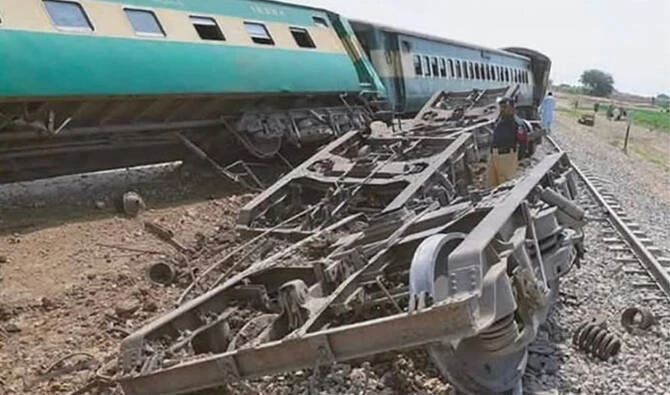
Destroyed railway wagons of the Peshawar-bound Jaffar Express are pictured a train track near Quetta’s Spezand Railway Station in Pakistan on August 10, 2025. (Pakistan Railway)
Short Url
Updated 07 October 2025
Follow

Seven injured as blast derails Jaffar Express train in southern Pakistan

  • Explosion struck in Sindh’s Shikarpur district as train was en route from Peshawar to Quetta
  • Jaffar Express has been targeted multiple times this year, including hijacking and IED attacks

ISLAMABAD: Seven people were injured and four coaches of the Quetta-bound Jaffar Express passenger train derailed after an improvised explosive device (IED) went off in the southern Sindh province, police said on Tuesday.

The incident happened near Sultan Kot Railway Station in Shikarpur district as the train was traveling from Peshawar to Quetta.

The bomb disposal squad assessed that around five pounds of explosives were used in the IED blast, according to a senior police official who spoke on condition of anonymity.

“At least seven people were injured, one of them seriously, when four bogies overturned as a result of a blast near Sultan Kot Railway Station this morning,” he told Arab News over the phone.

“The injured were moved to a hospital for treatment.”

So far, no group has claimed responsibility for the attack.

Sindh Home Minister Zia-ul-Hassan Lanjar directed the police to begin an investigation and submit a report immediately.

“Terrorists involved in damaging the railway track will soon be brought to justice,” he said. “We will reach the culprits through concrete evidence and a thorough investigation.”

Earlier this year in March, the Balochistan Liberation Army (BLA), a separatist militant group, hijacked the Jaffar Express with about 400 passengers on board. The hijacking in the rugged Bolan mountain range ended after an hours-long military operation that killed 33 militants, while 23 soldiers, three railway staff and five passengers also lost their lives.

Last month, an IED blast derailed five coaches of the same train in Balochistan’s Mastung district. A similar attack also targeted the passenger train in August Quetta’s Spezand Railway Station.

Balochistan, which borders Iran and Afghanistan, has long been the center of an insurgency waged by Baloch separatist groups who frequently target government officials and foreigners.

The separatists accuse the central government of exploiting the province’s natural resources to fund development elsewhere in the country. Islamabad denies the allegation, saying it is working to improve livelihoods and promote development in Balochistan.


Pakistan speaker raises concern over Afghan militancy in talks with Iranian delegation

Updated 12 November 2025
Follow

Pakistan speaker raises concern over Afghan militancy in talks with Iranian delegation

  • Ayaz Sadiq met Iran’s deputy speaker a day after a suicide bombing in Islamabad blamed on Afghan-based militants
  • Iran offered to mediate between Pakistan and Afghanistan this month following border clashes, failed talks in Istanbul

ISLAMABAD: Pakistan’s National Assembly Speaker Sardar Ayaz Sadiq on Wednesday voiced concern over militant violence emanating from Afghanistan a day after a suicide bombing in Islamabad killed at least 12 people and was blamed by the Pakistani authorities on the proscribed Tehreek-e-Taliban Pakistan (TTP) militant network.

Sadiq’s comments came during a meeting with Iran’s Deputy Speaker Ali Nikzad, who is leading a parliamentary delegation to Islamabad. The Iranian official, whose country also shares a border with Afghanistan, discussed expanding parliamentary and economic cooperation with the National Assembly speaker while addressing regional security challenges.

Pakistan has in recent weeks accused Afghan authorities of harboring militants and facilitating their cross-border attacks on Pakistani security forces and civilians. The tensions triggered border clashes last month, followed by a collapse of peace talks in Istanbul earlier this month that aimed at easing bilateral tensions.

Iran, which maintains relations with both Kabul and Islamabad, subsequently offered to mediate between the two sides.

“Afghanistan’s soil is being used for terrorism in Pakistan,” Sadiq said during his conversation with the Iranian official, according to a statement from the National Assembly Secretariat. “Pakistan remains committed to the complete elimination of terrorism and to resolving conflicts through peaceful means.”

The speaker emphasized that cooperation between Pakistan and Iran was vital for regional peace, describing the two as “brotherly neighbors bound by shared history, religion and culture.”

He also thanked Tehran for its support to Pakistan during a military standoff with India in May and called for unity among Muslim countries in the face of regional crises.

Sadiq condemned Israeli strikes on Iran, noting that Pakistan’s parliament had unanimously passed a resolution denouncing the attacks, and congratulated Iran for its “firm response.”

Nikzad extended condolences over the suicide bombing in Islamabad and praised Pakistan’s “steadfast support” during his country’s war with Israel.

He also noted there were wide-ranging opportunities to expand cooperation between the two countries in multiple sectors.