

Punjab issues fresh flood alert as river levels rise after heavy rains

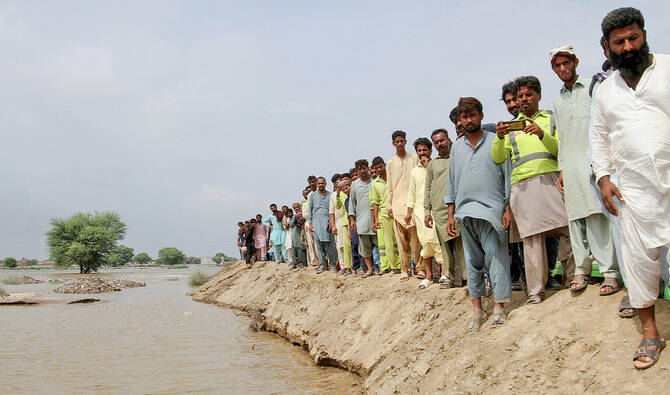
Residents stand at an embankment as they wait to be rescued from a flooded area, following monsoon rains and rising water levels of the Chenab River, in Jalalpur Pirwala, Punjab province, Pakistan, on September 8, 2025. (REUTERS/File)
Short Url
Updated 06 October 2025
Follow

Punjab issues fresh flood alert as river levels rise after heavy rains

  • PDMA warns of possible medium flood in River Jhelum, low flood in Sutlej within 24 hours
  • Over 1,000 people killed, 2.5 million acres of farmland damaged nationwide this monsoon

ISLAMABAD: The Punjab Provincial Disaster Management Authority (PDMA) on Monday issued a fresh flood alert, warning of rising river levels across the province that has already suffered weeks of rain-related damage and repeated flooding this monsoon season.

This year’s monsoon season, stretching from late June through September, has been one of the deadliest in recent years, killing at least 1,006 people nationwide and displacing tens of thousands, according to the National Disaster Management Authority (NDMA). The downpours have damaged hundreds of thousands of homes and large stretches of roads, while washing away livestock and destroying key crops — including cotton, rice, and maize — across the country’s agricultural heartland.

Punjab, Pakistan’s most populous and agriculturally vital province, has been hit by repeated flooding since August, with nearly 2.5 million acres of farmland destroyed. 

“Flows in River Jhelum at Mangla upstream are likely to rise, with a possibility of reaching medium flood level within the next 24 hours,” a PDMA spokesperson said. “There is also a likelihood of low flood conditions in River Sutlej at Ganda Singh Wala, depending on water releases from India.”

The PDMA said it had alerted all divisional commissioners and deputy commissioners to remain vigilant and ensure round-the-clock staffing in District Emergency Operation Centers (DEOCs). Departments of irrigation, health, livestock, communication and works and local government have been directed to mobilize resources for flood preparedness.

PDMA Director General Irfan Ali Kathia instructed officials to pre-position heavy machinery, strengthen embankments, and clear drainage channels to prevent breaches. 

“District administrations have been directed to stay alert as river flows and nullahs may rise due to ongoing rainfall,” he said.

Citizens were urged to exercise caution and follow safety adviseries during the wet spell. The PDMA said the wet spell is likely to subside within 36 hours, but monitoring and early warning systems would remain active.

Pakistan witnessed its most devastating monsoon season in 2022 when floods killed 1,739 people and caused an estimated $30 billion in damage.


Pakistan reviews austerity measures amid Middle East crisis, urges strict nationwide implementation

Updated 11 March 2026
Follow

Pakistan reviews austerity measures amid Middle East crisis, urges strict nationwide implementation

  • Deputy Prime Minister Ishaq Dar chairs review meeting of austerity steps
  • Officials briefed on salary cuts, school closures, four‑day week, petrol conservation

ISLAMABAD: Pakistan’s government on Wednesday assessed progress on a sweeping set of austerity measures introduced to mitigate the country’s economic strain from sharply rising global oil prices and supply disruptions linked to the ongoing war in the Middle East.

Prime Minister Shehbaz Sharif this week announced a series of austerity steps, including a four‑day work week for government offices, requiring 50  percent of staff to work from home, cutting fuel allowances for official vehicles by half, grounding up to 60  percent of the government fleet and closing all schools for two weeks to conserve fuel amid the global oil crisis.

The measures were unveiled in response to global oil market volatility triggered by the conflict involving the United States, Israel and Iran, which has disrupted supply routes such as the Strait of Hormuz and pushed crude prices sharply higher, straining Pakistan’s heavily import‑dependent energy sector.

“The meeting stressed the importance of strict and transparent adherence to the austerity measures, promoting fiscal responsibility and prudent use of public resources,” Deputy Prime Minister and Foreign Minister Senator Mohammad Ishaq Dar said in a statement.

He was chairing a meeting of the Committee for Monitoring and Implementation of Conservation and Additional Austerity Measures, constituted under the directions of the PM, bringing together federal and provincial officials to review execution of the broad cost‑cutting plan. 

Dar emphasized the government’s commitment to enforcing the PM’s austerity steps nationwide. The committee’s review also covered reductions in departmental expenditure, deductions from salaries of senior officials earning over Rs. 300,000 ($1,120), and coordination with provincial administrations to ensure uniform implementation of the plan.

Participants at the meeting reiterated that all ministries and divisions must continue strict monitoring and reporting, with transparent oversight mechanisms, as Pakistan navigates the economic pressures from the prolonged Middle East crisis and its fallout on global energy and trade markets.