

Typhoon Matmo strengthens, prompts China to evacuate 347,000

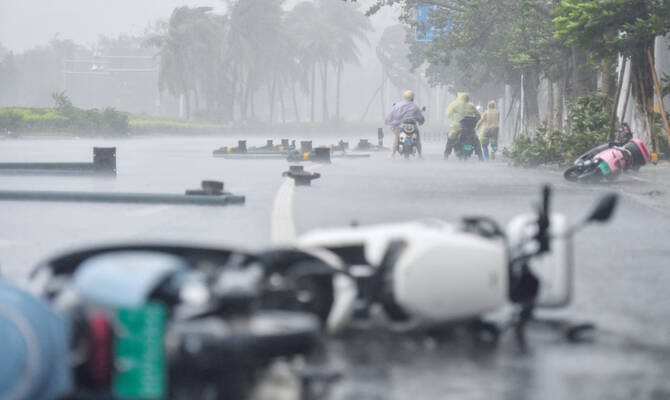
People ride electric scooters amid strong wind and heavy rainfall brought by Typhoon Matmo, in Haikou, Hainan province, China, on Sunday. (AFP)
Short Url
Updated 06 October 2025
Follow

Typhoon Matmo strengthens, prompts China to evacuate 347,000

  • Flights, public transport, and businesses have been shut down since Saturday in preparation for the storm

BANGKOK: Typhoon Matmo strengthened Sunday in China, prompting the government to evacuate some 347,000 people from the southern provinces of Guangdong and Hainan.

The typhoon had maximum sustained wind speeds of 151 kph on Sunday morning, according to China’s National Meteorological Center. It hit Zhanjiang in Guangdong around mid-afternoon Sunday. The weather authority issued a red-level typhoon warning, the highest in its system.

Hainan, which is also in the pathway of the storm, canceled flights and shut down public transport and businesses starting Saturday in preparation for the storm. The province also preemptively evacuated 197,856 people, according to state media, The Paper.

Matmo directly hit the southwestern parts of Guangdong, where 151,000 people evacuated, The Paper reported. Meanwhile, local media aired footage showing large waves washing seawater onto roads in villages by the coast in Guangdong’s Zhanjiang.

Authorities are also warning of heavy rain, with rainfall expected to hit 3.93 to 9.8 inches in some parts of Guangdong and Hainan.

In the region of Macau, which is not in the typhoon’s direct path, classes and tutoring sessions were canceled due to weather conditions.

Matmao had passed through the Philippines earlier this week. While there were no reports of casualties or major damage, the storm affected more than 220,000 people in five northern agricultural plains and mountainous regions. Nearly 35,000 of them either moved to emergency shelters or houses of relatives away from landslide- or flood-prone villages, disaster-response officials said on Sunday. The storm will then move westward and north, toward northern Vietnam and China’s Yunnan province.

Linking Macao to Hong Kong, world’s longest sea bridge grows into travel hotspot

A general view of the Hong Kong-Zhuhai-Macau bridge on Oct. 28, 2025. (AN photo)
Updated 6 sec ago
Follow

Linking Macao to Hong Kong, world’s longest sea bridge grows into travel hotspot

  • Spanning 55 km, the bridge cost $20bn and took 9 years to complete
  • It recorded over 25m passenger trips so far in 2025

MACAO: Stepping onto a shuttle departing from Hong Kong, passengers are struck by the scale of the bridge, as it carries them toward Macao. Behind them, the land quickly fades, and for the next half hour, only open sea stretches on either side of the bus.

The 55 km-long passage is the world’s longest bridge-tunnel sea-crossing, spanning the waters of the Lingding Channel in the Pearl River Estuary, a key waterway in southern China that flows into the South China Sea.

It connects China’s two special administrative regions — Macao and Hong Kong — and the mainland city of Zhuhai.

When it opened in October 2018, the new link cut travel time by roughly 70 percent. Today, it is not only a convenient route but also a growing tourist attraction.

“It is really exciting, especially seeing the vast stretch of sea from inside the bus as it moved across the bridge. At first, I didn’t expect it to be that long, but the ride felt comfortable and smooth. Seeing the sea on both sides felt calm and stunning at the same time,” said Fitrinaz, a young public relations consultant from Indonesia, who was visiting Macao for the first time.

“What moved me the most was the scenery. The sea was incredibly wide and looked peaceful from above. I loved seeing the ships and boats passing beneath the bridge, which made the view feel more alive.”

Before the Hong Kong-Zhuhai-Macao Bridge, her journey would take up to four hours by land.

“I only found out later that this is actually the longest sea bridge in the world, and it felt incredible to cross it in person,” Fitrinaz told Arab News.

“This trip made me even more amazed at how Macao and Hong Kong are connected through such massive infrastructure. For me, it became one of the most memorable experiences during my visit to Macao.”

Built by a consortium of Chinese state-owned construction companies, the $20 billion bridge took nine years to complete and was designed to withstand earthquakes and typhoons. According to HZMB Authority data, over 420,000 tons of steel went into the project, which is enough to make nearly 60 Eiffel Towers.

Around 30 km of the bridge stretches across the waters of the Pearl River Delta. A 6.7 km section in the middle dips into an undersea tunnel, running between two artificial islands, to allow ships to pass.

The rest of the structure consists of link roads, viaducts, and land tunnels that connect Zhuhai, Hong Kong, and Macao to the main bridge.

Xinhua, China’s official state news agency, reported in late October that the HZMB had handled more than 93.34 million passenger trips in total, including 25 million so far in 2025. More and more of them are international tourists.

Budy Santoso, a celebrity photographer from Jakarta, was visiting the region for the first time. Unsure of what to expect in Macao, he initially worried about navigating the entry and the language barrier.

“Thankfully, it turned out not to be as difficult as I imagined … Macao seems to be developing itself into a tourist destination. From the bridge, you can already see colorful lights as evening approaches,” he said.

“I was greeted by a beautiful city as I crossed that long bridge. I entered a modern city with all its expensive facilities.”