

Life back to normal as deal ends days of unrest in Azad Kashmir

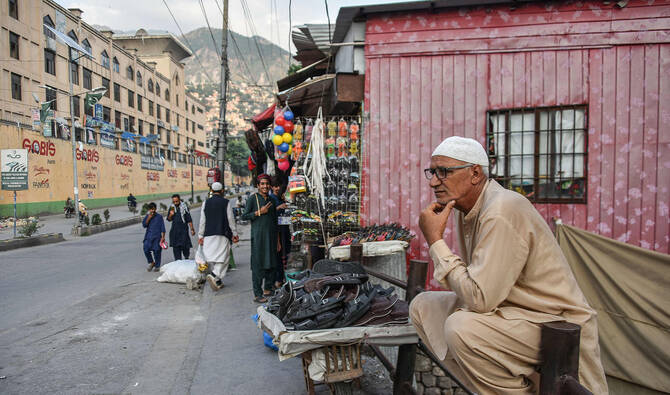
A Kashmiri man sits along a street in Muzaffarabad, the capital of Pakistan-administered Kashmir, on October 4, 2025, following the end of deadly anti-government demonstrations. (AFP)
Short Url
Updated 05 October 2025
Follow

Life back to normal as deal ends days of unrest in Azad Kashmir

  • Shops reopen and phone services restored as protesters end days of unrest in Muzaffarabad
  • Civil rights alliance calls off demonstrations after government accepts most of its demands

MUZAFFARABAD: Shops reopened and mobile services resumed in Azad Kashmir’s capital on Saturday after days of violent anti-government protests ended under a deal between demonstrators and authorities.

The agreement followed nearly a week of unrest led by traders and civil rights groups demanding better public services and subsidies in the disputed region that is part of the larger Himalayan valley of Kashmir claimed by both India and Pakistan. 

Thousands had taken to the streets in Muzaffarabad and nearby towns, calling for reforms in electricity pricing and government spending. Clashes between protesters and security forces left at least six civilians and three police officers dead, officials said.

Kashmir, divided between Pakistan and India since their independence from Britain in 1947, has a long history of political discontent. In the latest protests, demonstrators accused local leaders in Azad Kashmir of neglecting health, education and infrastructure while prioritizing perks for officials. Under the agreement that ended the unrest, Islamabad pledged new projects wort $35 million to upgrade electricity supplies and other public services.

“Our demands have been accepted, and this is the result of our long struggle,” said Choudhury Rafiqe Ahmad, a shopkeeper in Muzaffarabad.

“Most of our issues have been resolved, and this has been made possible by the grace of Allah. Even though we suffered losses in our businesses along the way, we have no regrets, because what has been achieved is in the interest of the nation, and we are proud of it.”

Another resident, Shujat Kazmi, said the movement had exposed the disconnect between political elites and ordinary citizens and praised the Joint Awami Action Committee civil alliance that led the protests. 

“The Awami Action Committee is the only force that truly represents the people,” he said. “Political parties have become irrelevant because they have abandoned their original agenda. They were engaged in self-serving politics, flattering the ruling elite, and pursuing personal gains instead of speaking for the public.”

He said it was only the Awami Action Committee and the people who took matters into their own hands. 

“The people had, in a way, sparked a new revolution,” Kazmi said. 

Officials said calm had returned to Muzaffarabad as roads were cleared, businesses reopened, and communication lines restored. The government said it would continue talks with community representatives to prevent a repeat of the unrest.


Pakistan’s Mahnoor Omer named among TIME’s ‘Women of the Year’ for 2026

Updated 01 March 2026
Follow

Pakistan’s Mahnoor Omer named among TIME’s ‘Women of the Year’ for 2026

  • Omer moved a Pakistani court against the so-called ‘period tax’ in Sept. 2025 which has since sparked a national debate
  • Taxes on sanitary pads in Pakistan can add up to 40 percent to retail price, UNICEF says only around 12 percent women use such products

ISLAMABAD: Pakistani women’s rights activist Mahnoor Omer, who fought against taxes on menstrual products, has been named among the TIME magazine’s ‘Women of the Year’ for 2026.

Omer’s efforts have been recognized alongside 16 activists, artists, athletes and businesswomen in the TIME’s Women of the Year 2026 list, including Olympic gold medalist Sydney McLaughlin-Levrone and Oscar-nominated filmmaker Chloe Zhao.

Dissatisfied with the efforts to educate Pakistani girls about sexual violence, Omer founded the Noor Foundation at the age of 14 and held her own workshops with village girls about everything from climate change to menstruation, according to the TIME magazine.

Two years later, a conversation with a domestic worker about the price of pads made her realize that not everyone could afford these essentials. She moved a court against the so-called “period tax” in Sept. 2025 and the case has sparked a national debate on the subject, considered a taboo by many in Pakistan, since its first hearing late last year.

“A decade and one law degree after her interest in activism was sparked, Omer, now 25, is putting her passion and expertise to work in the name of gender equity,” TIME wrote about Omer on its website.

Taxes imposed on sanitary products in Pakistan can add up to 40 percent to the retail price. UNICEF estimates just 12 percent of women in the country use commercially produced pads or tampons. The alternative, using cloth, risks health impacts including rashes and infections, and can make it impossible for girls to attend school while menstruating.

Omer’s suit, which awaits the government response, has sparked a national discussion. She says she spoke about menstruation to her father and male cousins, who thanked her for standing up for their daughters.
The 25-year-old, who is currently enrolled in a master’s degree in gender, peace, and security at the London School of Economics, sees this case as just the first of many.

“I’m not free until every woman is free,” she was quoted as saying by TIME. “I want to leave no stones unturned in terms of what I can do with the next few decades, as a lawyer for the women in my country and gender minorities in general.”