‘We were treated like animals,’ deported Gaza flotilla activists say

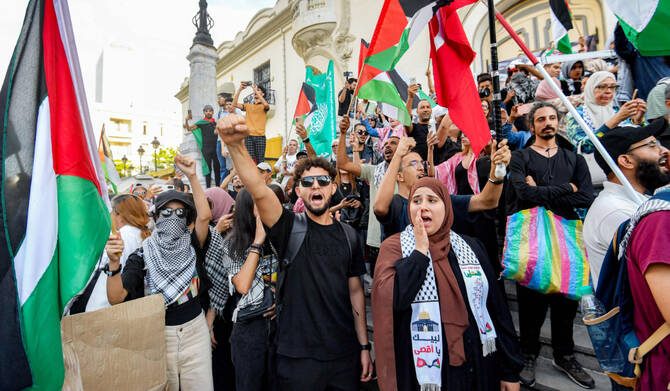
Demonstrators gather for a rally condemning Israel’s interception of the Global Sumud Flotilla outside the French Embassy in central Tunis on Saturday. (AFP)
Short Url
Updated 05 October 2025
Follow

‘We were treated like animals,’ deported Gaza flotilla activists say

  • They put us on our knees, facing down. And if we moved, they hit us. They were laughing at us, insulting us, and hitting us

ISTANBUL: International activists who arrived in Istanbul after being deported from Israel following the military’s interception of their Gaza-bound flotilla said on Saturday they had been subjected to violence and “treated like animals.”

The Global Sumud Flotilla set sail last month seeking to ferry aid to war-battered Gaza, but Israel blocked the boats, detaining more than 400 people whom it began deporting on Friday. Of that number, 137 activists from 13 countries arrived in Istanbul on Saturday, including 36 Turkish nationals.
“A huge number of military vessels intercepted us,” Paolo Romano, a regional councillor from Lombardy in Italy, said at Istanbul airport.
“Some boats were also hit by water cannon. All of the boats were taken by very heavily armed people and brought to shore,” the 29-year-old said.
“They put us on our knees, facing down. And if we moved, they hit us. They were laughing at us, insulting us, and hitting us,” he said.
“They were using both psychological and physical violence.”
Among those on board the flotilla, which counted some 45 vessels, were politicians and activists, including Swedish climate campaigner Greta Thunberg.
Romano said they tried to force them to admit they had entered Israel illegally.
“But we never entered Israel illegally. We were in international waters, and it was our right to be there.”
On landing, they were taken to a prison and held there without being allowed out, and were not given bottled water, he said.
“They were opening the door during the night and shouting at us with guns to scare us,” he said.
“We were treated like animals.”
Iylia Balqis, a 28-year-old activist from Malaysia, said Israel’s interception of the boats was “the worst experience.”
“We were handcuffed (with hands behind our backs), we couldn’t walk, some of us were made to lie face down on the ground, and then we were denied water, and some of us were denied medicine,” she said.
The activists were flown to Istanbul on a specially chartered Turkish Airlines plane.
In a post on X, the Israeli Foreign Ministry confirmed “137 more provocateurs of the Hamas-Sumud flotilla were deported today to Turkiye.”
Relatives of the Turkish activists could be seen awaiting their arrival at the VIP lounge inside Istanbul airport, waving Turkish and Palestinian flags and chanting “Israel murderer.”
The Turkish activists were to undergo medical checks on arrival and would appear in court on Sunday to give testimony, their lawyers said.
Turkiye has denounced Israel’s interception of the flotilla as “an act of terrorism,” saying on Thursday it had opened an investigation.
Foreign Minister Hakan Fidan praised the activists as “brave individuals who gave voice to humanity’s conscience” in a post on X and stated that Ankara would ensure all of its nationals were brought back, without providing an overall number.
Italian journalist Lorenzo D’Agostino, who was on board the flotilla to cover its mission, said they “were kidnapped in international waters when we were 88 km from Gaza.”
“It was two hellish days that we spent in prison. We are out now thanks to the pressure of the international public that supports Palestine,” he said.
“I really hope this situation ends soon because it has been barbaric the way we have been treated.”
Libyan activist Malik Qutait said he was not afraid and vowed to keep trying to reach Gaza.
“I will collect my group, arrange medicine, aid and a ship and I will try again,” he said.


Lebanon warns Israeli violations threaten stability as UN peacekeepers enter final phase of mission

Updated 11 November 2025
Follow

Lebanon warns Israeli violations threaten stability as UN peacekeepers enter final phase of mission

  • UN envoy accuses Israel of jeopardizing ‘hard-won progress’ by undermining Lebanese sovereignty and territorial integrity through airstrikes and border violations
  • He says Lebanon’s army commander has presented to ministers his second progress report on a plan to extend state authority country-wide and limit weapons to state control

NEW YORK CITY: Lebanon has warned that Israeli airstrikes and border violations risk undermining progress toward achieving stability in southern Lebanon, as the UN peacekeeping mission in the country begins preparations for its withdrawal.

Speaking before the UN General Assembly’s Fourth Committee, Lebanon’s permanent representative to the organization, Ahmad Arafa, welcomed the recent renewal of the UN Interim Force in Lebanon’s mandate under Security Council Resolution 2790. This authorized the extension of the force’s operations until Dec. 31, 2026, followed by an “orderly, safe and coordinated” drawdown within a year.

“The Lebanese Armed Forces have been working tirelessly to ensure full implementation of Resolution 1701,” Arafa said, referring to the 2006 resolution that ended the war that year between Israel and Hezbollah.

It calls for the disarmament of all militias in Lebanon, including Hezbollah. The US has consistently pressured Lebanese authorities to disarm the group, designating it a terrorist organization.

The November 2024 ceasefire deal with Israel also requires Lebanon to disarm Hezbollah and establish a state monopoly on arms. The agreement states that only state security forces should bear arms, which is interpreted by Israel and others as requiring the full disarmament of Hezbollah. The group insists it applies only to southern Lebanon.

Arafa said the commander of the Lebanese army has presented to the Council of Ministers his second progress report on a plan to extend state authority throughout the country and confine possession of weapons to legitimate state institutions.

However, he accused Israel of jeopardizing the “hard-won progress” that has been made, through what he described as ongoing violations of Lebanon’s sovereignty and territorial integrity, including airstrikes, the continued occupation of Lebanese territory, and the creation of “so-called buffer zones.”

UNIFIL spokesperson Dany Ghafri said last week that Israel had carried out more than 7,000 airspace violations since the cessation of hostilities in November last year, Arafa noted. UNIFIL has warned that the airstrikes breach Resolution 1701, “threaten the safety of civilians, and undermine progress toward a political and diplomatic solution,” he added

Lebanon also condemned Israeli attacks on UNIFIL personnel and positions, describing them as “a blatant violation of international law.”

Arafa expressed gratitude to the leadership of the UN force, and the countries that contribute troops, for their “dedication and sacrifice” since the mission was established in 1978. He called for the avoidance of any “security vacuum” during the upcoming transitional period, while maintaining stability and respect for Lebanon’s sovereignty.