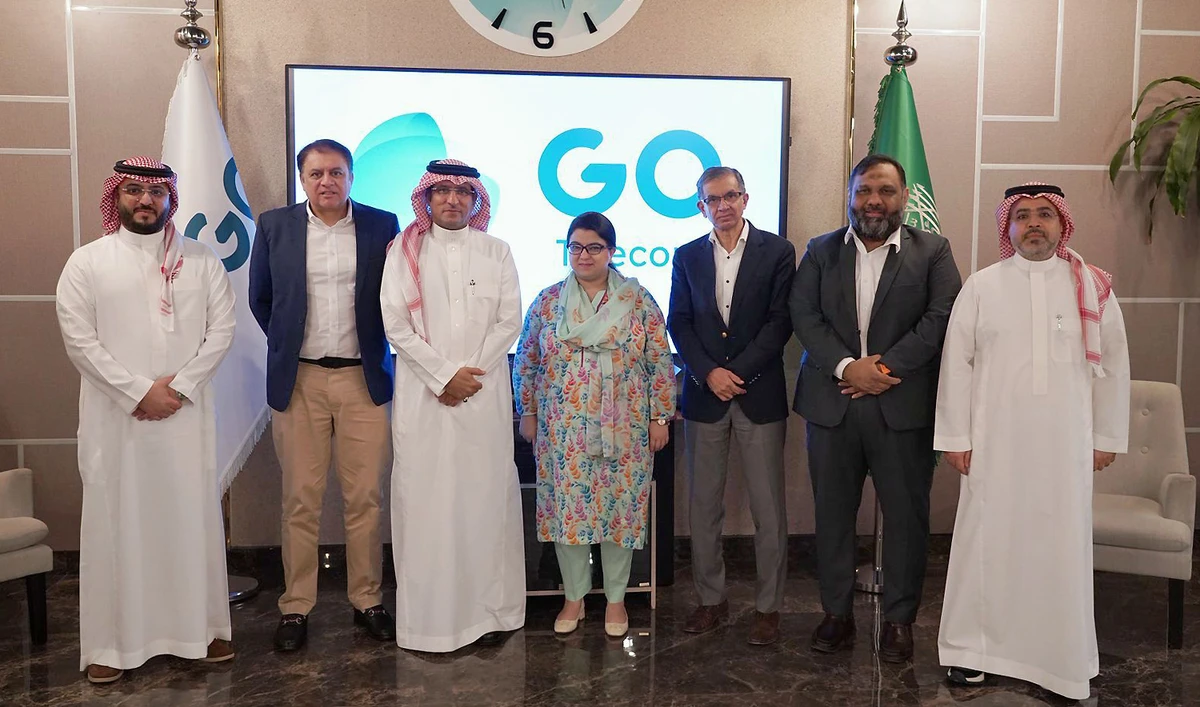
- The specialized center for AI technologies and digital innovation is designed to foster knowledge transfer and capacity building
- The development comes as both nations plan to forge partnerships in artificial intelligence, cybersecurity and other tech fields
ISLAMABAD: Saudi Arabia’s GO Telecommunications Group will launch an Artificial Intelligence (AI) hub in Pakistan this month to jointly develop digital solutions and empower the youth, the Pakistani IT ministry said on Saturday.
The announcement comes during IT and Telecommunications Minister Shaza Khawaja’s visit to Saudi Arabia to discuss bilateral cooperation under Saudi Vision 2030 and Pakistan’s National AI Policy 2025.
She met with GO Telecommunications Group CEO Yahya bin Saleh Al-Mansour in Riyadh to discuss collaboration in digital infrastructure, artificial intelligence and human capital development.
“Pakistan and Saudi Arabia share a deep and evolving partnership rooted in mutual growth and digital progress,” the IT ministry quoted Khawaja as saying.
“Through initiatives like GO AI Hub Pakistan, we aim to strengthen collaboration in emerging technologies, empower youth through digital skills and accelerate our shared vision of a connected, knowledge-driven future.”
Pakistan and Saudi Arabia share deep religious, cultural, diplomatic, and strategic ties, particularly in trade and defense. The Kingdom hosts over two million Pakistani expatriates, who make up the largest source of remittances for the South Asian nation.
Both countries are now planning to forge a partnership in the fields of artificial intelligence (AI) and cybersecurity, Pakistani state media reported this week.
The GO AI Hub will be a specialized center for AI technologies and digital innovation, designed to foster knowledge transfer and capacity building, according to the IT ministry.
The two figures also discussed digital infrastructure expansion, data center development and the establishment of a technical talent development center in Pakistan for future collaboration.
The GO Telecommunications Group chief said his discussions with Pakistan’s IT minister underscored the “strong potential for cooperation between the Kingdom and Pakistan,” the Pakistani IT ministry said.
“The group’s expansion into the Pakistani market aligns with our strategic vision of diversification and strengthening partnerships with friendly and brotherly nations,” he was quoted as saying.
Khawaja earlier this week met with President of Saudi Data and Artificial Intelligence Authority (DAIA) Dr. Abdullah bin Sharaf Al-Ghamdi in Riyadh, the state-run Radio Pakistan broadcaster reported.
The two figures discussed promoting enhanced bilateral cooperation under the framework of Saudi Vision 2030 and Pakistan’s National AI Policy 2025.
Saudi Arabia is consolidating its economy on modern lines under the Vision 2030, which is a strategic development framework intended to cut the Kingdom’s reliance on oil. It is aimed at developing public service sectors in the Kingdom such as health, education, infrastructure, information technology (IT), recreation and tourism.
Pakistan, on the other hand, approved the National AI Policy 2025 in July to democratize artificial intelligence, aiming to enhance public services and generate employment opportunities for the youth.
The policy aims to create 50,000 AI-driven civic projects and 1,000 local AI products in the next five years, according to Pakistani state media. The government intends to make the use of AI inclusive through the distribution of 3,000 annual AI scholarships and facilitate 1,000 research projects, the state media said.