

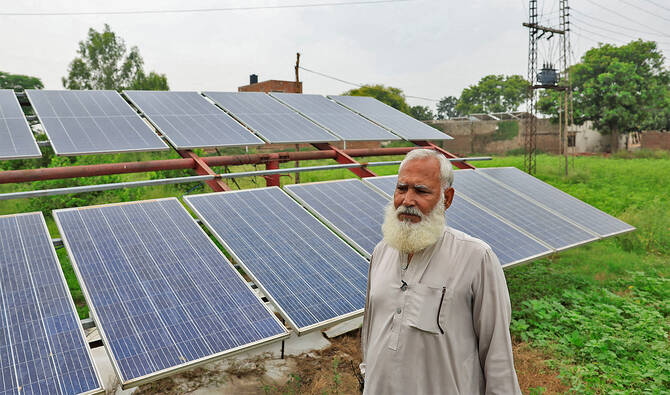

MURIDKE: Out in the fields near Pakistan’s city of Muridke in Punjab province, rice farmer Karamat Ali’s cows and buffalos once provided his family with milk until earlier this year, when he sold about a dozen of them to buy a set of solar panels.
Ali now uses his panels to power a tube well, which is composed of a water well and a motorized groundwater pump. The solar device allows Ali to irrigate his crops with greater ease and frees him from depending on the erratic electricity grid and pricey diesel to extract groundwater.
“It keeps my costs low because it runs without diesel and keeps my water supply running smoothly,” Ali said.

A worker installs a folding solar panel unit, to run a tube well, the motorised pump that taps groundwater, in a rice field in Muridke, Sheikhupura District in Punjab province, Pakistan, on August 12, 2025. (REUTERS)
As Pakistan undergoes a solar revolution fueled by cheap Chinese-made panels, farmers like Ali are increasingly ditching diesel and grid power for sun-powered tube wells, according to interviews with growers, as well as government officials and analysts.
The solar boom has coincided with the rapid depletion of water tables in Pakistan’s most populous province, according to previously unreported Punjab water authority documents viewed by Reuters. The documents did not pinpoint any cause.
Farmers who spoke to Reuters said they had started irrigating their rice paddies several times a day, which would not have been possible without solarised pumps. They are also choosing to grow more thirsty rice crops than in previous years, with the size of rice fields increasing 30% between 2023 and 2025, US Department of Agriculture data shows.
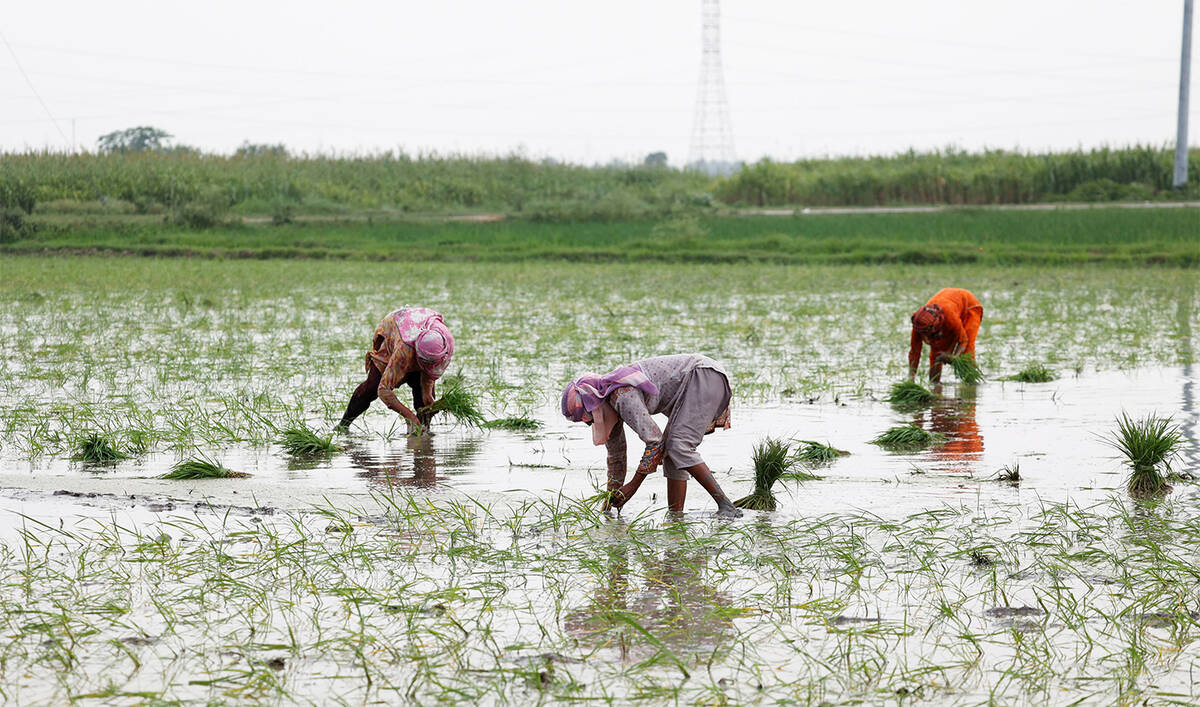
Women farmers plant rice saplings in a field in Muridke, Sheikhupura District in Punjab province, Pakistan, on August 11, 2025. (REUTERS)
There are no recent official estimates on the number of tube wells in Pakistan, which doesn’t require their registration. But so widespread is their use that farmers choosing to power the devices with solar are set to drive a 45 percent collapse in the amount of grid electricity consumed by the agriculture sector in the three years through 2025, said energy economist Ammar Habib, who serves as an adviser to Pakistan’s power minister. His estimate was based on consumption data published by the national energy authority.
Reuters’ calculations based on Habib’s data, which were reviewed by Habib and Lahore-based renewables analyst Syed Faizan Ali Shah, indicate that some 400,000 tube wells that once relied on electricity have switched to solar. Farmers dependent on such panels have likely purchased an additional 250,000 tube wells since 2023, Habib estimated, signalling that the sun now powers roughly 650,000 such devices across Pakistan.
The explosion in availability of cheap solar panels is posing a particular threat to water levels in the South Asian bread basket of Punjab.
The water table has shrunk below 60 feet — a level designated as critical by the provincial irrigation department — across 6.6% of Punjab as of 2024, according to maps published for internal use by water authorities and seen by Reuters.

Adnan Hassan, Senior Research Officer, checks the dipmeter to examine the ground-water level from a borehole, at the Irrigation Research Institute in Punjab Irrigation Department, in Lahore, Pakistan, on August 13, 2025. (REUTERS)
That marks an increase of some 25% between 2020 and 2024, while the deepest pockets — with water levels beyond 80 feet — more than doubled in size during the same period.
Punjab Irrigation Minister Muhammad Kazim Pirzada said there are around 10 cities in the province where water has been seriously depleted.
His department told Reuters it was continuing to study the relationship between tube wells and groundwater depletion, but that it had undertaken measures to protect the water table.
But for many farmers in Punjab, the threat to the water table is a problem for tomorrow.
“Solar panels should be installed at all cost,” said 38-year-old subsistence farmer Rai Abdul Ghafoor, who has been saving for a purchase.

Mian Muhammad Kazim Ali Pirzada, Minister of Irrigation, Punjab, speaks on mobile phone next to a portrait of the Chief Minister of Punjab Maryam Nawaz Sharif during an interview with Reuters in Lahore, Pakistan, on August 12, 2025. (REUTERS)
The switch to solar has allowed 61-year-old Mohammad Naseem to save some 50,000 rupees ($175.21) monthly on electricity and diesel since he bought his panels four years ago. That is 25 percent more than the minimum monthly wage in Punjab.
“I sleep near it. I arrange to guard it at night; we remain vigilant so that it doesn’t get damaged,” said Naseem, who prizes his panels so much that he dismantles them every evening and brings them home from the fields.
While poor farmers are still reliant on diesel and grid power, many agriculture-dependent villages have pooled sums to purchase the panels as communal property.
Hajji Allah Rakha, an 80-year-old farmer who has 16 panels, shares them with two other families. Electricity bills have gone down significantly, benefiting everyone who invested in the technology, Rakha said.
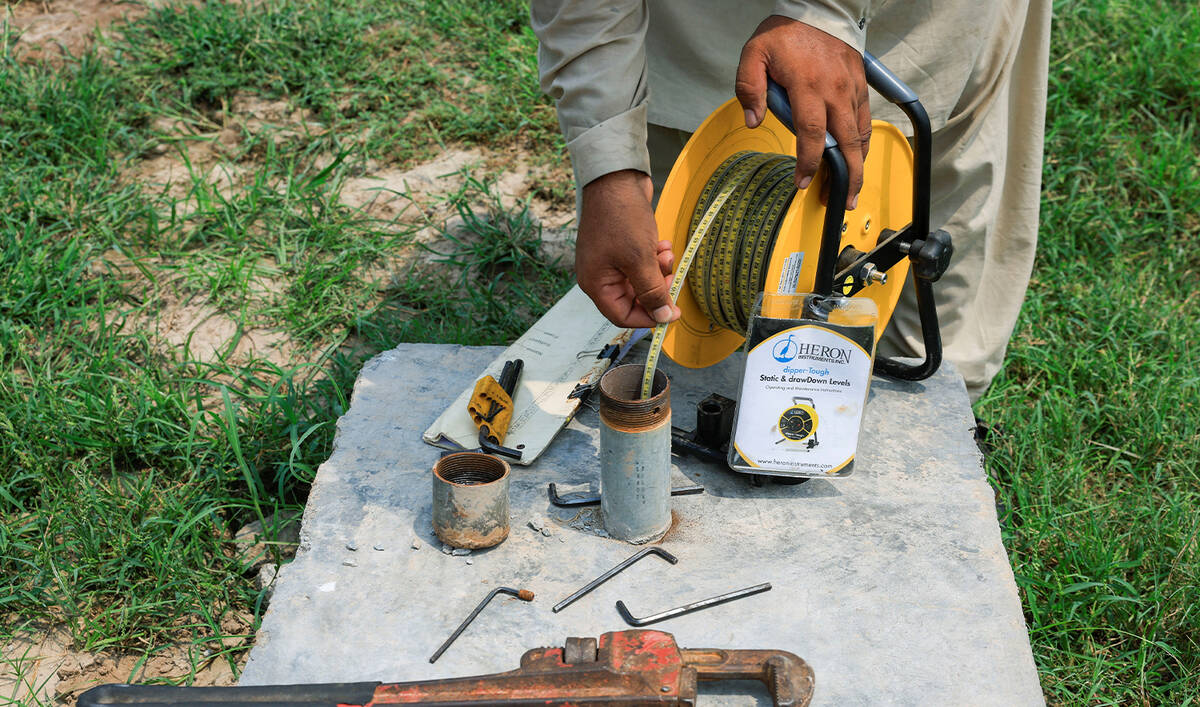
Zaheer, 29, an employee of Punjab Irrigation Department, uses a dipmeter to check the ground water level at a borehole, in Babakwal, Sheikhupura District in Punjab province, Pakistan, on August 13, 2025. (REUTERS)
Shahab Qureshi, a businessman selling solar panels in the provincial capital Lahore, said the solar boom has many farmers using all means to get their hands on the device.
“They would sell land, jewelry, or take loans just to get the solar panels,” Qureshi said.
Meanwhile, federal and provincial officials have started to pay more attention to the slow-boiling crisis, especially after India suspended its participation in an accord governing the sharing of water from the critical Indus River system earlier this year.
Punjab began aquifer-recharge pilots, which aim to slow depletion and ensure stable groundwater supply, at more than 40 sites before India’s April move, though officials said such projects have grown in importance since.
The province is also reviving old infrastructure such as the Ravi Siphon, a colonial-era tunnel that helps stabilize flows from the Ravi River. Officials hope that improving conventional irrigation methods will reduce the need for farmers to extract groundwater.
“What we are injecting in the aquifer, that quality must be equal to the drinking water quality. If you inject polluted water from the roads to the aquifers, then the next generation will suffer the consequences,” said Adnan Hassan, a researcher for Punjab’s irrigation department.


