

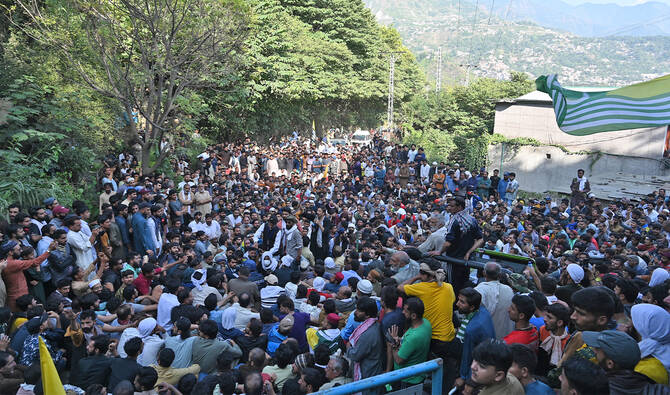

ISLAMABAD: The government in Azad Kashmir has reached an agreement with a civil rights alliance to end days of unrest in the northern Pakistani region, a Pakistani federal minister announced on Saturday, following the killing of at least nine people in deadly clashes.
The clashes erupted after calls for an indefinite ‘lockdown’ by the Jammu Kashmir Joint Awami Action Committee (JKJAAC) from Sept. 29, seeking removal of perks for government officials, ending 12 seats in the regional assembly reserved for Kashmiri migrants who came from the Indian-side of the territory, and royalty for hydel power projects.
The protests have turned violent as protesters and police came face to face and clashed at various locations, with authorities confirming killing of six civilians and three policemen this week. The crisis prompted Pakistan Prime Minister Shehbaz Sharif to send a negotiations team to the territory to join the regional government in talks with the protesters.
“It was the wisdom of local and national leadership and the spirit of dialogue that enabled us to resolve this stand-off peacefully, without violence, without division, and with mutual respect,” Pakistani Planning Minister Ahsan Iqbal, who was part of the negotiations, said on X.
Pakistani Parliamentary Affairs Minister Dr. Tariq Fazal Chaudhry shared a copy of the agreement on X, which included the formation of a judicial commission to probe violent incidents, reduction in the number of regional government ministers and secretaries, and setting up a committee on reserved seats for migrants.
“Persons killed in the incidents of 1st and 2nd October 2025 shall be compensated with monetary benefits equivalent to LEAs (law enforcement agencies),” it read. “Gunshot injuries will be compensated at the rate of Rs10 lac ($3,554) per injured person. A government job shall be granted to one of the family members of each dead person within 20 days.”

The picture shared on Oct. 4, 2025, shows government officials and representative of Joint Awami Action Committee meeting in Muzaffarabad. (Ahsan Iqbal/X)
Sardar Umar Nazir, a JKJAAC member, congratulated supporters in Kohala, Muzaffarabad, over the agreement. “Twelve seats of refugees [from Indian-administered Kashmir], firstly, ministries have been withdrawn from ministers on those 12 seats,” he said, explaining details of the agreement with the government.
“Number two, the funds in the name of refugees, which used to be transferred to Pakistan, all those funds have been abolished. And the third thing, the [government job] quota in the name of refugees has also been abolished.”
Kashmir is divided between India and Pakistan since their independence from British rule in 1947. Both claim the territory in its entirety, but rule in part.
Azad Kashmir is the part administered by Pakistan. The negotiations between the government and JKJAAC followed shutter-down and wheel-jam strikes that disrupted public life in the territory.
In May 2024, a similar wave of protests paralyzed the region. After six days of strikes and violent clashes that left at least four dead, PM Sharif approved a grant of Rs 23 billion ($86 million) for subsidies on flour and electricity, and a judicial commission to review elite privileges.
Protest leaders suspended their campaign at that time but warned that failure to implement the package would fuel fresh unrest.


