

At UNGA80 arts festival, first-ever Pakistani panel links climate justice and cultural survival

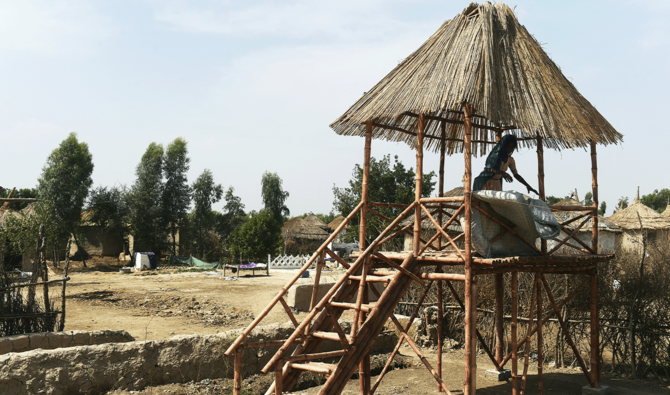
In this picture taken on April 9, 2023, a girl places a mattress for drying at an elevated bamboo structure in Pono Colony at Sanjar Chang village, in Tando Allahyar district. (AFP/File)
Short Url
Updated 04 October 2025
Follow

At UNGA80 arts festival, first-ever Pakistani panel links climate justice and cultural survival

  • Experts, artisans and heritage keepers urge global action to protect indigenous knowledge and traditions
  • Speakers highlight the impact of floods and extreme weather on rural communities and cultural identity

ISLAMABAD: In a first, a panel of Pakistani experts, artisans and heritage keepers convened online during Climate Week NYC, warning that environmental changes are eroding the country’s intangible cultural heritage, organizers said in a statement on Friday.

Titled “Stitching Survival: Reclaiming Heritage and Climate Justice Through the Art of Displaced Pakistani Artisans,” the session was held as part of the Arts for the Future Festival, an international gathering that brings together artists, activists and policymakers to explore how culture and heritage can help build more resilient futures.

Held on Sept. 27 during Climate Week NYC alongside the UN General Assembly, the panel highlighted how extreme weather is damaging Pakistan’s landscapes as well as its traditions, crafts, oral histories and indigenous knowledge systems.

“Pakistan is too often missing from the global creative economy but when we are left out, the world loses centuries of sustainable knowledge and artistry,” said Amneh Shaikh-Farooqui, chair and curator of the Women of the World Festival in Pakistan.

“Our artisans aren’t just makers,” he continued. “They are leaders, carrying cycles of sustainability that the world urgently needs.”

London-based couture designer Omar Mansoor criticized the rise of fast fashion and its environmental impact, calling for a shift toward more sustainable practices in the global fashion industry.

Karachi-based artist Ayman Babar spoke about the destruction of indigenous cotton crops due to corporate practices and weak regulation, urging “seed sovereignty” to ensure genuine sustainability.

Senior journalist Mohsin Sayeed stressed the pivotal role of rural communities, describing them as “the legacy of ancient civilizations” whose knowledge was essential for survival amid the climate crisis.

“To protect heritage is to protect the soil of memory,” he said. “Art is not a luxury in crisis but a lifeline. The Global North needs to learn to listen to us, not talk at us. We are inheritors of forms of living that have survived man-made and natural disasters.”

“There is a truth to indigenous knowledge and their way of living that we simply cannot afford to ignore anymore,” he added.

Publisher Mehr Husain highlighted the human cost of climate change, speaking about her ancestral village of Shorkot, which has been devastated by recent floods.

“When our lands are washed away, it is not only our homes that are lost but the songs, symbols, stitches, stories that carry our history and identity,” she said. “This panel seeks not only to inform but to spark systemic shifts in how heritage, art and climate policy intersect and reinforce one another.”



Pakistan’s Punjab launches tech-driven shrimp estates plan with Saudi, UAE expertise

Updated 4 sec ago
Follow

Pakistan’s Punjab launches tech-driven shrimp estates plan with Saudi, UAE expertise

  • Project to include hatcheries, aqua malls, processing plants, cold storage facilities and logistics chain
  • Pakistan’s seafood exports declined in FY 2024, with export value dropping by 17.4 percent to $410 million

ISLAMABAD: The chief minister of Pakistan’s most populous Punjab province this week launched a plan to establish technology-driven shrimp estates in Muzaffargarh and Sargodha by March 2026 with the expertise of Saudi Arabia and the United Arab Emirates (UAE).

The project will include hatcheries, aqua malls, processing plants, cold storage facilities, and an integrated transport and logistics chain. Shrimp estates are designated zones for large-scale shrimp farming and processing, designed to cluster the entire value chain in one location to improve efficiency, biosecurity and export capacity.

"Phase-I will establish 5,300 acres of shrimp estates in Muzaffargarh and Sargodha by March 2026, Insha’Allah," Punjab Chief Minister Maryam Nawaz Sharif said in a post on X on Sunday.

"The initiative is built on global R&D, advanced aquaculture technologies and world-class expertise from the UAE, Saudi Arabia, Thailand, Ecuador, Australia and Mexico," she added.

"The project has been formally launched, with machinery already on the ground and dedicated teams working day and night to ensure timely execution."

Sharif said the development followed the successful completion of a 100-acre shrimp pilot and research project last year, highlighting that a feasibility study is underway for an additional 26,000 acres.

Pakistan’s fish and fishery product exports declined in FY 2024, with export value dropping by 17.4 percent to $410 million and quantity decreasing by 6.9 percent to 199,738 metric tons compared to FY 2023, according to the Pakistan Bureau of Statistics.

The country's 1,046-km coastline along a major trade route remains underutilized, with a maritime economy held back by limited fleets, outdated ports and falling seafood exports.