

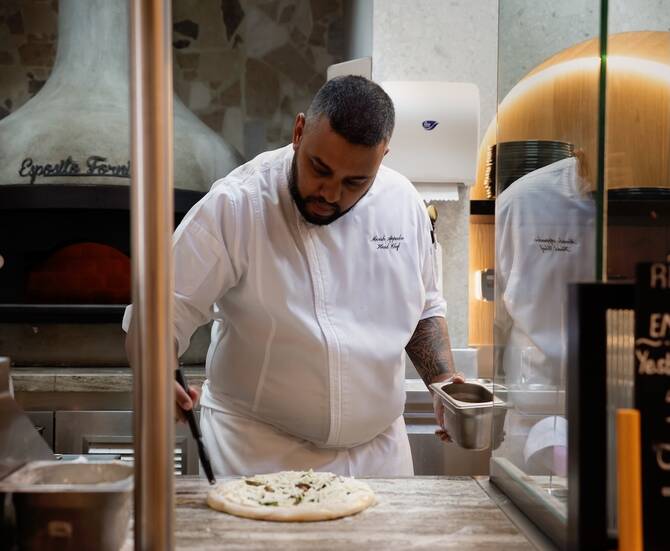

DUBAI: Long before he led professional kitchens or perfected complex stocks, Mevish Appadoo, now head chef at Twine — a Mediterranean restaurant in Dubai — was just a teenager in Mauritius captivated by the aromas coming from his grandfather’s stove.
“I was always telling my parents and my grandmother, ‘One day I will cook like Grandpa,’” Appadoo told Arab News. “This stayed in my head.”
At 17, after dropping out of school, he made the leap into the culinary world. What began as a boy’s dream quickly turned into a career path marked by discipline, patience and an enduring passion for process. Now aged 32, with years of experience behind him, including time spent as a ramen chef, he has developed a leadership style shaped by old-school mentorship and modern sensibilities.

Mevish Appadoo is the head chef at Twine. (Supplied)
When you started out, what was the most common mistake you made?
You know, in the kitchen, we always need to wash our hands, but I wasn’t drying my hands properly before seasoning. I’d get shouted at a lot by the chef. When your hands are wet, the seasoning gets stuck to your fingers, so you don’t have control (over it).
What’s your top tip for amateur chefs?
You need to have patience. You can’t just cook very fast. The food will never be good if you don’t give it the time it’s supposed to take to cook. Anyone can cook pasta in five minutes, but it’s not going to be the same as pasta that takes 15 minutes.
What one ingredient can instantly improve any dish?
Salt. It’s so important, and there are lots of people who don’t know when or how to use it. If it’s a stock or soup, you can put the salt in at the last minute. But if you’re cooking a meat dish, you need the salt at the beginning to help it penetrate the meat and make it more flavorful.
When you go out to eat, do you find yourself critiquing the food?
To be honest, I did that when I first started as a chef, because I thought I knew more than everyone. But over time, especially when I became a sous-chef at that level, I stopped doing it. Now what I do is I go, eat, pay my bill, and if I have any complaints, or even compliments, I try to go directly to the chef. I never go to the manager or the waiter because I don’t want it to look like a complaint. I just go to the chef and tell him, “I liked this.” Or “Maybe you should try this.” Things like that.
What’s the most common issue you find in other restaurants?
I would say it starts with the service. If they don’t treat you well at the beginning, it affects everything. If they take 15 minutes to bring you the menu, or they don’t smile, or you order still water and they bring sparkling, your mood starts to drop. That’s how guests start to complain. Sometimes, even if you give them good food, everything that happened before has already spoiled the experience.
What’s your favorite cuisine or dish to eat?
I’m not a fan of big restaurants or big culinary spaces, even though that’s where I work. I prefer to eat in small cafeterias. My favorite dish in Dubai is omelet, paratha with cheese, and Oman chips. I could eat that every day.

Twine is a Mediterranean restaurant in Dubai. (Supplied)
What’s your go-to dish to cook quickly at home?
I always prefer simple food. So, noodles — but Mauritian noodles. They’re very different. They’re kind of like ramen, but everything is different, the stock, the noodles themselves, and the garnish.
What’s your favorite dish to cook?
At work, I love to make stocks — chicken stock, beef stock… — to use as a base for sauces. It requires a lot of steps. If I’m at home, I love to cook biryani. That also requires many steps. Everything that has stages excites me… there’s something about following that process. The steps are what make it pleasurable to cook.
What’s the most difficult dish for you to get right?
Before, I was a chef at a Japanese restaurant where we made ramen. It was very challenging to get the taste of the soup right. Ramen broth has to cook for six to eight hours. You can’t miss a step. You can’t put it on a high flame, it needs to be controlled very, very delicately. When people eat ramen, they think it’s about the meat or the egg or the noodle. No, it’s about the soup. The soup is what makes it what it should be.
As a head chef, what are you like?
I would say I’m a mix of generations. Because I started very young, I never trained with people my age; all the chefs who trained me were old — in their sixties. I don’t know how to describe them, but they really made me strong. Without them, I wouldn’t be the person I am today. So many people tell me, “You’re very young. How can you do this? How can you do that?” I hope (those chefs) can hear me when I say this is all because of them. Now I try to bring that experience to the new generation and adapt how I guide them, because they are not like the generation before. You can’t just shout at them. They understand things differently now.
Chef Mevish’s Greek watermelon and feta salad with honey zaatar dressing

Chef Mevish’s Greek watermelon and feta salad with honey zaatar dressing. (Supplied)
Ingredients for 1 portion:
Salad
25g Watermelon
25g feta
10g roasted almonds
15g cucumber
5g kalamata olives
Fresh herb salad
2g mint leaves
2g zaatar
2g dill leaves
2g parsley
2g rucola
Dressing
6ml olive oil
2ml lemon juice
4ml honey
3g chopped fresh zaatar
Salt and pepper for tasting
Directions:
Cut the watermelon and feta into cubes.
Roast the almonds and slice.
Shave the cucumber and form it into rolls.
Dehydrate the kalamata olives in a food dehydrator or oven at 50-60°C for one hour.
Once the kalamata olives are dehydrated, blend them into a powder using a blender.
In a separate bowl, prepare the honey zaatar dressing by combining olive oil, lemon juice, honey, chopped fresh zaatar and salt and pepper to taste.
Then make the Fresh Herb Salad by mixing mint leaves, zaatar, dill leaves, parsley and rucola, then add a little bit of the dressing.


