JAKARTA: Indonesian families whose children were offered free school meals are joining non-profit groups calling for the flagship government program to be suspended after thousands of students fell ill from the food.
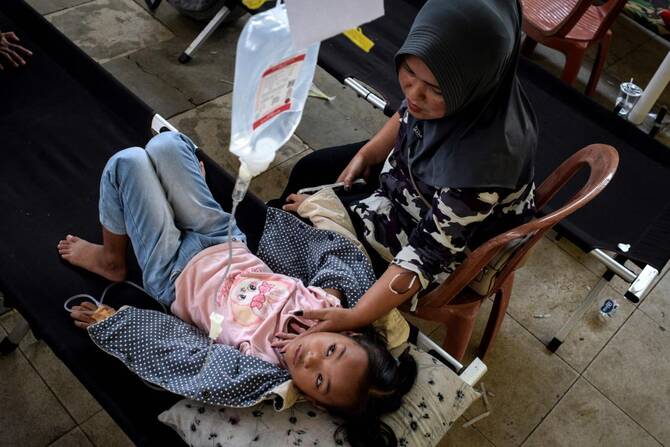
Cases of food poisoning spiked last week in West Bandung, a district of Java island, when more than 1,300 children were rushed to health clinics after suffering from breathing difficulties, nausea and diarrhea, local media reported.
President Prabowo Subianto’s initiative was touted as a way to tackle a child nutrition crisis but the government has instead had to suspend dozens of production kitchens.
“This program should be stopped and replaced with cash,” said 50-year-old grandmother Aminah, who goes by one name and whose seven-year-old grandson got sick after a free meal.
“I’d rather the kids bring their own lunch from home.”
The disastrous rollout comes as Prabowo is working to move on from violent anti-government protests fueled by deep inequality in Indonesia, where stunting spurred by malnutrition affects more than 20 percent of children.
But nine months after the program began, food poisoning cases have affected thousands of people, prompting mounting calls from non-profit groups for a temporary halt to the multi-billion-dollar scheme.
In West Bandung, students wailed in pain as they were hooked up to oxygen tanks in a temporary health clinic set up by local government to handle the surge in food poisonings, an AFP journalist saw.
The National Nutrition Agency (BGN), which is responsible for the initiative, reported 70 food poisoning incidents since the program began in January until late September.
More than 6,400 people are affected, the agency said in an update on Wednesday.
The reported cases were the “tip of the iceberg,” said Diah Satyani Saminarsih, founder of the non-profit Center for Indonesia’s Strategic Development Initiatives.
“The actual number of cases could be higher because the government has not yet provided a publicly available reporting dashboard,” Diah said.
Part of the problem was the government’s rapid expansion of the program, she added.
Rapid expansion
The government initially aimed to deliver meals to almost 83 million people by 2029, including students, pregnant women and breastfeeding mothers, but now says the target will be reached by the end of 2025.
The nutrition agency expanded the number of production kitchens from around 1,000 in April to more than 9,600 by late September.
The number of beneficiaries grew from three million to 31 million over the same period.
The agency did not immediately respond to a request for comment.
Dadan Hindayana, chair of the nutrition agency, said in a statement on Sunday that most of the cases occurred in newly operating kitchens where cooks lacked experience.
The food poisoning incidents were also caused by the quality of raw materials, water and violations of operational standards, he said.
Prabowo’s administration has allocated 62 cents per meal and set a budget of 71 trillion rupiah ($4.2 billion) for 2025.
Finance Minister Purbaya Yudhi Sadewa said last week that the government had prepared an additional budget of 28 trillion rupiah requested by the agency, local media reported.
Prabowo defended the program in a televised speech on Monday, saying cases of food poisoning incidents were long a small percentage of the number of meals served.
“We calculated from all the food that went out, the deviation, or shortcoming or error is 0.00017 percent,” he said.
He added that all kitchens involved in the program were ordered to test foods before distribution.
Calls for suspension
It was “very urgent” for the program to be suspended given the number of people who fell ill, said Izzudin Al Farras, a researcher at the Institute for Development of Economics and Finance.
Ubaid Matraji, a researcher at the Network for Education Watch, said the program should be suspended before matters worsen.
“We stress that we will no longer wait until we have thousands more victims — we cannot let death happen,” he said.
The nutrition agency suspended 56 kitchens allegedly responsible for “food safety incidents,” it said in a statement Monday.
Nanik S. Deyang, the agency’s deputy chair, said the suspension was part of a “comprehensive evaluation” to prevent similar incidents from recurring.
“The safety of the people, especially children who receive the free nutritious meals, is our top priority,” she said.

Indonesia free meals program under fire after thousands sickened
Short Url
https://arab.news/gnt47
Indonesia free meals program under fire after thousands sickened
- Indonesian families whose children were offered free school meals are joining non-profit groups calling for the flagship government program to be suspended after thousands of students fell ill
China to halt Japan seafood imports amid Taiwan spat: reports
TOKYO: China will suspend Japanese seafood imports, media in Tokyo reported Wednesday as a row sparked by comments about Taiwan deepens, although neither government confirmed the move.
The uneasy neighbors’ most serious spat since 2012 was triggered by new Prime Minister Sanae Takaichi suggesting on November 7 that Tokyo could intervene militarily in any attack on Taiwan.
China, which claims Taiwan as part of its territory, has been furious, summoning Tokyo’s ambassador and advising its citizens against travel to Japan.
The release of at least two Japanese movies will also be postponed in China, according to state media.
Reporting the suspension of seafood imports, Japanese media, including public broadcaster NHK, cited unnamed government sources.
China explained the move as necessary to monitor treated wastewater being released from the stricken Fukushima nuclear power plant, NHK said.
China had only recently resumed purchasing some marine products from Japan following an earlier ban imposed after the Fukushima operation began in 2023.
The UN atomic agency said the release of the equivalent of 540 Olympic pools’ worth of cooling water collected since a tsunami crippled the facility in 2011 was safe.
But Beijing has accused Japan of treating the Pacific as a “sewer.”
Beijing’s foreign ministry did not confirm the latest reported suspension when asked on Wednesday.
Ministry spokeswoman Mao Ning told a regular news conference: “Under the current circumstances, even if Japanese seafood were exported to China, there would not be a market.”
Japanese government spokesman Minaru Kihara also said there had been “no notifications from the Chinese side on this.”
“It is important to follow through on the understanding shared between Japan and China in September last year (about seafood),” Kihara told reporters.
In 2023, seafood shipments to mainland China accounted for 15.6 percent of a total of 390 billion yen ($2.5 billion), down from 22.5 percent in 2022.
Hong Kong accounted for 26.1 percent, and the United States accounted for 15.7 percent in 2023.
- ‘Strong protest’ -
Key trading partners, China and Japan have seen ties frayed by territorial rivalries and military spending in recent years.
China is the biggest source of tourists to Japan, with almost 7.5 million visitors in the first nine months of 2025.
One analyst estimated that Chinese travelers have canceled around half a million air tickets in recent days.
“Recently, 90 percent of our customers (going to Japan) have asked for refunds,” Wu Weiguo, 48, a manager at a Shanghai travel agency, told AFP.
“I think relations will be able to improve, as long as Japan can tone down their rhetoric... After all, there are a lot of Chinese people currently in Japan, including my cousin, who is married to someone there,” said his colleague Zhou Pei, 47.
Japan on Monday urged its citizens in China to be careful of their surroundings and to avoid big crowds.
Beijing on Tuesday vowed to “protect the safety” of foreigners in China, but said it had again lodged a “strong protest” with Tokyo over Takaichi’s comments.
Seeking to defuse the row, the top official in Japan’s foreign ministry for Asia-Pacific affairs, Masaaki Kanai, held talks Tuesday in Beijing with his Chinese counterpart Liu Jinsong.
“During the consultations, China once again lodged a strong protest with Japan” over “Takaichi’s erroneous remarks,” said Beijing’s foreign ministry spokeswoman Mao Ning.
“Takaichi’s fallacies seriously violate international law and the basic norms governing international relations,” Mao said, adding the premier’s comments “fundamentally damage the political foundation of China-Japan relations.”
The uneasy neighbors’ most serious spat since 2012 was triggered by new Prime Minister Sanae Takaichi suggesting on November 7 that Tokyo could intervene militarily in any attack on Taiwan.
China, which claims Taiwan as part of its territory, has been furious, summoning Tokyo’s ambassador and advising its citizens against travel to Japan.
The release of at least two Japanese movies will also be postponed in China, according to state media.
Reporting the suspension of seafood imports, Japanese media, including public broadcaster NHK, cited unnamed government sources.
China explained the move as necessary to monitor treated wastewater being released from the stricken Fukushima nuclear power plant, NHK said.
China had only recently resumed purchasing some marine products from Japan following an earlier ban imposed after the Fukushima operation began in 2023.
The UN atomic agency said the release of the equivalent of 540 Olympic pools’ worth of cooling water collected since a tsunami crippled the facility in 2011 was safe.
But Beijing has accused Japan of treating the Pacific as a “sewer.”
Beijing’s foreign ministry did not confirm the latest reported suspension when asked on Wednesday.
Ministry spokeswoman Mao Ning told a regular news conference: “Under the current circumstances, even if Japanese seafood were exported to China, there would not be a market.”
Japanese government spokesman Minaru Kihara also said there had been “no notifications from the Chinese side on this.”
“It is important to follow through on the understanding shared between Japan and China in September last year (about seafood),” Kihara told reporters.
In 2023, seafood shipments to mainland China accounted for 15.6 percent of a total of 390 billion yen ($2.5 billion), down from 22.5 percent in 2022.
Hong Kong accounted for 26.1 percent, and the United States accounted for 15.7 percent in 2023.
- ‘Strong protest’ -
Key trading partners, China and Japan have seen ties frayed by territorial rivalries and military spending in recent years.
China is the biggest source of tourists to Japan, with almost 7.5 million visitors in the first nine months of 2025.
One analyst estimated that Chinese travelers have canceled around half a million air tickets in recent days.
“Recently, 90 percent of our customers (going to Japan) have asked for refunds,” Wu Weiguo, 48, a manager at a Shanghai travel agency, told AFP.
“I think relations will be able to improve, as long as Japan can tone down their rhetoric... After all, there are a lot of Chinese people currently in Japan, including my cousin, who is married to someone there,” said his colleague Zhou Pei, 47.
Japan on Monday urged its citizens in China to be careful of their surroundings and to avoid big crowds.
Beijing on Tuesday vowed to “protect the safety” of foreigners in China, but said it had again lodged a “strong protest” with Tokyo over Takaichi’s comments.
Seeking to defuse the row, the top official in Japan’s foreign ministry for Asia-Pacific affairs, Masaaki Kanai, held talks Tuesday in Beijing with his Chinese counterpart Liu Jinsong.
“During the consultations, China once again lodged a strong protest with Japan” over “Takaichi’s erroneous remarks,” said Beijing’s foreign ministry spokeswoman Mao Ning.
“Takaichi’s fallacies seriously violate international law and the basic norms governing international relations,” Mao said, adding the premier’s comments “fundamentally damage the political foundation of China-Japan relations.”
© 2025 SAUDI RESEARCH & PUBLISHING COMPANY, All Rights Reserved And subject to Terms of Use Agreement.


