MANCHESTER, England: An assailant drove a car into people outside a synagogue Thursday in northern England and stabbed two of them to death in what police called a terrorist attack on the holiest day of the Jewish year.
Officers shot and killed the suspect at the synagogue in Manchester, police said, though authorities took some time to confirm he was dead because he was wearing a vest that made it appear as if he had explosives. Police later said he did not have a bomb.
The Metropolitan Police force in London, which leads the nation’s counter-terrorism policing operations, declared the rampage a terrorist attack. The assault took place as people gathered at an Orthodox synagogue in an outer neighborhood of Manchester on Yom Kippur, the day of atonement and the most solemn day in the Jewish calendar.
Authorities said the man believed responsible was a 35-year-old British citizen of Syrian descent named Jihad Al-Shamie, who entered the UK as a young child and became a citizen in 2006. An initial check of records showed he was not part of a UK counter-terror program that tries to identify people at risk for being radicalized.
Police also said three people were arrested on suspicion of acts of terrorism. They are two men in their 30s and a woman in her 60s.
Police said the two people killed were Jewish. Authorities were working to formally identify them and determine the motive for the attack.
At least three people were hospitalized in serious condition, officials said. One person sustained a stab wound while a second was struck by the car involved in the attack. A third person arrived at a hospital with an injury that may have been sustained as officers stopped the attacker. A fourth injured person was taken to the hospital, but their injuries and condition were not available.
Denouncements of the attack and concern for Jewish communities
British Prime Minister Keir Starmer denounced the “vile” assailant who “attacked Jews because they are Jews.” He promised the Jewish community that he would do “everything in my power to guarantee you the security that you deserve, starting with a more visible police presence.”
“I promise you that over the coming days, you will see the other Britain, the Britain of compassion, of decency, of love,” Starmer said. “I promise you that this Britain will come together to wrap our arms around your community and show you that Britain is a place where you and your family are safe, secure and belong.”
Israeli Prime Minister Benjamin Netanyahu said Israel grieved with the Jewish community in the UK
“Our hearts are with the families of the murdered, and we pray for the swift recovery of the wounded,” he said. “As I warned at the UN: Weakness in the face of terrorism only brings more terrorism. Only strength and unity can defeat it.”
Antisemitic incidents in the UK have hit record levels following Hamas’ Oct. 7, 2023, attack on Israel and Israel’s ensuing military campaign in Gaza, according to Community Security Trust, an advocacy group for British Jews that works to eliminate antisemitism.
More than 1,500 incidents were reported in the first half of the year, the second-highest six-month total reported since the record set over the same period a year earlier.
“This is every rabbi’s or every Jewish person’s worst nightmare,” said Rabbi Jonathan Romain, of Maidenhead Synagogue and head of the Rabbinic Court of Great Britain. “Not only is this a sacred day, the most sacred in the Jewish calendar, but it’s also a time of mass gathering.”
Witnesses describe a car driving toward the synagogue and then a stabbing attack
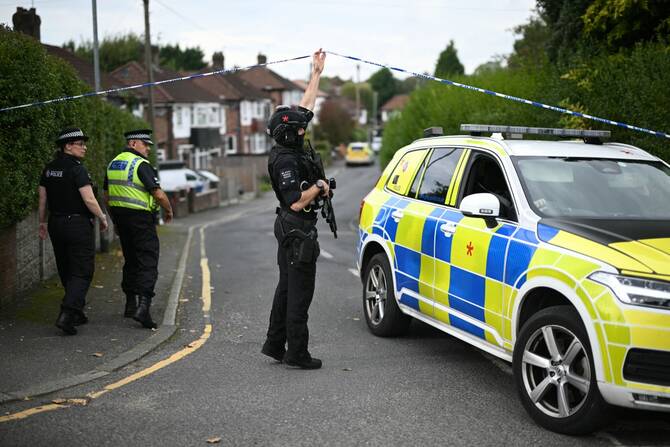
Greater Manchester Police said they were called to the Heaton Park Hebrew Congregation Synagogue around 9:30 a.m., shortly after services had begun.
Chief Constable Stephen Watson said the man drove directly at pedestrians outside the synagogue and then attacked them with a knife.
Chava Lewin, who lives next to the synagogue, said she heard a bang and thought it might be a firework until her husband ran inside their house and said there had been a “terrorist attack.”
A witness told her that she saw a car driving erratically crash into the gates of the house of worship.
“She thought maybe he had a heart attack,” Lewin said. “The second he got out of the car, he started stabbing anyone near him. He went for the security guard and tried to break into the synagogue.”
Minutes later, police fired shots at the assailant.
Video on social media showed police with guns pointed at a person lying on the ground beneath a blue Star of David on the brick wall of the synagogue.
A bystander could be heard on the video saying the man had a bomb and was trying to detonate it. When the man tried to stand up, a gunshot rang out and he fell to the ground.
On the sidewalk outside the synagogue gate nearby, the body of another person lay in a pool of blood.
Watson credited security guards and congregants for their bravery in preventing the assailant from getting inside the prayer service.
Police later detonated an explosive to get into the man’s car.
Manchester was the site of Britain’s deadliest attack in recent years, the 2017 suicide bombing at an Ariana Grande concert that killed 22 people.
Authorities declare an emergency
Immediately after the attack, police declared “Plato,” the national code word used by police and emergency services when responding to a “marauding terror attack.”
Starmer, who flew back to London early from a summit of European leaders in Copenhagen, Denmark, to chair a meeting of the government’s emergency committee, said additional police officers would be deployed at synagogues across the UK
King Charles III said he and Queen Camilla were “deeply shocked and saddened″ to learn of the attack “on such a significant day for the Jewish community.”
“Our thoughts and prayers are with all those affected by this appalling incident, and we greatly appreciate the swift actions of the emergency services,’′ he said on his social media feed.

Manchester synagogue attacker is a UK citizen of Syrian origin: police
Short Url
https://arab.news/8tzxr
Manchester synagogue attacker is a UK citizen of Syrian origin: police
- Police arrested three other suspects in the attack
From AI to Starlink: how drone tech is reshaping war in Ukraine
KYIV: As the war in Ukraine drags into its fifth year, drones have come to completely dominate the front line — a transformation in modern warfare that is being watched around the world.
Here is a look at the technology that is reshaping the war, four years after Russia launched its full-scale invasion by pouring tanks and men over the border:
- Kill zone -
Ranging from cheap commercial devices designed for civilian use to explosive-packed miniature aircraft, drones are responsible for up to 80 percent of battlefield damage, Ukraine’s Defense Minister Mykhailo Fedorov has said.
“Modern warfare is now impossible without drones,” Koleso, a Ukrainian infantry soldier, told AFP in eastern Ukraine.
The front line has been transformed into a “kill zone” stretching up to 20 kilometers (12 miles) deep — “an area between two sides where nothing can survive because it’s constantly monitored by drones,” military expert Kateryna Bondar explained.
Soldiers can only operate there in small groups, moving fast and with their eyes fixed to the sky, hoping to stay undetected.
Heavy pieces of artillery, as well as sluggish tanks and armored vehicles, are too slow and visible — making them easy targets for both sides.
Unwilling to send more men that necessary into the kill zone, Ukrainian troops use ground drones to ferry supplies to dangerous areas and to evacuate wounded soldiers.
- Fibre optics -
Maintaining a stable connection between the drone and its operator, controlling it remotely, is a crucial task.
“That’s where the real race is happening — communications and connections,” Bondar said.
Initially, most drones operated on a radio connection.
But they proved vulnerable to electronic warfare — the practice of jamming and intercepting enemy craft, causing them to drop out of the sky or lose connection to the operator.
Russia has turned to drones controlled by ultra-thin fiber-optic cables, largely immune to electronic jamming.
In scenes that resemble a dystopian sci-fi movie, their widespread use has left swathes of frontline cities and fields entombed in webs of cable.
- Starlink -
In another alternative to radio control, Ukrainians have begun attaching Starlink terminals to drones.
This allows them to fly using a satellite Internet connection.
“We need to fly far away with a stable video signal and stable control,” said Phoenix, a commander from Ukraine’s Lasar Group, a pioneer in the use of Starlink.
Russian troops soon started copying, until Ukraine pushed Elon Musk last month to disable unauthorized Russian terminals.
The move disrupted both Russian and Ukrainian systems, military observers said.
The US-based Institute for the Study of War said the switch-off likely helped enable a localized, but rapid, Ukrainian advance in the southern Zaporizhzhia region in early February.
- Air defenses -
The spread of drones has forced a revamp of air defense systems.
Firing advanced missiles — which can cost millions — to down drones worth just a fraction of that is too expensive a response.
Alongside jamming, Ukraine has also developed cheap interceptor drones built specially to destroy other craft mid-air.
“We opened the chapter of the war of drones with drones,” said Marko Kushnir of General Cherry, a leading interceptor drone maker.
Roads near the front have been equipped with protective nets attempting to stop attacking drones, while trucks fitted with anti-drone cages and drone jammers speed along them.
Machine guns are also a last resort to shoot down drones from the sky.
Ukraine’s Western allies have increasingly looked to Kyiv’s experience after Russian drones made repeat incursions into European airspace in recent months.
- AI -
Engineers are racing to equip drones with artificial intelligence to improve their performance.
Ukrainian firms such as The Fourth Law (TFL) say they have developed so-called terminal guidance, which allows AI to take control of a device in the final moments before impact.
This is meant to improve the accuracy of strikes, especially as connection is typically lost in the final moments before a hit.
“Russia and China are also developing such technologies, and if our countries don’t... we will lose,” said TFL’s Maksym Savanevskyi.
But full autonomy remains some way off.
“AI is performing a helping function rather than substituting human,” said Bondar, the military expert.
“I thought they could simply remove people from battle equipment, that it could be fully automated. That’s a naive view,” said former Google CEO Eric Schmidt, now head of SwiftBeat, a company that supplies AI drones to Ukraine’s army.
“For the foreseeable future, you’ll have drones first, people second,” he told a conference in Kyiv.
All the way on the eastern front, Koleso said foot soldiers would always remain relevant.
“Until you plant the flag yourself, with your own hands, and take the position, it cannot be considered yours,” he said.
Here is a look at the technology that is reshaping the war, four years after Russia launched its full-scale invasion by pouring tanks and men over the border:
- Kill zone -
Ranging from cheap commercial devices designed for civilian use to explosive-packed miniature aircraft, drones are responsible for up to 80 percent of battlefield damage, Ukraine’s Defense Minister Mykhailo Fedorov has said.
“Modern warfare is now impossible without drones,” Koleso, a Ukrainian infantry soldier, told AFP in eastern Ukraine.
The front line has been transformed into a “kill zone” stretching up to 20 kilometers (12 miles) deep — “an area between two sides where nothing can survive because it’s constantly monitored by drones,” military expert Kateryna Bondar explained.
Soldiers can only operate there in small groups, moving fast and with their eyes fixed to the sky, hoping to stay undetected.
Heavy pieces of artillery, as well as sluggish tanks and armored vehicles, are too slow and visible — making them easy targets for both sides.
Unwilling to send more men that necessary into the kill zone, Ukrainian troops use ground drones to ferry supplies to dangerous areas and to evacuate wounded soldiers.
- Fibre optics -
Maintaining a stable connection between the drone and its operator, controlling it remotely, is a crucial task.
“That’s where the real race is happening — communications and connections,” Bondar said.
Initially, most drones operated on a radio connection.
But they proved vulnerable to electronic warfare — the practice of jamming and intercepting enemy craft, causing them to drop out of the sky or lose connection to the operator.
Russia has turned to drones controlled by ultra-thin fiber-optic cables, largely immune to electronic jamming.
In scenes that resemble a dystopian sci-fi movie, their widespread use has left swathes of frontline cities and fields entombed in webs of cable.
- Starlink -
In another alternative to radio control, Ukrainians have begun attaching Starlink terminals to drones.
This allows them to fly using a satellite Internet connection.
“We need to fly far away with a stable video signal and stable control,” said Phoenix, a commander from Ukraine’s Lasar Group, a pioneer in the use of Starlink.
Russian troops soon started copying, until Ukraine pushed Elon Musk last month to disable unauthorized Russian terminals.
The move disrupted both Russian and Ukrainian systems, military observers said.
The US-based Institute for the Study of War said the switch-off likely helped enable a localized, but rapid, Ukrainian advance in the southern Zaporizhzhia region in early February.
- Air defenses -
The spread of drones has forced a revamp of air defense systems.
Firing advanced missiles — which can cost millions — to down drones worth just a fraction of that is too expensive a response.
Alongside jamming, Ukraine has also developed cheap interceptor drones built specially to destroy other craft mid-air.
“We opened the chapter of the war of drones with drones,” said Marko Kushnir of General Cherry, a leading interceptor drone maker.
Roads near the front have been equipped with protective nets attempting to stop attacking drones, while trucks fitted with anti-drone cages and drone jammers speed along them.
Machine guns are also a last resort to shoot down drones from the sky.
Ukraine’s Western allies have increasingly looked to Kyiv’s experience after Russian drones made repeat incursions into European airspace in recent months.
- AI -
Engineers are racing to equip drones with artificial intelligence to improve their performance.
Ukrainian firms such as The Fourth Law (TFL) say they have developed so-called terminal guidance, which allows AI to take control of a device in the final moments before impact.
This is meant to improve the accuracy of strikes, especially as connection is typically lost in the final moments before a hit.
“Russia and China are also developing such technologies, and if our countries don’t... we will lose,” said TFL’s Maksym Savanevskyi.
But full autonomy remains some way off.
“AI is performing a helping function rather than substituting human,” said Bondar, the military expert.
“I thought they could simply remove people from battle equipment, that it could be fully automated. That’s a naive view,” said former Google CEO Eric Schmidt, now head of SwiftBeat, a company that supplies AI drones to Ukraine’s army.
“For the foreseeable future, you’ll have drones first, people second,” he told a conference in Kyiv.
All the way on the eastern front, Koleso said foot soldiers would always remain relevant.
“Until you plant the flag yourself, with your own hands, and take the position, it cannot be considered yours,” he said.
© 2026 SAUDI RESEARCH & PUBLISHING COMPANY, All Rights Reserved And subject to Terms of Use Agreement.


