


Pakistani sauce brand eyes India exports via Gulf to bypass trade barriers

CEO of ITT Foods Syed Zeeshan Haider in conversation with Arab News on September 16, 2025, in Karachi Pakistan. (AN Photo)
Short Url
Updated 02 October 2025
Follow

Pakistani sauce brand eyes India exports via Gulf to bypass trade barriers

  • Pakistan suspended trade with India in 2019 over tensions related to disputed Kashmir territory
  • Dipitt is in talks to acquire tomato manufacturing facility in Jeddah that was shut down in 2023

KARACHI: Pakistan’s ITT Foods, known for its leading sauces and confectionery under the Dipitt brand, is exploring options to bypass trade barriers and export products to India with a manufacturing facility in Jeddah, the company’s chief executive officer (CEO) said recently.

Dipitt eyes $5 billion Indian market as part of its expansion plans, according ITT Foods CEO Syed Zeeshan Haider. The country, where 37 percent population lives in urban centers, offers $4.73 billion sauces and seasonings and $324 million condiments markets to Pakistan’s largest sauces brand.

Pakistan suspended trade with India in Aug. 2019 after New Delhi revoked special autonomy granted to Indian-administered Kashmir. In April this year, Islamabad announced suspending all trade with India, including to and from any third country, following an attack in Indian-administered Kashmir that New Delhi blamed on Islamabad. Pakistan denied involvement.

In an interview with Arab News, Haider said Dipitt, which has an office in Dubai, gets a lot of queries from India whenever it partakes in the Gulfood exhibition, and the Karachi-based food company is in advanced talks to take over a tomato manufacturing facility in Jeddah Industrial Zone 2 that was shut down in 2023 by a Saudi steel company diversifying into food production.

“So, that’s another bigger market [India] out there which I think we should work with,” Haider said. “And then since Dipitt has a base in Dubai, so that’s another thing that we are exploring from there.”

He said ITT Foods was seeking to set up production facilities outside Pakistan to cut logistics costs and serve the markets faster. Through the facility, it could also navigate trade barriers to India.

“For Pakistan, there is another angle that we are unable to export to India,” he said. “So, that also can be covered from that [Gulf region] market.”

Asked if he would rename his brand, Dipitt, if required for entering the Indian market, Haider said “it will depend on our strategy, various factors, and the regulatory environment at that time.”

‘RIGHT FOOTING, NOT HASTE’

ITT Foods is Pakistan’s largest exporter of sauces and seasonings, which it supplies to 32 countries in five continents across the globe. Exports currently make up about 40 percent of its sales. The company also seeks to expand its business into newer markets such as the US, Germany, France, Russia and Mexico.

Haider said partnering with big-name retailers such as Walmart, Albertsons and others in the US and European regions is the “next milestone” that ITT Foods would set out to achieve this year.

“We want to make sure that when we enter, we enter at the right footing, not in haste,” he said. “It will be very soon that you will find us there.”

Currently, about 20 percent of ITT Foods’ exports go to the North American and European markets.

Haider said these markets were home to a large consumer base where the consumption of sauces is “far more over there as compared to this part of the world.”

ITT Foods plans to expand its business network to 50 countries in the next three years, after which it may look to get listed on the Pakistan Stock Exchange (PSXX), Haider said.

“I think 2030 would be the right time for us to go and seek out if we have to do anything outside,” he said.

‘PROBLEM FOR EVERYBODY’

Asked about the challenges, Haider pointed to increasing taxes that his company was facing in Pakistan. He said the recent increase in the tax on sugar has impacted Dipitt products since sugar is one of the major raw materials needed in manufacturing of ketchups.

“Yes, I think we are taking whatever measure we can take to ensure that the consumer gets the product at the same price,” he said. “Till it becomes to an unbearable point where we cannot take any more.”

Cash-strapped Pakistan has been working with the International Monetary Fund (IMF) to increase its revenues by withdrawing subsidies and increasing taxes in recent years. The move has caused inflation to surge, which peaked to 38 percent in May 2023 before gradually cooling down to 3 percent in August.

According to global accounting firm PricewaterhouseCoopers (PwC), the rate of taxes on Pakistani corporations ranges from 20 to 39 percent.

Financial experts, however, warn the recent floods may spike inflation in the coming days.

“Now taxation is becoming... I think that’s a problem for everybody,” Haider said. “It is becoming difficult and difficult day by day.”

Pakistan calls for calm after 16 people killed in Khamenei protests

Updated 23 min 8 sec ago
Follow

Pakistan calls for calm after 16 people killed in Khamenei protests

  • The violence came hours after Iranian authorities confirmed Supreme Leader Ali Khamenei was killed in coordinated US-Israeli strikes
  • Nine people were killed in clashes in Karachi where protesters stormed US consulate, while UN offices were set ablaze in Gilgit, Skardu

ISLAMABAD/KARACHI/GILGIT/PESHAWAR: Pakistan’s Interior Minister Mohsin Naqvi on Sunday urged calm after at least 16 people were killed in protests linked to the killing of Iran’s Supreme Leader Ayatollah Ali Khamenei in joint US-Israeli strikes.

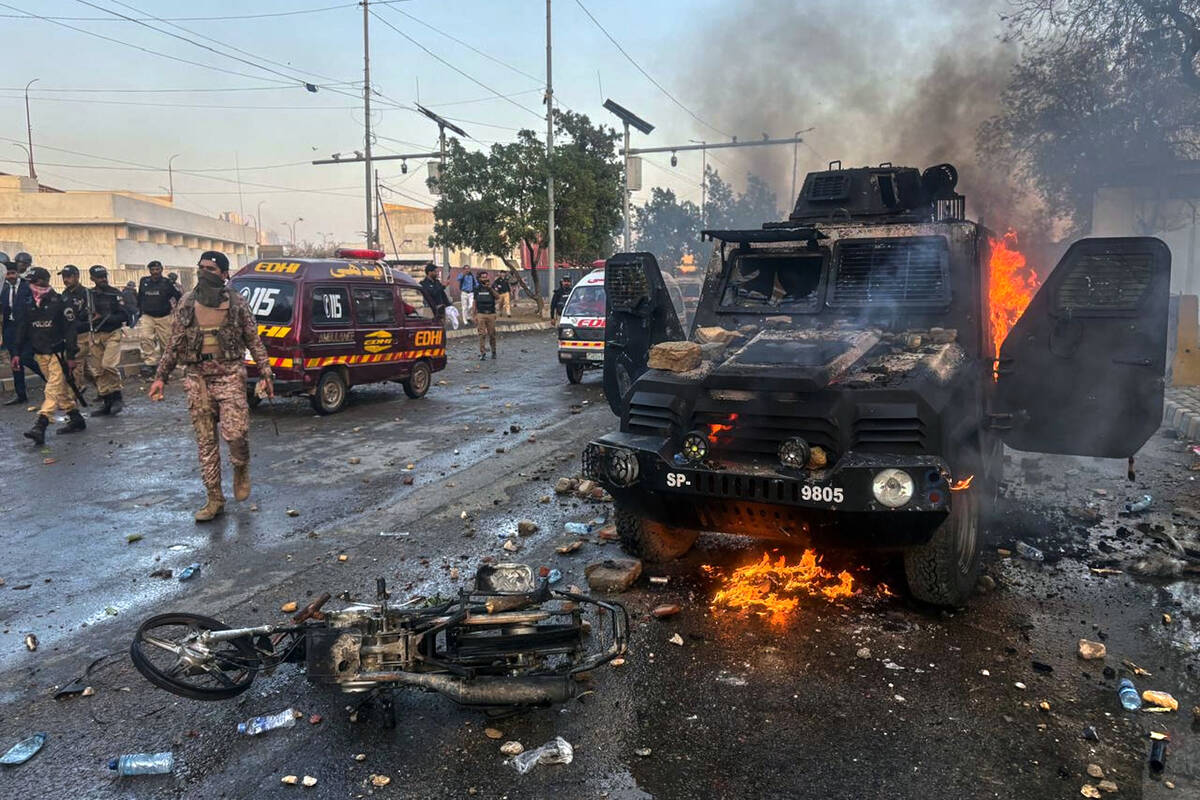
Hundreds of protesters gathered outside the US consulate in Karachi on Sunday morning. Videos showed protesters armed with sticks smashing doors and windows. Separate footage appeared to show property inside the consulate premises set on fire, prompting police to fire tear gas at them.

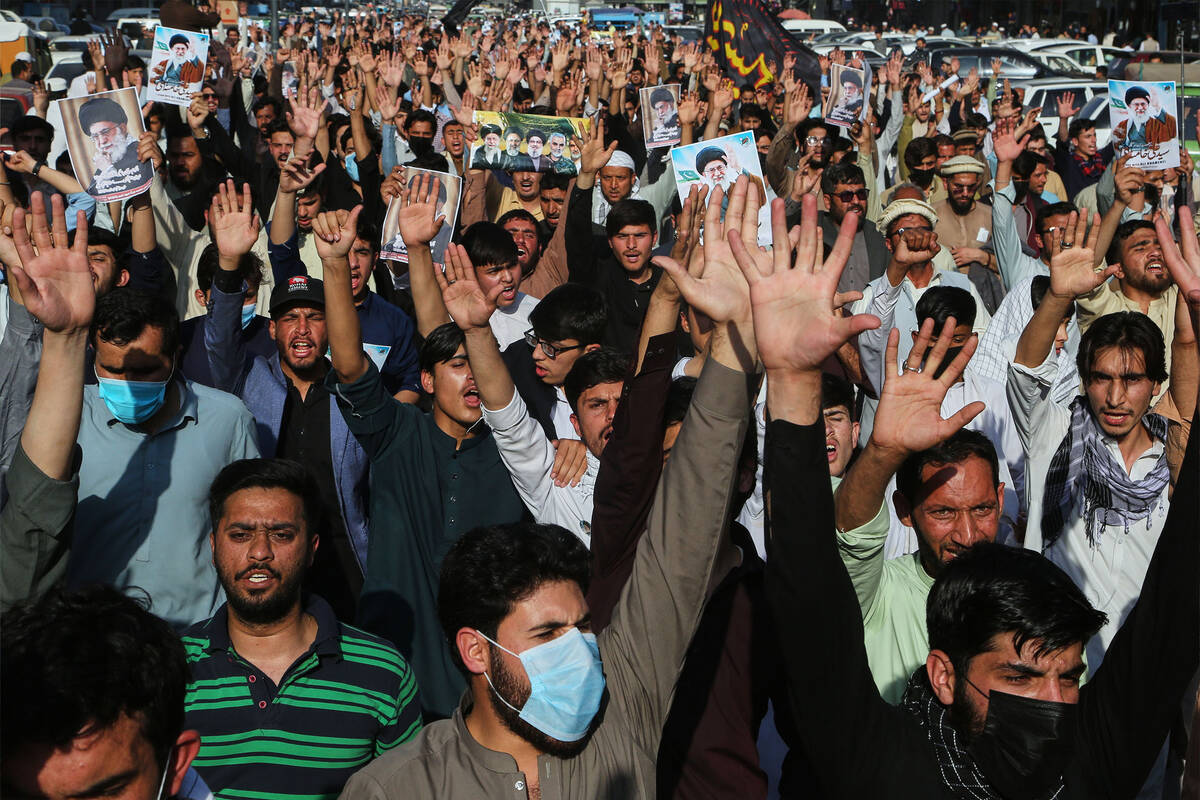
In Islamabad, protesters entered the Red Zone which houses key government and diplomatic offices in the capital, prompting authorities to fire tear gas to disperse the demonstrators. Similarly, people gathered outside the press club in the northwestern city of Peshawar, from where they were marching toward the US consulate.

At least nine people were killed and 60 others sustained injuries in clashes with law enforcement outside the US consulate in Karachi, according to authorities. Seven more were killed in the northern Gilgit-Baltistan region, where clashes left 45 people injured.

Paramilitary soldiers and police officers walk past a burning police's armoured vehicle, which was set on fire by Shiite Muslims during a protest over the killing of Iranian Supreme Leader Ayatollah Ali Khamenei, in Karachi, Pakistan, Sunday, March 1, 2026. (AFP)

“After the martyrdom of Ayatollah Khamenei, every citizen of Pakistan is saddened in the same way as the citizens of Iran are grieving,” Naqvi was quoted as saying by his ministry.

“We are all with you. We request the citizens not to take the law into their hands, and to record their protest peacefully.”

Naqvi visited different areas of Islamabad and reviewed the law-and-order situation, according to the interior ministry. He ordered foolproof security arrangements at the Diplomatic Enclave, which is home to foreign missions, in Islamabad’s Red Zone.

PROTESTERS STORM US CONSULATE IN KARACHI

Additional Inspector General Karachi Azad Khan told reporters that protesters had managed to enter the US consulate from the outer gate before police dispersed them.

“Nine people are dead while 39 injured are being treated at the Shaheed Mohtarma Benazir Bhutto Institute of Trauma,” Karachi Police surgeon Dr. Summaiya Syed said in a statement.

She said seven others were injured at the Jinnah Postgraduate Medical Center, among them five police personnel, while 14 others were receiving treatment for wounds at private hospitals in the city.

Separately, the Sindh provincial government expressed grief at the loss of lives in the clashes outside the US consulate in Karachi, saying it had constituted a high-level joint investigation committee (JIT) to carry out an impartial investigation into the incident.

“The JIT will determine the circumstances in which the incident occurred and what its causes were,” a statement by the provincial government said, adding that it respects the constitutional right of citizens to protest.

VIOLENCE IN GILGIT-BALTISTAN

In GB, protesters set fire to and vandalized several buildings, including United Nations (UN) regional offices, according to Shabbir Mir, who speaks for the GB chief minister. Religious leaders were trying to quell the protests.

“Seven people were killed and 45 were injured in today’s clashes in Gilgit,” Dr. Wajahat Hussain, a senior health official in Gilgit, told Arab News on Sunday.

Tufail Mir, a deputy inspector-general of police, told Arab News several people were injured in the Skardu district as well.

MIDDLE EAST TENSIONS

The violence came hours after Iranian authorities confirmed Khamenei was killed in coordinated strikes carried out by the US and Israel, dramatically escalating tensions in the Middle East and triggering protests in several countries.

Muslims chant anti U.S slogans during a rally to condemn the killing of Iranian Supreme Leader Ayatollah Ali Khamenei, in Peshawar, Pakistan, Sunday, March 1, 2026. (AFP)

According to US officials, the operation targeted Revolutionary Guard command facilities, air defense systems, missile and drone launch sites, and military airfields. The US military said it suffered no casualties and reported minimal damage to its bases despite what it described as “hundreds of Iranian missile and drone attacks.”

Iran retaliated by launching missiles and drones toward Israel and targeting US military installations in Bahrain, Kuwait, Qatar and the UAE. The Emirati government said its air defense systems intercepted dozens of Iranian missiles and drones, but debris from the interceptions caused material damage in Abu Dhabi and Dubai, and at least one civilian, a Pakistani national, was killed. It issued rare emergency alerts urging residents to seek shelter, underscoring how the conflict has rippled far beyond Iran’s borders. 

The Israeli military said dozens of Iranian missiles were fired toward Israeli territory, many of which were intercepted. Israel’s Magen David Adom rescue service said a woman in the Tel Aviv area died after being wounded in a missile strike.