

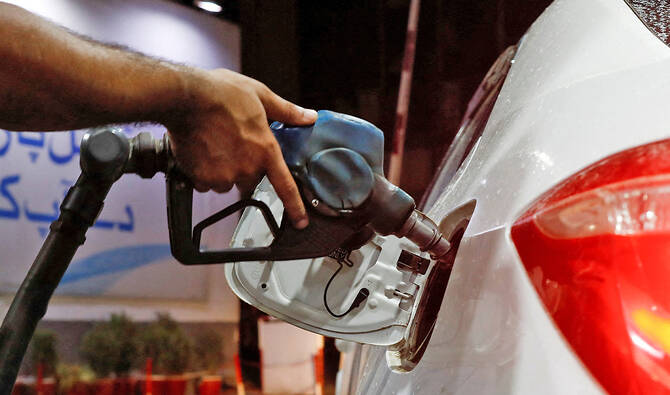
Pakistan raises petrol, diesel prices by about Rs4 for next two weeks

A worker holds a fuel nozzle to fills fuel in a car, after the government announced the increase of petrol and diesel prices, at petrol station in Karachi, Pakistan, on September 16, 2023. (REUTERS/File)
Short Url
Updated 01 October 2025
Follow

Pakistan raises petrol, diesel prices by about Rs4 for next two weeks

  • Petrol now costs Rs268.68 per liter while HSD has risen to Rs276.81
  • Price hike comes amid inflation warning following monsoon floods

KARACHI: Pakistan’s government has increased the price of petrol by Rs4.07 per liter and high-speed diesel (HSD) by Rs4.04 per liter for the next fortnight, the finance division announced late Tuesday, with the revised prices taking effect today.

Fuel prices in Pakistan are adjusted every two weeks and are influenced by global oil market trends, currency fluctuations, and changes in domestic taxation.

According to the official notification, petrol now costs Rs268.68 per liter, up from Rs264.61, while HSD has risen to Rs276.81 per liter from Rs272.77.

“The Government has revised the prices of petroleum products for the fortnight commencing October 01, 2025, based on the recommendations of Oil and Gas Regulatory Authority (OGRA) and the relevant Ministries,” the Finance Division said in its statement.

Fuel price increases have a direct impact on inflation, raising production and transportation costs and driving up the prices of essential goods and services, particularly food.

The effect of the latest price hike may further be amplified as the finance ministry noted in its monthly economic outlook a day earlier that flood-related disruptions could put pressure on food supply chains and push up consumer prices.

“Inflation is expected to rise temporarily but remain contained within the 3.5-4.5 percent range in September 2025,” it said in its report.



Imran Khan not a ‘national security threat,’ ex-PM’s party responds to Pakistan military

Updated 06 December 2025
Follow

Imran Khan not a ‘national security threat,’ ex-PM’s party responds to Pakistan military

  • Pakistan’s military spokesperson on Friday described Khan’s anti-army narrative as a “national security threat”
  • PTI Chairman Gohar Ali Khan says words used by military spokesperson for Khan were “not appropriate”

ISLAMABAD: Former prime minister Imran Khan’s Pakistan Tehreek-e-Insaf (PTI) party on Saturday responded to allegations by Pakistan military spokesperson Lt. Gen. Ahmed Sharif Chaudhry from a day earlier, saying that he was not a “national security threat.”

Chaudhry, who heads the military’s media wing as director general of the Inter-Services Public Relations (ISPR), spoke to journalists on Friday, in which he referred to Khan as a “mentally ill” person several times during the press interaction. Chaudhry described Khan’s anti-army narrative as a “national security threat.”

The military spokesperson was responding to Khan’s social media post this week in which he accused Chief of Defense Forces Field Marshal Asim Munir of being responsible for “the complete collapse of the constitution and rule of law in Pakistan.” 

“The people of Pakistan stand with Imran Khan, they stand with PTI,” the party’s secretary-general, Salman Akram Raja, told reporters during a news conference. 

“Imran Khan is not a national security threat. Imran Khan has kept the people of this country united.”

Raja said there were several narratives in the country, including those that created tensions along ethnic and sectarian lines, but Khan had rejected all of them and stood with one that the people of Pakistan supported. 

PTI Chairman Gohar Ali Khan, flanked by Raja, criticized the military spokesperson as well, saying his press talk on Thursday had “severely disappointed” him. 

“The words that were used [by the military spokesperson] were not appropriate,” Gohar said. “Those words were wrong.”

NATURAL OUTCOME’

Speaking to reporters earlier on Saturday, Pakistan’s Defense Minister Khawaja Asif defended the military spokesperson’s remarks against Khan.

“When this kind of language is used for individuals as well as for institutions, then a reaction is a natural outcome,” he said. 

“The same thing is happening on the Twitter accounts being run in his [Khan’s] name. If the DG ISPR has given any reaction to it, then I believe it was a very measured reaction.”

Khan, who was ousted after a parliamentary vote of confidence in April 2022, blames the country’s powerful military for removing him from power by colluding with his political opponents. Both deny the allegations. 

The former prime minister, who has been in prison since August 2023 on a slew of charges he says are politically motivated, also alleges his party was denied victory by the army and his political rivals in the 2024 general election through rigging. 

The army and the government both deny his allegations.